
Latest
Boutique Bass Builder: Hiro Miura


Boutique Bass Builder: Hiro Miura…
Hiro Miura once dreamt of using his hands to pilot the controls of jets as he flew across the globe at supersonic speeds. Now, his hands are used to fulfill the dreams of musicians. In a small workshop near the Van Nuys airport, he makes guitars and basses that transmit his craftsmanship around the world at the speed of sound.

The man who designed and built instruments for such musical icons as Carmine Rojas, Chuck Rainey, John Pena, Chris Duarte, and Katsuji Morioka, never saw himself as a world renowned builder. He simply wanted to fly airplanes.
Life has a funny way of pushing you in one direction while making you think you are going in another. The aspirations of youth are often rerouted when the world interjects itself in your reality. Cowboys become accountants. Rock stars become convenience store clerks. And pilots become instrument makers.
Miura had always enjoyed playing guitars as a hobby and never gave the instrument much thought until he lost interest in attending college. He dropped out to become a guitar salesman for Moon Guitars in Japan. He stepped foot on that path at a time when the Yen trumped the U.S. dollar and the Japanese craze for vintage American guitars in the early 1980s was just taking off.
He was sent to America to buy vintage guitars and bring them back for resale Japan. After a few years of hopping back and forth across the Pacific, he decided to make Los Angeles his home in 1986.
While buying, selling, and studying vintage guitars, he befriended custom guitar builder Taku Sakashita.
“I told him about my design ideas for a new guitar head and body,” recalls Miura. “Taku built the first one for me and then showed me how to make it myself.”
Miura and Sakashita were often joined by the legendary bass builder Nicholas Tung. The trio would share ideas and experiment with various designs and building concepts. It was that experience of working with master luthiers that inspired Miura to build and later launch his own brand, Xotic Guitars, in 1996.
Unlike other builders, Miura didn’t design his guitars to showcase his artistic abilities. His passion was, and continues to be, creating an instrument that allows the musician to play without concentrating on the physical act of doing so. In other words, he wanted to create the tools that lent themselves to effortless mastery.
After 18 years with Xotic, Miura decided it was time for a change. He left Xotic and started Miura Guitars in August 2014. He is the sole employee and his personal motto is reflected in his mission statement: “Never complete, keep evolving.”
“I have no plans to bring on any other employees. I’d rather do the work myself,” said Miura. “It’s not hard to have someone make the instrument. But even if we use the same wood and the same parts, theirs will sound different than mine. I want to make sure every instrument that leaves my shop sounds the way I want it to sound.”
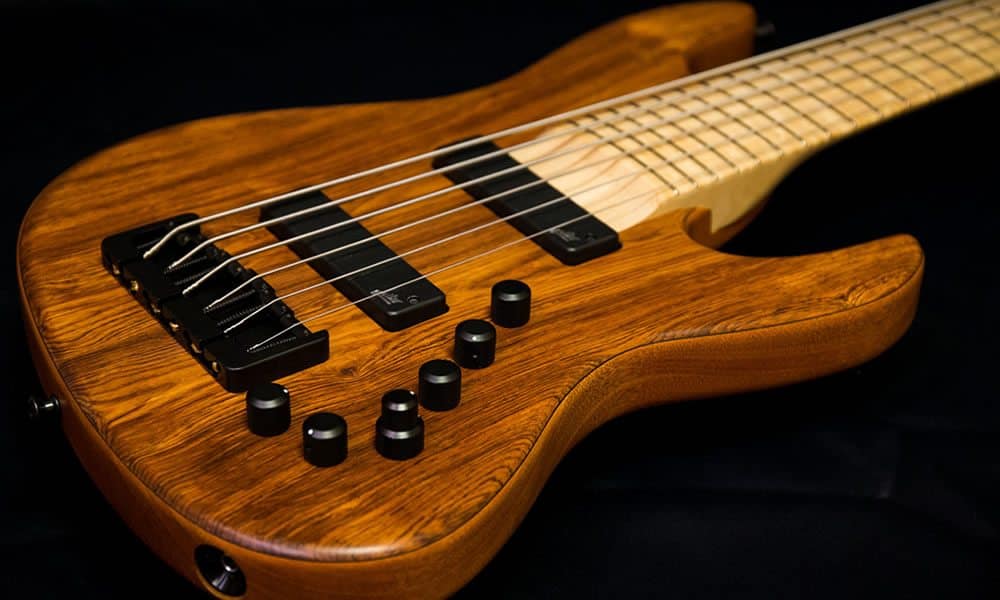
Miura currently builds two bass models that he designed with playability and tone as his top priorities: the MB-2 (below) and the MB-1 (shown at top of article).

“The MB-2 is my simple bass. I don’t like many decorations and I want a simple instrument that the working musician can afford,” said Miura. “Many basses are headstock heavy so it’s hard for the bass player, and more stressful, for longer playing. I don’t want you to think about the instrument. I want you to think about the music.”

The MB-2 has an ash (or alder) body with a 34-inch scale (22-fret) maple neck and maple or Pau Ferro fingerboard. Miura uses Hip Shot Type-B bridges and Aguilar Super Singles pickups and an Aguilar OBP-3 pre-amp. The control set up features a master volume, pickup blender pot, master tone, with mini pots for active eq (bass, mid, treble). The mini-switch allows for plus/minus 16 dB @ 400Hz or 800 Hz.
Miura considers his MB-1 to be his flagship model. It features an angled head stock, 24 frets and uses either the Hipshot Type-A, Type-B and Badass (5-string only) bridge. Top wood choices are olive, quilted maple, maple burl, walnut, mahogany, as well as other premium woods. Fingerboard options are maple and Madagascar rosewood.
The electronics are upgraded to higher end Aguilar, Delano, Bartolini, or Kent Armstrong for pickups, and East, Glocken, or Michael Pope for preamps.

Miura’s guitars and basses are currently built to order. “There are not many companies doing it with one person,” said Miura, laughing. “I make the body and the neck. The paint is done outside. But other than that, I touch every part myself.”
“When luthiers work by themselves, one instrument is very expensive and usually not within reach of most working musicians. I want to make top quality instruments that are affordable for people who will play them. That’s why I can only make about eight guitars or basses a month.”
Miura often drives five hours north of his workshop to find the right wood to use in his instruments. “It would be nice to just be able to make 10 necks and 10 bodies and put them together. But I can’t do that. I have to find the right wood that balances that particular instrument’s body with the neck. Wood has very different properties. It can have the same weight and be physically balanced, but still not sound right. I have to choose the right wood to make a good bass sound great.”
For more information about Miura Guitars, visit his website at www.miuraguitars.com.



Check out our top 10 favorite basses on Instagram this week…
Click to follow Bass Musician on Instagram @bassmusicianmag
FEATURED @hiltonguitars @olintobass @vortice.custom.guitars @cb_basses @belforti.instruments @acguitars.co.uk @basscentralofficial @michaeltobiasdesign @timsway1 @officialspector
Check out our top 10 favorite basses on Instagram this week…
Click to follow Bass Musician on Instagram @bassmusicianmag
FEATURED @didonatoguitars @brancoguitars @ja.guitars @lindoguitars @sawtooth_musical_instruments @pensacustomguitars @alpherinstruments @dtcbass @camazon_guitars @ebg_instruments
Check out our top 10 favorite basses on Instagram this week…
Click to follow Bass Musician on Instagram @bassmusicianmag
FEATURED @ja.guitars @mrrjackson @skjolddesign @karvanguitars @sireusaofficial @wonkorbasses @mihado_gs @odiengcustom @sirekorea @brute_bass_guitars
Check out our top 10 favorite basses on Instagram this week…
Click to follow Bass Musician on Instagram @bassmusicianmag
FEATURED @polarisbasses @daveswiftbass @ramabass.ok @officialibanezguitars @serek_basses @dacruzluthieria @alusonic @sadowskynyc @maruszczyk_instruments @pensacustomguitars
Check out our top 10 favorite basses on Instagram this week…
Click to follow Bass Musician on Instagram @bassmusicianmag
FEATURED @officialspector @alusonic @ariaguitars @stradiluthier @sandbergguitars @billysheehanonbass @offbeatguitar @colibriguitars @jens.ritter @overwaterbasses

Maestro Ron Carter, Sharing the Spirit – June/July 2026 Issue

New Music: Danielle Nicole, Tug Of War

Right Hand Technique Strategies with Dr. Randy Kertz

New Music: Golden Flower, Are You Even Awake?

Interview With Bassist Adam Russell
Right Hand Technique Strategies with Dr. Randy Kertz

April 6 Edition – This Week’s Top 10 Basses on Instagram
April 13 Edition – This Week’s Top 10 Basses on Instagram
20 April Edition – This Week’s Top 10 Basses on Instagram