
Bass Edu
Walking the Bass Line 2


Opening Photo Credit: Tony Cole, 2022
The other day a new bass-playing friend asked me for advice on the best exercises to improve his playing.
I have to admit I’ve never been a great fan of the standard teaching approaches of recent times. There are hundreds of seemingly quick routes on YouTube but I decided to go as old school as possible.
What to learn is half the battle and depends on what floats your boat. YouTube has given us access to some very good, and very bad, tutorials on how to play our favourite songs.
Legendary bassist Carol Kaye said that simply learning ‘scales’ will ruin your ears from a Jazz musician’s perspective. Although not conversant with jazz, I agreed with her and chose to learn songs I loved which featured bass players I respected.
- John Paul Jones | Led Zeppelin
- Andy Fraser | Free
- Jack Bruce | Cream
- Carl Radle | Eric Clapton
Today I feature John Paul Jones and Andy Fraser with Bruce and Radle coming along in the next episode.
All about bass guitar
If you happened to stumble across this article, it may be worth reading the June edition of Walking the Bass Line which is the first in my series for new bass players.
John Paul Jones // Led Zeppelin // The Lemon Song – aka Killing Floor
Lemon is great for killing parasites on raw chicken. It is also a zesty addition to a large vodka and tonic but in a musical context the playfulness of sexual innuendo in Blues music.
Back in 1929, Joe Williams sang “You Squeezed my lemon/Caused my juice to run” in the song I Want It Awful Bad.
This pales into a smoothie of citric insignificance when you consider the mightiest lemon of all time for players of the electric bass guitar – The Lemon Song from Led Zeppelin II played by the legendary John Paul Jones (JPJ) and recorded in 1969.
The song borrowed heavily from Howlin’ Wolf’s Killing Floor. Copyright holders for Chester Burnett (Wolf’s birth name) ended up reclaiming the tune in an out-of-court settlement in 1972.
Before Led Zeppelin, JPJ was a much sought-after London-based session musician playing hundreds of sessions with a variety of artists, genres and styles giving him great versatility.
Learning to love the lemon
Word has it that he improvised the whole song, adopting more of a funk-oriented approach rather than your typical walking blues lines.
Starting at the beginning I would play a phrase of the song over and over and over again trying to work out what notes/chords were being played, then tried to cross-reference with any half-decent videos that were out there to make sure I was playing in the right place of the neck.
Then unlearning phrases because I had made a pig’s ear of it and made things doubly difficult (at times impossible) for myself …and so it continued for months! And by months I mean half a year!
Standing at the foot of the bass mountain, I reminded myself of a note I had pinned to my wall when I was studying for a second degree at University – “It’s only difficult because you haven’t learned it yet!”
I fell asleep with the bass line running through my head – and woke up with the same blinkin’ line there to greet me – it almost drove me crazy!!
Don’t get me wrong, I love playing but this was an absolute brain mangler at times, especially dissecting the faster parts; it made me feel like I was spinning on a never-ending mad fairground ride!
It’s all about the tone…
Part of learning the song is emulating the ‘sound’ of the bass in the track. This is tricky as only a small part of the tone comes from the gear, the real sound comes from the way you play the part – yes, your fingers.
I love that ‘60s/‘70s sound and am the proud owner of a ‘70s HiWatt DR201 valve amp which I use with a selection of cabinets.
Early on with Led Zeppelin, JPJ used HiWatt and Marshall amps, moving on later to the more powerful Acoustic 360 bass head paired with a 361 cabinet – the stack of choice for bass players in the ’70s, including the mighty Jaco Pastorius.

Taken from the Acoustic 361 User Manual – late ‘60s
Flats
From the tone, I suspect that he employed a Marshall or HiWatt plus his trusty 1962 Fender Jazz Bass with flat-wound strings in the recording of The Lemon Song. I use flats on most of my basses born from an early recommendation from bassist Andy Seward, and later reinforced by JPJ and Andy Fraser. They were right, flats are punchy, thick and gorgeous!
Anyway, enough of the chatter, just listen to this badass track…
Led Zeppelin – The Lemon Song (Official Audio)
Andy Fraser // Mr Big // Free
Andy Fraser was the bass player and co-composer in British rock band Free which he co-founded in 1968 with vocalist Paul Rodgers, guitarist Paul Kossof and drummer Simon Kirke – he was 15 years old – so young!!

Photo, Permission given by Jasmine and Hannah Fraser
That same year he had been kicked out of Grammar school for refusing to have his hair cut and enrolled at Hammersmith College of FE where he met Sappo, the daughter of Alexis Korner, a pioneering bluesman and a hugely influential radio presenter. Alexis became like a father figure to Andy who came from a broken home and was influential in him joining the legendary band John Mayall’s Bluesbreakers.
Sadly Andy died in 2015 of a heart attack at the young age of 62 and John Mayall died a few days ago at the ripe old age of 90. Read John’s obituary in The Guardian newspaper to get an overview of his influence and achievements.
“Andy was the most amazing musician. As a bass player, he was up there with Jack Bruce. But as Andy would say, if he was around now, he wasn’t just a bass player, he was a great all-round musician. He had this amazing ability to listen to something and play it straight back.” Simon Kirke

The list of Andy’s musical influences comes as no surprise – Paul McCartney, Bill Wyman, Stax, Motown, James Jamerson, Carol Kay and early Stevie Wonder. Jack Bruce also played a big part in the early days of Fraser’s tutelage. Amongst others, his band ‘Free’ was based on ‘Cream’ with Eric Clapton, Jack Bruce and Ginger Baker.
What I do like is that he mentioned specific stand-out songs to check out:
- The Rolling Stones version of I Wanna Be Your Man (composed by Lennon & McCartney) with Bill Wyman on bass
- John Entwistle’s bass break in The Who’s My Generation
- Marvin Gaye’s What’s Going On with James Jamerson on bass
If you want to find out more about Andy’s life, read his autobiography ‘All Right Now… Life, Death and Life Again’.
Valve power
As was the de rigueur in those heady days, Andy used amplifiers by Marshall, Matamp and Orange plus 4×12 speaker cabinets. It’s now easy to discount this setup but know from experience, that it sounds great both live and in the studio.
His basses were always short-scale fitted with flat wound strings, the Gibson EB3 being his weapon of choice, just like his hero Jack.
Watch this live video of ‘Free’ when they played at Granada Studios in Manchester, UK in July 1970. Andy has a fabulous bass tone – like a big stomping elephant.
British rock at its finest…
FREE Live – Granada , Manchester, England 24th July 1970 FULL HD
Amps & cabs
I started playing with a tour booked and an album to record on so my gear trajectory was set. No pressure!
In last month’s article, I wrote about my first two bass guitars and first pedal board setup which was simple and designed for a tour of the UK with my husband Simon.
Where do you start when buying your first amplifier & cabinet?
It all depends on what kind of sound you are looking for – there are so many to choose from in all shapes and sizes and it can be a bit overwhelming.
Are you planning on playing live or just in the bedroom? Do you want to rehearse with friends? Are you concerned with weight, size and portability?
All these factors will determine your selection, but like any gear, buying the best you can afford is important.
Choosing second-hand from a reputable source such as REVERB (which does have customer protection) and/or paying via PayPal is always a good plan.
A well setup bass and an amplifier which cleanly reproduces the sound of your instrument are essential.
I would be happy to give specific recommendations.
It’s all about the space…
One thing that influences the sound of any bass amplifier is its position. You will always hear more low end if the cabinet is on the floor due to half-space loading. If you want to mash your brain, check out this article – but an easier and more pleasurable way is to try it yourself by lifting the cabinet off the floor.
The Hiwatt DR201 & Bergantino NV610
I met music producer and bassist Andy Seward back in 2014 when he was working on my husband Simon’s second solo album The Knife and knowing what I was up to, suggested I buy a Bergantino NV610 to match the 1974 HiWatt DR201 which I had picked up in the UK – my first amplifier.

Photo Credit, Simon Campbell
The NV610 is cool and here is a precis from Bergantino’s press release:
“Unique in the Bergantino Audio Systems line of speakers are the New Vintage NV series of bass guitar speaker cabinets. Designed by Jim Bergantino (who is a really lovely chap) the cabinets are sealed (rather than the traditional ported design) which provides the NV cabinets with a tighter and more immediate bass response
The NV620 with six – 10 inch speakers, comes with ‘tilt-back’ casters and full-length amp glides on the back to facilitate loading and unloading. It also has side mounted recessed handles (at the right height to lift these onto any stage).
The cabinetry employs a precision-tuned cabinet architecture with the enclosure built from the finest 100% Baltic birch plywood. It is covered in traditional tolex for durability and has a rigid black grille to protect the drivers.
The NV series is a favorite of both finger style and pick players because of the tight-creamy low end.
If you want a little more clarity and open sound, but don’t like tweeters? This is THE cabinet for you! It sounds great with tube amplifiers (pull out the V4B, Model T, Hiwatt, etc.) and this cab will make you smile. Vintage heaven!”
I decided to buy the version without the tweeter as my style doesn’t require the extended top end.
Many bass players still love these cabinets and they are very hard to come by. I bought my 610 when Jim and Holly Bergantino produced a limited run back in 2015 and I’m hoping they will do another production run again soon.
Unusually, Jim Bergantino uses ceramic magnets in a lot of his speaker cabinets because he prefers the sound. This obviously adds some weight to the finished cabinet but I’ve always thought that this is my sound and part of the sonic ritual of my setup.
However, if lighter is the way you want to go, Bergantino also produces a range featuring neodymium magnets and lighter smaller cabinets.
Check out their website and take a look for yourself bergantino.com/bass-guitar-speakers/
From big rigs to no rigs
This move to smaller and smaller gear – the ultimate being the modelling pedal – and in-ear monitoring saddens me somewhat. Even though I love technology and keep up with many of the advances, there is nothing like a valve head and a big cabinet with heavy ferrite magnets.
Watch this video when we played a very rare cover of Free’s Mr Big at The Met in Bury, UK with Starlite & Campbell. Warning – bass solo at 3:55.
Gear employed: Gretsch ThunderJet bass with TV Jones pickups fitted with Thomastik-Infeld Jazz Bass (JF324) short-scale flat-wound strings // Supertone MinCap ‘A’ cable // Lehle RMI BassSwitch IQ DI with all FX disengaged // 1974 HiWatt DR201 bass head // Bergantino NV610 bass cabinet mic’d with no DI.
Starlite Campbell Band: ‘Mr Big’ LIVE at The Met, Bury, UK featuring Suzy Starlite on bass guitar
Second pedal
My second pedal on my board sounds like the son of a comedian – the Ernie Ball Volume Pedal Jr. It’s a sturdy piece of gear made from aircraft-grade aluminium housing which is virtually indestructible.
It gives you a smooth foot sweep that does the job and doesn’t break the bank. I use it to swell in the sound smoothly, which along with a delay device (echo unit), is especially effective in creating atmospheric soundscapes.

Photo Credit, Simon Campbell
I used this on our song Hello which we played live at the Head for the Hills Festival (Ramsbottom Festival) whilst touring the UK with my husband Simon. It’s a 28-minute song which we are releasing later this year.
The eagle-eyed reader will notice that this is the 25K version which is suitable for active electronics. Apart from my Fylde King John acoustic bass – with an under-saddle transducer – all my basses are passive. So what’s that all about? The answer: it’s always in a buffered FX loop!
The importance of good technique
Understanding what chord you are playing under and your left-hand fingering shapes are super important to give a smooth performance. Once dialled in, this allows you the freedom to improvise over a chord when writing a part for yourself.
Listen to the part.
How is the bass line sitting in the track? Is it serving what the song needs? Am I crashing the vocal? Is the line too busy and confusing the track or is it not giving the movement by not being busy enough? Is this major third working with the bass synth? Do I need to play that note an octave up or down? And most importantly is it working with the drums??
All these are vital but fade into the cheap seats if you have poor technique.
Recording an electric bass guitar
One key aspect that has benefitted my bass playing is working in the recording studio. I started tracking bass on various projects virtually from day one, which helped me understand both the role of the bass in a piece of music and also my technical ability – or lack thereof.
When recording with a multi-speaker cabinet, you need to mic up the best-sounding speaker. Of course, they should sound the same, but that isn’t always the case. Usually, you find one that sounds better than the rest and once you’ve found the best one, move the microphone around the speaker cone to find that sweet spot: there always is one!
Try it out and listen for yourself.
Keep it clean
I’ve learned a few harsh lessons from recording and can’t stress enough how important it is to record your bass from the very beginning. It allows you to hear, in detail, what you sound like and if you are playing clean notes.
If you are a real low-end dweller, mostly below the seventh fret and working in a typical live rock band, it’s tricky to hear the real details of your playing. Ringing notes, clacking and buzzing strings are all camouflaged by the racket created by the band; when recording everything is revealed – warts and all.
OK, you think you’ve recorded a groovy take but something isn’t quite gelling! The producer is trying to work out what’s going on and through a process of elimination, listens to all the instruments separately until that fateful moment when they solo the bass track!
Yeah, baby – solo bass – just the bass – on it’s own – usually heavily compressed which brings out every tiny detail – and you, on your own! It feels like you are standing there naked in that moment of truth.
Oh shit!! That doesn’t sound at all like I thought I’d played it – strings are ringing here and there and a sort of growling, humming low-end dissonance and unwanted harmonics in places because I’d not always managed to dampen/mute the other strings. It’s a harsh, but necessary lesson.
Watch this video where I bare my soul and go acoustically naked live on camera.
Also, check out Simon’s article How to record an electric bass guitar which is part of a series on Analogue Recording Techniques.
ANALOGUE RECORDING – HOW TO RECORD BASS GUITAR
And finally
Next month I will feature two songs from Jack Bruce and Carl Radle, my practice amp setup – you will be surprised – and another pedal.


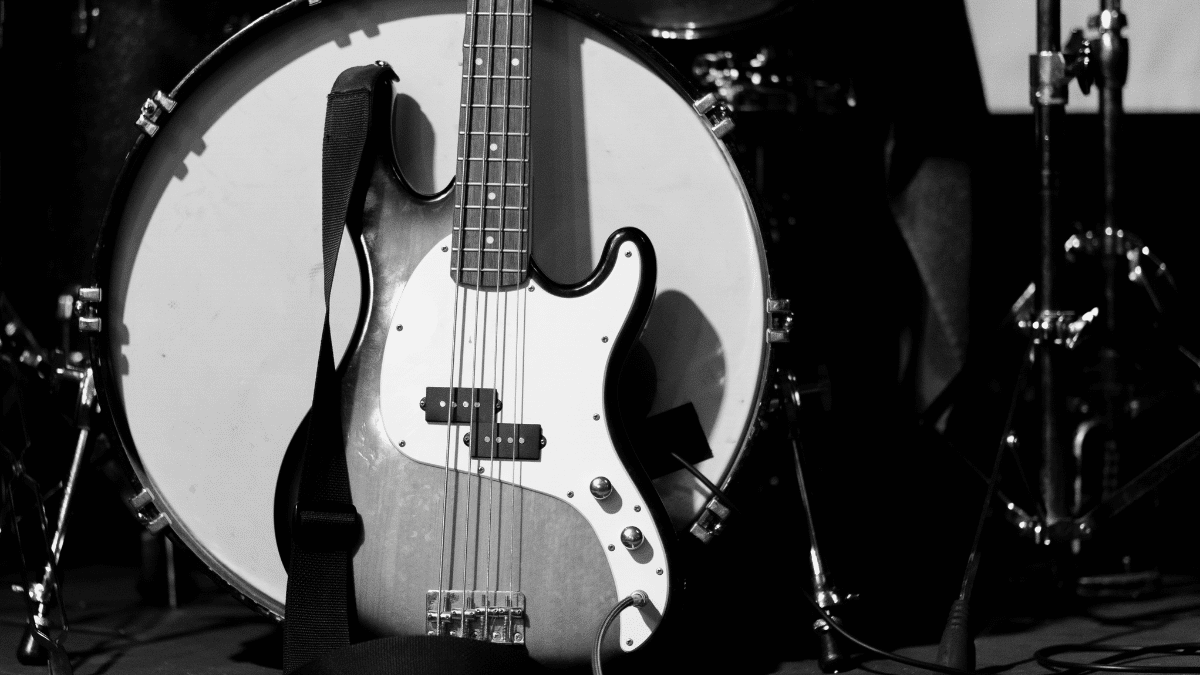
Ready to take your rhythm section from good to unforgettable? It’s time to dive into bass and drums practice exercises that actually work.
If you and your drummer have been jamming for a while but still feel like something’s “off,” the missing ingredient is likely structured groove practice. Playing songs is fun, but real groove is forged in the fire of repetition, timing drills, and trust-building exercises.
So grab your drummer (or a drum machine), warm up your fingers, and get ready to go deeper than ever into the pocket.
Why Groove Practice Matters More Than Rehearsal
There’s a big difference between rehearsing a set list and actually practicing groove. Rehearsals are about song structure, transitions, and cues. But bass and drums practice exercises are all about feel.
Here’s why it matters:
- You develop musical chemistry
- You improve your internal timing
- You learn to communicate nonverbally
- You build consistency that carries into live shows
These exercises will help you achieve that, one locked-in groove at a time.
Exercise 1: The 2-Bar Loop Challenge
This is one of the simplest, most effective bass and drums practice exercises out there, and it’s addictively fun.
How to do it:
- Choose a simple 2-bar drum groove.
- As the bassist, play a simple line that locks into the kick and supports the snare.
- Loop those two bars… again and again… for at least 5 minutes straight.
- Focus on micro-adjustments: tone, dynamics, feel.
Why it works:
Repetition builds groove memory. This exercise strengthens your timing and teaches you to feel slight variations in the drummer’s pocket.
Exercise 2: Play With and Without a Click
Drummers and bassists both benefit from click practice, but here’s the twist: learn to feel the groove with the click, then test it without.
How to do it:
- Set a metronome to 70–80 BPM.
- Play a 4-bar groove with the click for a minute.
- Mute the click, and keep playing for another 2–3 minutes.
- Bring the click back in. Are you still in time?
Why it works:
This tests your internal clock as a unit. A tight rhythm section should be able to stay locked, even when the external reference disappears.
Exercise 3: Trade Eighths and Sixteenths
This one boosts your responsiveness and strengthens your groove vocabulary.
How to do it:
- Drummer starts with a basic beat.
- You play eighth notes for two bars.
- Switch to sixteenth notes for the next two bars.
- Go back and forth for 5+ minutes.
Optional twist: Have the drummer switch up their pattern too… ghost notes, syncopated hi-hats, rim shots. You adapt.
Why it works:
It trains you to adapt rhythmically while staying glued to the groove.
Exercise 4: Groove Call and Response
Think of this like a musical conversation.
How to do it:
- Drummer plays a 1- or 2-bar groove.
- You “respond” with a groove that complements or mirrors it.
- Switch… now you play first, and the drummer answers.
- Keep the phrases short and groovy.
Why it works:
It develops groove intuition and trains you to hear rhythmic ideas and respond with intention.
Exercise 5: The Ghost Note Sync-Up
This one’s a deeper dive. Ghost notes are subtle, so this is about listening and matching energy, not just rhythm.
How to do it:
- Drummer plays a groove with ghost notes on the snare.
- You add subtle ghost notes (muted plucks, low-volume notes) in between your main bass notes.
- Try to mirror the drummer’s energy, not necessarily their exact pattern.
Why it works:
Subtlety = groove mastery. Matching ghost note dynamics helps you blend and groove like pros.
Exercise 6: Dynamic Drops
Playing tight isn’t just about time, it’s about touch. This exercise sharpens your control.
How to do it:
- Groove at medium intensity.
- At random intervals, drop to whisper-quiet playing.
- Then build back up to full volume, together.
- Do it without talking or cueing—just eye contact or feel.
Why it works:
Real rhythm sections control the emotional flow of a song. This teaches dynamic awareness and builds musical trust.
Bonus: Record Yourself
No matter which bass and drums practice exercises you do, always record yourselves, even on a phone.
Listen back. What worked? What felt stiff? Where did the groove pop?
You’ll improve twice as fast when you can hear where you’re tight (or not) as a rhythm section.
How Often Should You Practice Together?
Ideally:
- Once a week for 30–60 minutes of groove-specific practice
- Rehearsals are separate… this is groove-only time
- Consistency is more important than length
You’ll start to notice the groove showing up in rehearsals, gigs, and recordings.
Remember… Groove Isn’t Luck, It’s Built
A tight rhythm section doesn’t happen by accident. It’s built on intention, sweat, patience, and yes, plenty of mistakes. The more bass and drums practice exercises you do together, the more effortless the groove will feel.
Remember: the audience may not know exactly what you’re doing, but they’ll feel it. That’s the power of a locked-in groove.
So next time you and your drummer get together, skip the set list. Start with the groove. The music will thank you for it.


My next series of lessons using the pentatonic scale will continue exploring several sequence variations and the ideas they generate. After working on these sequences as strict exercises, melodic ideas should begin to creep into your playing. Spend enough time on each exercise until they become muscle memory. Make a conscious effort to apply these ideas to your groove and solo repertoire.
The first exercise follows a pattern starting with the second scale degree, third, fifth, and root. Follow the pattern up and back through the scale.

The second exercise starts with the pattern– root, 3rd, second scale degree, and fifth. Follow the pattern up and back, respectively.

The third exercise starts with the pattern—root, 5th, second scale degree, and the third. Follow the pattern up and back, respectively.

It will take more than one practice session to commit the ideas to memory. Make a commitment to making these exercises a normal part of your practice routine. Good luck!


Being a great bassist isn’t just about scales, chops, or playing complex lines. At a certain point, you realize the real difference between a solid player and a true professional comes down to one thing: how you think about the music.
Thinking like a professional bassist means developing a deeper level of awareness, where every note has a purpose, every space is intentional, and every decision supports the music.
1. Know Your Role
The bass sits right between harmony and rhythm. We’re not just there to “hold it down”, we help shape the feel and direction of the groove.
A professional bassist is always asking:
- What does this song really need?
- Do I need to lay back, push forward, or stay out of the way?
It’s not about playing more—it’s about playing with purpose.
2. Listen First, Then Play
One of the biggest mistakes players make is thinking about what to play before actually listening.
Real listening means:
- Locking in with the drummer
- Following the harmonic movement
- Being aware of the band’s dynamics
Pro bassists don’t just react, they anticipate what’s coming next.
3. Groove Comes First
Technique matters… but groove is everything.
You can play all the right notes, but if the feel isn’t there, it won’t connect. On the flip side, a simple bass line with great time and feel can make the entire band sound better.
At the professional level, the priorities are clear:
- Time
- Tone
- Feel
Everything else comes after that.
4. Leave Space
Silence is part of the music.
Knowing when not to play is a skill that separates experienced players from mature musicians. Space gives the groove clarity and lets the music breathe.
You don’t have to fill every bar.
Sometimes the best note is the one you don’t play.
5. Serve the Music
The ego can get in the way of great playing.
Professional bassists aren’t trying to impress; they’re trying to make the music feel right. That means making choices that support the song, even if they’re not flashy.
That’s real musical maturity: doing what the music needs, not what your ego wants.
Thinking like a professional bassist is a lifelong process.
It’s about constantly growing in how you listen, how you feel, and how you respond in the moment.
At the end of the day, it’s not just about the notes you play; it’s about how you support, connect, and elevate the music.
“Play less. Listen more. Serve the music… always.”
— Jaime David Vázquez

Hello bass players and fans of bass playing! This month, we’re going to talk about The Art of Playing Live! ARE YOU READY TO GROOVE?
There’s a powerful shift that happens the moment you step on stage.
Practicing at home is about control.
Playing live is about connection.
And as bass players, we live right in the center of that transformation.
We are not just supporting the band… we are anchoring the entire musical experience.
Groove Over Everything
In a live setting, perfection is overrated.
The audience won’t remember how many notes you played… but they will remember how you made them feel. The way your bass locks in with the kick drum can move an entire room without saying a word.
Playing less, with intention, often creates more impact than filling every space.
Great bass players understand this: Space is part of the groove.
Listening is Your Superpower
One of the most underrated skills on stage is deep listening.
Your connection with the drummer defines your foundation.
Your awareness of the vocalist shapes your dynamics.
Your sensitivity to the band creates cohesion.
When you truly listen, you don’t just play your part, you become part of the conversation.
And that’s when live music stops being structured… and starts being alive.
Presence Speaks Louder Than Notes
You don’t need to be front and center to command attention.
Presence is not about position—it’s about energy.
A bass player who is engaged, expressive, and connected elevates the entire performance. Your body language, your movement, your eye contact—it all communicates something beyond the instrument.
If you feel the music, the audience will feel it too.
Preparation Creates Freedom
The best live moments often feel spontaneous—but they are built on preparation.
Knowing the structure, transitions, and dynamics of each song gives you the confidence to explore without losing control.
When you’re prepared, you don’t overthink.
You react. You adapt. You create.
And that’s where the magic lives.
Adaptability is the Real Skill
No two stages are the same.
Different rooms. Different sound systems. Different audiences.
Sometimes, even different band dynamics.
A strong bass player reads the room and adjusts.
Maybe you simplify.
Maybe you dig in harder.
Maybe you leave more space.
Live performance is a living organism, and your role is to keep it grounded while allowing it to breathe.
Playing live is not just a performance… it’s a responsibility.
As bass players, we don’t just play notes… we shape the feel, the pulse, the emotional core of the music.
So the next time you step on stage, remember:
You are not in the background.
You are the foundation.
And everything moves because you do.
Stay tuned for more great stuff in the next issue and keep in touch with #bassmusicianmag,
#basslines, #bmmbasslines, #keepgrooving, #keepthegroovealive&kicking, #jdvinstrumental, #groovewars, #fullbassattack, #jdv, #boricuabass, #groovingtheworld, #bassgrooves, #groovemaniac, #6stringbass, #goodpracticemakesperfect #theartofplayinglive, #livemusic
The bass line is the heartbeat of modern music. It bridges rhythm and harmony, connecting the groove of the drums with the harmonic structure of the band. A well-crafted bass line does more than support; it defines the feel, direction, and emotional impact of a song. From Motown to rock, jazz to Latin music, the bass serves as both anchor and storyteller.
What Makes a Great Bass Line?
A great bass line balances time, tone, note choice, and space. While technical skill is valuable, musicality and intention are what truly elevate a bass performance.
1. Time and Groove
The primary responsibility of the bassist is to lock in with the drummer. This rhythmic unity creates the pocket, the groove that makes listeners move.
• Play slightly behind the beat for a laid-back feel
• Sit on top of the beat for energy and drive
• Maintain consistency to build trust within the band
Legendary players like James Jamerson demonstrated how groove can define an entire genre.
2. Note Choice and Harmony
Bass lines outline chord progressions and guide listeners through harmonic movement.
Essential tools include:
• Root notes to establish tonal center
• Fifths and octaves for strength and clarity
• Passing tones to create motion
• Chromatic approaches for tension and release
A strong bass line makes harmony audible even without chords.
3. Space: The Power of Restraint
One of the most overlooked aspects of bass playing is silence. Space allows the music to breathe and enhances the impact of each note.
Ask yourself:
• Does this note serve the song?
• Am I leaving room for other instruments?
Great bassists know that what you don’t play is just as important as what you do.
Styles of Bass Lines
Walking Bass
Common in jazz, walking bass lines use quarter notes to create forward motion while outlining chord changes.
Ostinato and Riffs
Repeated patterns, common in rock, funk, and Latin music, establish identity and groove. Think of iconic riffs that define entire songs.
Melodic Bass Lines
In modern genres, the bass often takes on a lyrical role, using phrasing and dynamics to create memorable melodies.
Tone: Your Sonic Signature
Your tone is your voice. Factors that shape tone include:
• Fingerstyle vs. pick vs. slap
• String type and gauge
• Instrument choice
• Amplification and EQ
A warm, round tone suits ballads, while a brighter tone can add articulation and presence in dense mixes.
The Bass in Contemporary Music
Today’s bassist must be versatile. In modern productions, bass lines may blend traditional playing with effects, extended range instruments, and melodic approaches. Six-string basses, looping, and chordal techniques are expanding the role of the instrument beyond its traditional boundaries.
The bass line is more than a supporting role, it is the foundation upon which music stands. Whether simple or complex, the best bass lines serve the song, connect the band, and move the listener.
As bassists, our mission is clear: support, enhance, and inspire through groove and musicality
Stay tuned for more great stuff in the next issue and keep in touch with #bassmusicianmag,
#basslines, #bmmbasslines, #keepgrooving, #keepthegroovealive&kicking, #jdvinstrumental, #groovewars, #fullbassattack, #jdv, #boricuabass, #groovingtheworld, #bassgrooves, #groovemaniac, #6stringbass, #goodpracticemakesperfect, #jdvbass, #jdvinstrumental

Right Hand Technique Strategies with Dr. Randy Kertz

New Music: Golden Flower, Are You Even Awake?

Interview With Bassist Adam Russell

Interview With Bassist Tim Neilsen

Gear News: Fender Unveils Highly Anticipated Vintera III Series
Right Hand Technique Strategies with Dr. Randy Kertz

Mar 30 Edition – This Week’s Top 10 Basses on Instagram
April 6 Edition – This Week’s Top 10 Basses on Instagram
April 13 Edition – This Week’s Top 10 Basses on Instagram