
Bass CDs
New Album: FINGER ELEVEN, Title Track From Last Night On Earth

FINGER ELEVEN Released Title Track From First Studio Album In A Decade, ‘Last Night On Earth,’ Due November 7 Via Better Noise Music.
One of the best-selling Canadian bands of all time, multi-Platinum rockers FINGER ELEVEN (@finger_eleven) are bringing more new music to their legions of fans with the release of “Last Night On Earth.” Released today (September 19), it’s the title track from their first new studio album in a decade. Pre-orders for the LAST NIGHT ON EARTH album—out November 7 via Better Noise Music, their first with the label.
While everyone agreed the title track was a special song, it took FINGER ELEVEN—Scott Anderson (vocals), James Black (lead guitar, backing vocals), Rick Jackett(rhythm guitar), Sean Anderson (bass), and Steve Molella (drums)—many years to find the diamond inside of this movingly candid string-laden ballad about how relationships fall apart. Jackett realized that they had no true chorus, but as they were tracking drums for the last four songs on the album, drummer Steve Molella suggested doing an acoustic, campfire-style jam. They nailed it during their final hour of studio time.
“Scott wrote some of my favorite lyrics,” Molella beams. “It was the most natural the song has ever sounded.”
“I think ‘Last Night On Earth’ could be placed squarely in a traditional relationship frame where you forget what you’re even fighting about,” continues Scott Anderson, whose vocals compellingly illuminate the song’s sadness. “But you hate that feeling in the pit of your stomach when something’s not resolved and you don’t know what tomorrow’s gonna look like.”
“Last Night On Earth” is the follow-up to the album’s second single and video which was released August 1, the thunderous “Blue Sky Mystery” featuring Richard Patrick fromFilter, which has landed the band their third consecutive radio Billboard Top 10 hit in Canada. Listen to the song HERE and view the video HERE.
Last year, fans got the first taste of LAST NIGHT ON EARTH via the high-octane “Adrenaline” (which reached the Top 20 on the Mediabase Active Rock chart) and a video that’s reached over 176k views on YouTube. The song also reached #2 on the Active Rock chart in Canada, where the song held strong in the Top 5 for over four months.
FINGER ELEVEN is now propelled by a fresh musical vigor. “As we were making LAST NIGHT ON EARTH, there was this feeling that we were making a big Rock record,” Rick Jackett recalls. “We had done that early in our career, and then we veered away from it. But it was time to go back and embrace that bigness of the sound. Even the soft songs sound big.”
Originally from Burlington, Ontario and now based mostly out of Toronto, FINGER ELEVEN have released a series of consecutive hit albums and become among the greatest live bands to ever emerge from the great White North. Their self-titled debut album broke the band into the international mainstream, achieving Gold status in the United States and Platinum in Canada, and smashing the first single, “One Thing,” across the radio and Billboard charts. Their 2007 album, THEM VS. YOU VS. ME, launched the single “Paralyzer,” setting radio records in the U.S., peaking at #1 internationally and going 5x Platinum, the band’s second million-plus seller. They won the Juno Award for Rock Album the following year and set an incredible run at rock radio, with an unbeaten #14 weeks at the top spot. LIFE TURNS ELECTRIC, was nominated for a Juno Award for Best Rock Album of the Year. 2015’s FIVE CROOKED LINES continued to electrify audiences the world over and their 2023 GREATEST HITS includes their biggest smash hit in a decade, “Together Right,” which topped the radio charts for an amazing five-week run at #1.
After rocking a busy festival season this summer, FINGER ELEVEN will hit the U.S. with Alien Ant Farm and Brkn Love for a flurry of concerts leading up to the new album’s release. This will be followed by a national Canadian tour with fellow native sons Headstones and Tea Party joining them. Tickets are available now on the band’s official website.
CONNECT WITH BETTER NOISE
Website | Facebook | YouTube | Spotify | Instagram | Twitter | TikTok


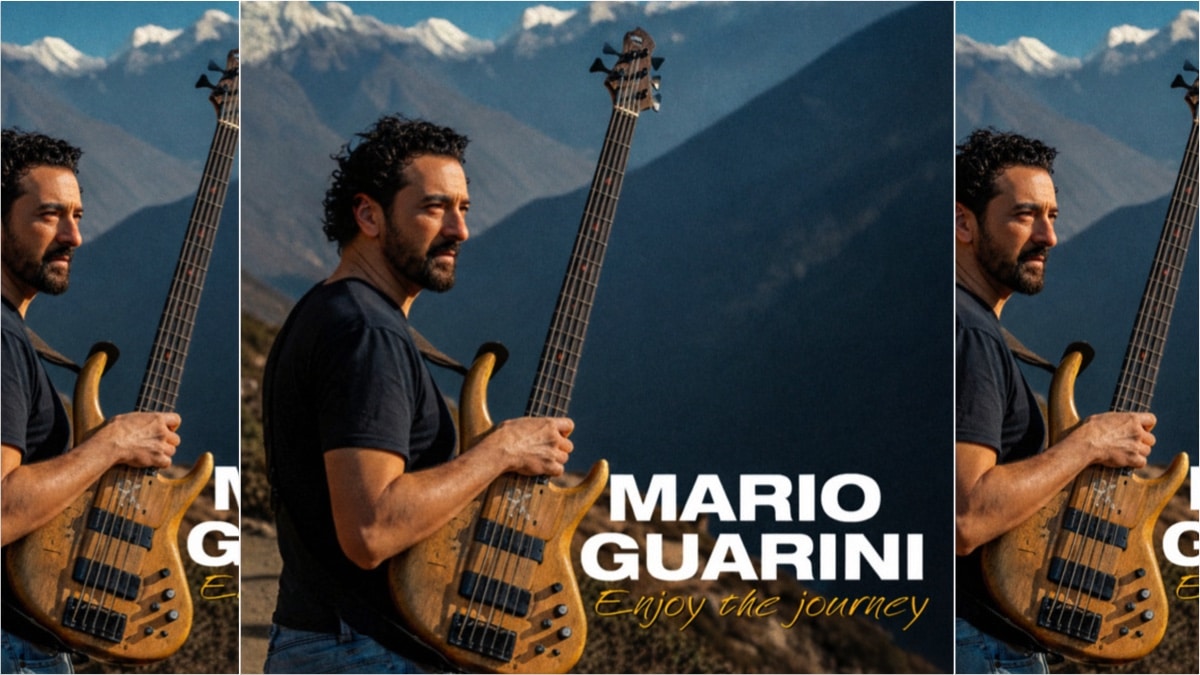
Following the success of his debut album Now It’s My Turn, Mario Guarini — one of the most acclaimed bass players on the Italian contemporary music scene — returns with Enjoy the Journey.
The album is available on all digital platforms. Featuring ten original tracks, Enjoy the Journey marks a natural and mature evolution in Guarini’s artistic path: a deep, refined work where groove and melody merge into a multi-stylistic and ethnic instrumental language, capable of crossing cultures, influences and sensibilities with remarkable compositional coherence.
The project stands out for its outstanding international collaborations, further reinforcing the album’s global scope. Among the featured artists are Vinnie Colaiuta, a true drumming legend whose unmistakable touch enriches the entire record; the iconic Victor Wooten, a worldwide benchmark of electric bass, appearing on both bass and bow bass; Oz Noy, a leading figure of the New York jazz-fusion scene on guitars; Michael Pipoquinha, the extraordinary Brazilian six-string bass virtuoso; Sandro Haick, internationally renowned musician and producer, contributing on guitars, drums, keyboards and vocals; and Israel Varela, one of the most authoritative voices in contemporary jazz drumming, here performing on drums, cajón and palmas.
Alongside these major international names, the album also features an impressive roster of Italian talents, including Daniele Gottardo, Alberto Marsico, Daniele Bonaviri, Giulio Carmassi, Elio Rivaghi, Max Rosato, Adriano Milinari, among many others, creating a rich, deep and authentically international musical dialogue.
These collaborations enrich the album with diverse languages, cultures and sensibilities, reinforcing the idea of the journey as a shared artistic and human experience.
The project aims to showcase Italian excellence within a truly international artistic context, maintaining the highest production standards and a strong expressive identity, further shaped by the production of Antonello Boezio, founder and producer of Bobo Records. The album was recorded at MAST Recording Studio, and mixed and mastered by Massimo Stano.
In an era increasingly driven by numbers, metrics and visibility, Enjoy the Journey tells a different story — one shaped by people, cultures and genuine encounters. Brazil, India, Japan, America and Spain intertwine in a sonic narrative that moves through blues, soul, funk, flamenco and ethnic influences, where each track becomes a stop along the way and each collaboration a moment of shared growth.
With Enjoy the Journey, Mario Guarini confirms his place among the leading voices of contemporary instrumental music, delivering an album that will captivate not only bass players and industry professionals, but all lovers of high-quality music.
This project was produced with the support of the call “Nuove Produzioni Discografiche 2024/25”, funded by NUOVOIMAIE.
Bass CDs
New Music: ROSS VALORY Refreshed And Remastered Version Of His Debut Solo Album, All Of The Above

ROSS VALORY, the acclaimed original Journey bassist and songwriter, has confirmed August 21 as the release date for the refreshed and remastered version of his debut solo album ALL OF THE ABOVE (OID Music). Available for the first time on vinyl and CD, the updated release includes a new VALORY instrumental track and video for “City Lights.”
This marks the first time ALL OF THE ABOVE—originally released digitally in 2024—will be available on vinyl and CD, and the new version will include a special Purple Swirl Color Vinyl with autographed photo exclusively available via EXPERIENCE VINYL. Pre-order the special edition HERE. Click HERE to pre-order the standard vinyl and CD.
For “City Lights,” VALORY (who played standup bass on the song) teamed with a talented group of master players: Eric Levy (Night Ranger, Garage Mahal); Steve Smith (Journey and Vital Information); Bobby Strickland (Todd Rundgren); Stevie “Keys” Roseman (longtime Valory collaborator); and Mic Gillette (Tower of Power Horns), who did all the horn arrangements and played trumpet and trombone, including a trombone solo. Together, they “bring a new level of sophistication” to the track [a standout from ROSS’ vast repertoire],” he says. The visually arresting clip for the song is set against the backdrop of New York City—throughout different time periods—capturing the hauntingly seductive instrumental track.
“‘City Lights’ is really about people out and about in the city, possibly in the rain, looking for and finding romance,” ROSS adds with a laugh. “It’s just the simple enjoyment of nightlife and romance…the adventure, the excitement, the spontaneity. Just being out on the town.”
“‘City Lights’ [and the previously released] ‘Nightflower,’ are really sister songs,” VALORY says. “They both have—in terms of the time period that they represent—the flavor of the big city at night, and in particular, Michael [Cotten, the video director] and my impressions of Manhattan. And while the two music videos have a different visual storyline, they’re both related to nighttime in the city.”
Visit online:

On The All Seeing Eye, bassist, composer, arranger, and producer Will Lyle brings together a group of musicians whose collective experience spans several generations of modern jazz. The album features Lyle alongside pianist David Kikoski, drummer Billy Drummond, and saxophonist Lucas Pino, with additional appearances by drummer Ronen Itzik and vocalist Sirintip.
Available now, the record moves between angular post-bop, swing, balladry, modal jazz, and contemporary harmonic writing without losing the conversational interplay at the center of the session allowing each composition to dictate its own atmosphere and pacing.
The opening track, “Eridania,” written by composer Craig Cammell, introduces the album with shifting key centers and an angular melody that swerves through several harmonic directions before briefly settling in the bridge. Lyle describes the piece as “alien jazz,” though the quartet approaches its complexity with looseness and forward momentum rather than rigidity.
“Lineas de Sangre,” composed by New York saxophonist Rico Jones, draws from jazz and breakbeat influences while evoking the atmosphere of an early-2000s steampunk anime soundtrack. The tune’s layered rhythmic figures and unusual phrasing made it one of the more demanding pieces to rehearse. Guest drummer Ronen Itzik appears here, bringing a sharp and textural approach to the arrangement.
The quartet takes a quieter turn on “Autumn Nocturne,” the 1941 ballad first recorded as an instrumental by Claude Thornhill. Lucas Pino approaches the melody with a vocal sensibility, while the rhythm section leaves wide harmonic space beneath him. The performance developed naturally in the studio, resulting in a warm and restrained interpretation of the standard.
Cole Porter’s “All of You” centers around Billy Drummond’s ability to gradually build intensity behind the soloists without disrupting the flow of the performance. The band begins spaciously before settling into a deep swing feel that unfolds gradually over the course of the track.
Lyle’s original composition “Deepfake” is a contrafact on Jerome Kern’s “Make Believe” and references the melodic language associated with Lennie Tristano and Warne Marsh. The title came from the increasingly common use of digitally manipulated media online, though the composition itself intentionally contrasts that subject matter with a bright medium swing feel. “They say to write for the times,” Lyle notes. “Truly ‘Make Believe.’”
“Saturn Return” serves as the album’s modal centerpiece and Lyle’s homage to the modal jazz recordings of the 1990s. While the composition ultimately developed a different character than he initially imagined, the darker minor-key atmosphere became an important tonal contrast within the sequencing of the record.
The album closes with “On a Clear Day,” featuring vocalist Sirintip. Known primarily for her work in indie electro-pop settings, she brings her jazz background into a setting that avoids the feel of a traditional vocal jazz feature. Backed by the quartet, the performance captures a meeting point between younger and more established improvising voices.
Visit online at will-lyle-music.com/
Bass CDs
New Music: Five of the Greatest Living Bassists Appear on One Album – Kenny Peagler’s We Are Just Human

Marcus Miller, Victor Wooten, Will Lee, Jimmy Haslip, and Bakithi Kumalo each anchor different tracks on the new release from the acclaimed pianist and composer, produced by Grammy-winning drummer Poogie Bell
It is rare for a single album to gather even one bass icon. We Are Just Human, the new vocal album from pianist and composer Kenny Peagler, brings together five of the most influential bassists alive — each taking a different track, each bringing a distinct voice to the low end.
Marcus Miller plays on “Come Close To Me” and “Kiss and Make Up.” Five-time Grammy winner Victor Wooten anchors “Time Machine.” Will Lee appears on “Like No One’s In the Room” and “I Believe,” Jimmy Haslip on “Where Is The Love,” and Bakithi Kumalo — the voice behind some of the most recognizable bass lines in pop history — on “Live This Life For You.” The result is a record that doubles as a master class in modern bass: five players, five philosophies, one cohesive body of songs.
The album is produced by Grammy-winning drummer Poogie Bell, a fellow Pittsburgh native who holds down the kit across all nine tracks. The supporting cast extends the pedigree further, with saxophonist Lakecia Benjamin and percussionist Horacio “El Negro” Hernandez among the contributors.
At the center is Peagler himself — a classically trained pianist with more than three decades on international stages, from Carnegie Hall to the Umbria Jazz Festival to a performance for President Barack Obama. With We Are Just Human, he steps forward as a vocalist and songwriter for the first time, building songs sturdy enough to hold a roster of this caliber.
Critics have taken note. Music Connection awarded the album 8 out of 10, praising Peagler’s voice as “strong and warm” and the musicianship throughout as exceptional, while SoulTracks highlighted the project as revealing a powerful new dimension of an artist long respected on the bandstand.
For bass players, the appeal is direct: a chance to hear Miller, Wooten, Lee, Haslip, and Kumalo on the same album, in service of the song rather than the solo. The masters are owned outright, and isolated bass stems, hi-res audio, and interviews with Kenny Peagler and Poogie Bell are available on request.
We Are Just Human is out now on Apple Music, Spotify, and all major streaming platforms.
Visit online at www.kennypeagler.com

Danielle Nicole is excited to announce the release of her new album Fireflies, arriving August 28 via 40 Below Records. Pre-order here. Alongside the announcement, Nicole is sharing the album’s powerful new single, “Tug Of War,” a soulful anthem about reclaiming strength in the face of imbalance and emotional exhaustion.
“I wrote ‘Tug Of War’ for anyone finding themself no longer willing to accept the terms of a one way relationship,” says Danielle.
Long celebrated for her commanding voice, masterful bass playing, and emotionally fearless songwriting, Danielle Nicole traces the beginning of her musical journey back to a transformative moment in her teenage years: seeing Etta James perform live in Kansas City.
“We had a great blues festival in Kansas City,” Nicole recalls, “and I was able to see Etta James perform. She was fearless. My parents were musicians who played in cover bands, so music was always part of my family — but I didn’t realize I wanted to sing and perform, too, until I heard Etta.”
That reverence for the great soul singers, storytellers, and trailblazers who came before her has fueled a career spanning nearly 25 years, including 10 Blues Music Awards, a Grammy nomination, and international acclaim as both a songwriter and performer. With Fireflies, Nicole delivers what may be her most personal and musically adventurous statement yet — a raw, deeply felt collection recorded live to analog tape that explores grief, resilience, empowerment, and transformation through a rich blend of blues, soul, R&B, and roots music.
“There’s a lot of soul-driven music here,” she says. “A lot of storytelling. It’s a major step forward in my songwriting.”
Visit online at daniellenicolemusic.com/

Interview With Bassist Ellen Alaverdyan and Guitarist Hovak Alaverdyan

Gear News: Fender Honors James Jamerson with a 1962 Precision Bass

Artist Update With The Revivalists’ Bassist George Gekas

Maestro Ron Carter, Sharing the Spirit – June/July 2026 Issue

New Music: Danielle Nicole, Tug Of War

Right Hand Technique Strategies with Dr. Randy Kertz

May 4 Edition – This Week’s Top 10 Basses on Instagram
May 11 Edition – This Week’s Top 10 Basses on Instagram
May 18 Edition – This Week’s Top 10 Basses on Instagram