
Bass Books
Bass Book Smorgasbord… Reviews by Raul Amador


Meet Raul Amador –
 Here I am going to give you some brief bits about a few books. First we will look at another “Ultimate Bass Play Along…. “The Rolling Stones“ from Alfred publishing. I really like this format where you get two CD’s… One has the Bass lines and the other leaves them up to you; Neither CD has the actual “Stones” performing.
To make things interesting, you can play these on your computer and enjoy the “Tone and Tempo Changer” (TNT) feature. If you remember from a previous review this feature allows you to change the tempo without altering the pitch. Conversely you can change the pitch without altering the tempo! Pretty cool ehh?
The song list is:
Brown Sugar
Gimme Shelter
Honky Tonk Woman
Jumpin’ Jack Flash
Let it Bleed
Paint it, Black
(I Can’t Get No) Satisfaction
You Can’t Always Get What You Want
Brief performance notes about each of these songs makes I this book and CD Set a must have for you Stones Fans!
 Next on the menu we have “The Hofner Guitar, A History” by Gordon Giltrap and Neville Marten, published by Hal Leonard.
Now, most of this book is about the guitars but there is a small bit that covers their basses, specially the Famous “Beatle Bass”. There are some details about the bass itself but the most informative part comes from the two-page interview with Paul McCartney himself.
The pearls of this interview are:
- Paul got his first Violin Bass in Hamburg at the shop in the town center.
- “The original pickups were designed as oval shaped pendants of ebony, into which the coils and magnets were sunk” This would change on later models to metal-cased pickups and a couple of other redesigns. These bass were always crafted by hand.
- Paul’s first bass was stolen, (I am sure it is worth a bundle now), and additional Hofners were purchased at the Steinway’s shop in Hamburg.
- The main reason Paul chose this bass was because he is left-handed and the bass’s symmetry lent itself to not look “Stupid” when played upside down.
- The lightweight and instruments tone made Paul look past the tuning inaccuracies and problems.
I will sum up the interview with this quote:
“You know, I think that Hofner were some of the first people with any decent instruments; Not only the violin- shaped bass but their guitars as well. Obviously my big influence was the bass, but a few of the lads had the guitars and, even though they weren’t quite as good as, say, Fender or Gibson instruments, they had a great sound. I think a lot of people liked that distinctive sound.”
Want to know more about Hofner guitars? Read the book!
 Lastly, I will give honorable mention to “Gibson’s Fabulous Flat-Top Guitars, An Illustrated History & Guide” by Eldon Whitford, David Vinopal and Dan Erlewine, published by Hal Leonard.
The low down… there is not a single bass mentioned in the whole book, but if you double on guitar and it is a Gibson Flat top, you might enjoy this one
Available at:
www.Bassbooks.com
www.halleonard.com
www.Amazon.com


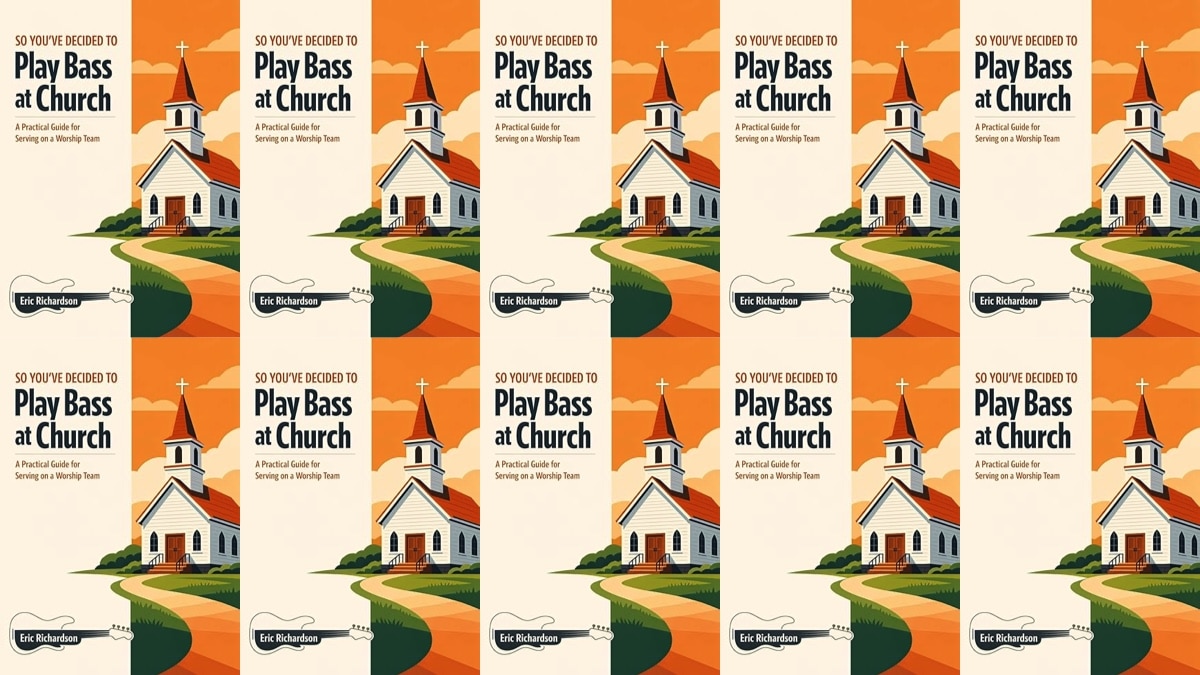
So You’ve Decided to Play Bass at Church: A Practical Guide for Serving on a Worship Team is a short ebook written by Eric Richardson specifically for musicians who are playing, or preparing to play, bass in contemporary worship settings.
Rather than functioning as a traditional lesson book, the guide serves as a practical field guide for church bassists. It focuses on the real situations that arise when serving on a worship team, including rehearsals, Sunday morning services, changing arrangements, and adapting when musicians or plans change.
The book intentionally avoids music theory instruction, bass exercises, chord charts, and scale diagrams. Instead, it explores practical ways bass players can approach their role within a worship band, both musically and relationally.
Drawing from firsthand experience in contemporary worship environments, the guide offers insights about supporting the band, communicating with other musicians, and adjusting in the moment depending on the needs of the group.
At 43 pages, the ebook is designed to be concise, practical, and accessible for volunteer musicians and church teams. DRM has been intentionally disabled so the resource can easily be shared among worship teams.
So You’ve Decided to Play Bass at Church: A Practical Guide for Serving on a Worship Team is available now on Amazon.

New Ebook Helps Volunteer Worship Bass Players Move Beyond Root-Only Playing, Without Overplaying…
Practical, song-first guide offers tasteful bass movement for church and worship settings
Your First Steps Beyond Roots: Contemporary Worship Bass Made Easy! addresses a common, but often unspoken, pattern in church music: volunteer worship bass players relying almost entirely on root notes, even after years of playing.
Written by a seasoned worship bassist, the short, practical ebook is designed specifically for church musicians who are not professionals but faithfully serve their congregations week after week. Many of these players have been making music for years, may play other instruments, and are comfortable on the bass, yet choose to stay on roots when playing in church.
This often comes from a desire to stay out of the way, avoid overplaying, or uncertainty about what is musically appropriate in a worship setting. The book speaks directly to that reality.
Rather than focusing on advanced technique or formal music theory, the guide offers straightforward, usable ideas for adding simple bass movement that fits modern worship music and real church environments. The emphasis is on supporting the song, maintaining clarity, and staying appropriate for congregational worship.
“I’ve played in worship settings for years and noticed that many volunteer bass players—people who simply attend church and serve on the team, tend to default to roots, even if they’ve been playing music for a long time or play other instruments,” says the author. “This book shows practical ways to add movement while still keeping the bass part supportive and appropriate.”
Intentionally concise and worship-focused, the ebook is accessible to volunteer musicians, church bassists, and players without formal training. DRM is disabled, allowing easy sharing among worship teams, churches, and reviewers.
Your First Steps Beyond Roots: Contemporary Worship Bass Made Easy! is available now on Amazon >>> VIEW

The bass guitar is a truly unique instrument and its role in modern popular music is well-defined. About 400 years ago, the first basslines were born, and the evolution of instruments producing mesmerising bass frequencies began. We’ve come a long way since then, and we now live in an age where the bass guitar plays a major role not only in music, but also in the online world of social media.
Available online at Amazon https://geni.us/I0Evl
In this book you will find thirty transcriptions of original compositions designed primarily for solo playing, with the aim of attracting attention on social media. However, there are no self-serving technical pieces or even circus stunts here. These compositions can be played solo, but all of the ideas and concepts are fully usable in wider musical contexts.
The pieces in this book are built around three techniques: fingerstyle, slap bass, and playing with the plectrum. The length of the pieces is usually between 45-90 seconds, which is longer than a simple exercise, but shorter than a standard song structure. This makes them ideal for players who want plenty of inspiration, but don’t want to learn whole songs or long etudes. Stylistically, the compositions are a mix of funk and alternative rock with occasional excursions into jazz or blues styles.
Each piece is notated in standard notation and TAB and is accompanied by some brief performance notes. The book contains links to video performances of all of the pieces and the accompanying audio files are available to download from the Bassline Publishing website.
This book contains the following pieces:
Funky Saturday (Muted by Sponge)
Super Slap Wednesday
B-String Beaten
(P)Funky Sh**t
These Licks are Fire
Neighbours Must Love Me
How to Break a Pick
Two G-Strings
Groovin’ at Grandma’s House
DJ’s are the New Rock Stars
INSomnia
Slappada Bass
Blues with Too Many Notes
Sonata in Drop C
Gentle Slap in F# Minor
Acid for the Children
Music Store Funk
Bend It in Drop D
Electro Vibes
Infinity
Flamenco Meets Thumb
Wheels on the Funk
You’ll Never Be As Cool As George
Chromatic Love
Lazy Afternoon
Shuffle for the Drivers
Half Tone, Whole Tone
Percussive Study in A Minor
Just Groove
Hammer-Ons Out of Control
Available online at Amazon https://geni.us/I0Evl

All jazz bassists recognize the pivotal role that the Bill Evans Trio played in creating a new model for the bass’ function in jazz. In this book, Bass Foundations, Chuck Israels (one of Bill’s long-time bassists) has created a masterpiece of explaining what that revolution consists of. Among other crucial concepts, he shows how the bass can both lay down the pulse and have a dialogue with the other musicians at the same time.
Backing up this analysis are 63 pages of Chuck’s improvised bass lines from his time with Bill Evans. With Bill’s chord changes included, this affords you the opportunity to play-along with the recordings, just like you were a member of his trio. Serious fun!
- Part I — Chuck’s insightful wisdom on the importance of rhythmic interaction with the soloist, the value of keeping the melody of the song in mind as you play, insights on playing in 2, rules for note choices in creating walking bass lines, and much more.
- Part II — Note-for-note transcriptions of Chuck’s bass playing on 18 songs he recorded with Bill Evans from “Moonbeams,” “How My Heart Sings,” “Trio ’65” and other classic recordings. (Generally just improvised choruses are included since the heads are particular to Bill’s recordings. Chuck’s improvised choruses are more useful as general role models.)
- Part III — Transcriptions of Chuck’s bass playing with his own groups. Again, chord changes are written out so you can play along with these great jazz compositions.
YouTube URLs are provided for each song, making it easy to listen, watch the bass lines go by, and then play along with the recordings.
Chuck Israels – Bass Foundations: Principles of Jazz Bass Construction available online at Amazon.com

Press Release
Welcome to the eleventh book in the Bass Gym 101 series, a collection of books for bassists who want to push their playing to the next level. We’ve reached the magic number of 1111 exercises, covering all of the important aspects of bass playing: warm-ups using the finger-per-fret system, arpeggios, pentatonics, all types of scales, odd time signatures, slap bass, plectrum technique and chord playing. This book is a continuation of the book for absolute beginners.
From the author… In writing this book, my intention was to write fun, practical and, above all, inspiring exercises that will guide the student through the various positions on the fretboard. The bass guitar’s fretboard is divided into four zones (or positions, if you prefer): from the open strings to the third fret (1st position), from the third to the sixth fret (2nd position), through the sixth to the ninth fret (3rd position) and finally from the ninth to the twelfth fret (4th position). In the second half of the book you will learn how to combine positions, and by the time you have completed all 101 exercises you should have a very detailed and effective knowledge of the fretboard from the open strings to the twelfth fret – this is the area in which the vast majority of the basslines you know so well from popular songs or musical styles take place.
Inside you will find 101 exercises that will take you through all the positions on the bass in a structured, logical sequence. These exercises will also get you playing in different musical styles, using the most common melodic and rhythmic patterns of popular basslines. Each exercise is written in both standard notation and TAB, and audio files can be downloaded from the Bassline Publishing website.
As the book is primarily aimed at beginner and intermediate players, you won’t find any of the more demanding techniques such as hammer ons, pull offs, trills etc. However, each exercise has been written for a specific playing situation and is immediately applicable to music practice. I’ve paid close attention to melody, clear phrasing and of course playability. Each of these exercises will challenge your attention and memory as you repeat them.
You’ll find basslines in many styles of music in this book: walking bass, hip hop, pop, rock, punk, ska, metal, progressive styles, various Afro-Cuban grooves, funk, indie, reggae, country and bluegrass, EDM styles, blues, soul and folk.
Bass Gym – 101 Position Exercises for Beginner and Intermediate Players available in the US at Amazon.com and in the UK at basslinepublishing.com

Gear News: Fender Unveils Highly Anticipated Vintera III Series

New Music: Oteil Burbridge & Lamar Williams Jr. New Single, Hush

Interview With Bassist Virginia Franks

Nathan East, Echoes of a Lineage – April/May 2026 Issue

Gear Review: Italia Leather Straps

Mar 2 Edition – This Week’s Top 10 Basses on Instagram
Mar 9 Edition – This Week’s Top 10 Basses on Instagram
Mar 16 Edition – This Week’s Top 10 Basses on Instagram
Mar 23 Edition – This Week’s Top 10 Basses on Instagram