
Latest
Finding Your Own Voice – The Inner Critic by Jimi Durso

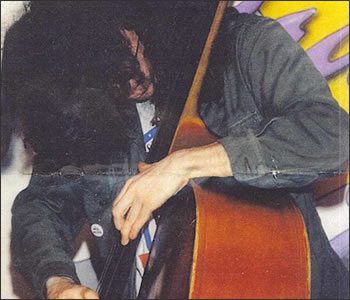
 In my most recent performance with Coincidence Machine, I was reminded again of the power of the inner critic. We all have one. It’s that voice in your head that tells you your line doesn’t groove, or that what you came up with isn’t hip enough, is too unusual, or too conventional, or whatever else you find wrong with your own playing. In order to be a creative bass player you need to come to terms with this aspect of yourself.
Some have recommended silencing this voice (though the earliest person I know of to speak on this was Maxwell Maltz in his system of “psycho-cybernetics”, my first exposure to the concept was at a seminar led by trombonist Ray Anderson) but the inner critic isn’t all bad. It’s the voice that tells you that you need to improve your intonation, or that you’re rushing the time, and many other weaknesses that without the aid of the inner critic you’d likely just leave alone (and never become the beat musician you can be).
But this critic becomes an issue when it disallows you from reaching your full potential, preventing you from exploring the vast wealth of possibilities that you can conceive of. This is why some say to “silence the inner critic”. Especially since, in a playing situation, you don’t generally have time to be arguing with yourself, or constantly passing judgment on what you’re trying to do in the moment.
The problem with this is that it’s next to impossible, and not really necessary (especially in light of the good things the inner critic does for us) to silence. I’d say it’s more a matter of learning to use this inner voice as a collaborator but not give it too much power.
For instance: imagine that you’re at a jam session and you’re struck with an idea, but it’s a bit unconventional. You’re inner critic may rise up and exclaim, “If you play that these people will think you’re too avant-garde”. This may even be true, but if you keep deferring to the judgment of your inner critic, you may find that it starts taking more and more control and you put yourself into a box (and one that continually gets smaller). Something I find useful is to acknowledge the inner critic, but treat what is about to happen as a sort of science experiment (e.g. “Let’s see if they do find this too avant-garde or not”). What I’ve found is that most of the time my inner critic is far more conservative than the people it’s afraid of alienating. As this continued, the inner voice started becoming less imposing (saying “This may be too unusual for this group” rather than “This will be too way-out and these guys will never want to play with you again”).
Over time you may find that your inner critic becomes more of a friend than an adversary, and you may start to enjoy discovering which ideas of yours really work and which ones don’t (in your own opinion). And every time you choose to do something that’s uniquely you, and the players and/or audience reward you for it, those inner criticisms become less stifling.


Check out our top 10 favorite basses on Instagram this week…
Click to follow Bass Musician on Instagram @bassmusicianmag
FEATURED @hiltonguitars @olintobass @vortice.custom.guitars @cb_basses @belforti.instruments @acguitars.co.uk @basscentralofficial @michaeltobiasdesign @timsway1 @officialspector
Check out our top 10 favorite basses on Instagram this week…
Click to follow Bass Musician on Instagram @bassmusicianmag
FEATURED @didonatoguitars @brancoguitars @ja.guitars @lindoguitars @sawtooth_musical_instruments @pensacustomguitars @alpherinstruments @dtcbass @camazon_guitars @ebg_instruments
Check out our top 10 favorite basses on Instagram this week…
Click to follow Bass Musician on Instagram @bassmusicianmag
FEATURED @ja.guitars @mrrjackson @skjolddesign @karvanguitars @sireusaofficial @wonkorbasses @mihado_gs @odiengcustom @sirekorea @brute_bass_guitars
Check out our top 10 favorite basses on Instagram this week…
Click to follow Bass Musician on Instagram @bassmusicianmag
FEATURED @polarisbasses @daveswiftbass @ramabass.ok @officialibanezguitars @serek_basses @dacruzluthieria @alusonic @sadowskynyc @maruszczyk_instruments @pensacustomguitars
Check out our top 10 favorite basses on Instagram this week…
Click to follow Bass Musician on Instagram @bassmusicianmag
FEATURED @officialspector @alusonic @ariaguitars @stradiluthier @sandbergguitars @billysheehanonbass @offbeatguitar @colibriguitars @jens.ritter @overwaterbasses

Maestro Ron Carter, Sharing the Spirit – June/July 2026 Issue

New Music: Danielle Nicole, Tug Of War

Right Hand Technique Strategies with Dr. Randy Kertz

New Music: Golden Flower, Are You Even Awake?

Interview With Bassist Adam Russell
Right Hand Technique Strategies with Dr. Randy Kertz

April 6 Edition – This Week’s Top 10 Basses on Instagram
April 13 Edition – This Week’s Top 10 Basses on Instagram
20 April Edition – This Week’s Top 10 Basses on Instagram