
Latest
Finding Your Own Voice: Range by Jimi Durso

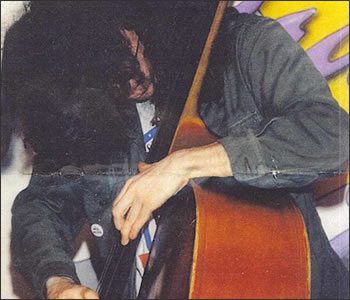
 Finding Your Own Voice: Range by Jimi Durso… I read an interview with Paul McCartney where he was asked why he played the bass line to Day Tripper in the same octave as the guitar, instead of an octave lower. He said that AM radio had terrible bass response, and he knew if he played it that low the bass line would be lost to most listeners.
What range you play in can be a very important aspect of how you approach the instrument. Most of us are playing the bass line as far down as we can and leaving the upper range for melody, chords, solos, basically for everyone else in the band. But it doesn’t have to be that way. Here are two things you can do to open your mind and fingers up to the full range of your instrument.
First is to simply observe how some other players have used range creatively. A great example is Flea’s line on “Give It Away”. The main line is only four notes, but it covers almost an octave, from the low A to the octave G. Or John Paul Jones on “Ramble On”, Where the verses are in the upper range (and he plays what could best be called a counter-melody to the voice), but for the choruses he drops into the lower register (now playing much more supportive lines, and making the sound much heavier).
When you’ve observed some of these ideas, the next step is to try them out yourself. Try playing the verses in one area and the choruses in another. I played a gig on my six string where for one song I stayed in the conventional bass range until the very last chorus, where I dropped down onto the low B string to give a sense of finality to the song. Or, as a fun experiment, write a line (either to someone else’s song or as a potential song of your own) and see if you can use the entire range of your bass. Or when soloing, solo where you normally don’t (like in the low positions rather than jumping up high for your solo spot). Or see if you can answer yourself, playing a phrase in one area and then the next phrase in another. At this point, you might be thinking of other things you can explore that I haven’t mentioned yet. Great! Try those things out first.
Try creating a bass line that spans more than an octave. Then try making one up that spans at least two. Think of all the ways you can do this, pulling off from high notes to open strings, tapping high pitches with your right hand, using harmonics, especially those under the 5th fret, or just conventionally playing across the range of the instrument.
To get more familiar with the entire range of your instrument (whether it be acoustic, electric, 4, 5, or 6 string), here’s a great exercise I got from Marc Johnson (with some variations I created): solo on a 12-bar-blues starting with the lowest note you can play in that key and ending (at the end of the 12th measure) on the highest. Also, do the opposite: start on the highest note you can play in that key and work your way down over the course of 12 measures to the lowest. Then, try starting at the lowest, playing up to the highest and back down before the 12 bars are up. Reverse this and start at the top and play to the bottom and back in 12 bars (you could do this over a form other than a blues, if you like). This is a great exercise as it not only gets you thoroughly familiar with the full range of your instrument but improves your phrasing as well.
Twang!
Also, my rock & roll duo is working on putting out our first CD. Find out more at: CoincidenceMachine.net


Check out our top 10 favorite basses on Instagram this week…
Click to follow Bass Musician on Instagram @bassmusicianmag
FEATURED @hiltonguitars @olintobass @vortice.custom.guitars @cb_basses @belforti.instruments @acguitars.co.uk @basscentralofficial @michaeltobiasdesign @timsway1 @officialspector
Check out our top 10 favorite basses on Instagram this week…
Click to follow Bass Musician on Instagram @bassmusicianmag
FEATURED @didonatoguitars @brancoguitars @ja.guitars @lindoguitars @sawtooth_musical_instruments @pensacustomguitars @alpherinstruments @dtcbass @camazon_guitars @ebg_instruments
Check out our top 10 favorite basses on Instagram this week…
Click to follow Bass Musician on Instagram @bassmusicianmag
FEATURED @ja.guitars @mrrjackson @skjolddesign @karvanguitars @sireusaofficial @wonkorbasses @mihado_gs @odiengcustom @sirekorea @brute_bass_guitars
Check out our top 10 favorite basses on Instagram this week…
Click to follow Bass Musician on Instagram @bassmusicianmag
FEATURED @polarisbasses @daveswiftbass @ramabass.ok @officialibanezguitars @serek_basses @dacruzluthieria @alusonic @sadowskynyc @maruszczyk_instruments @pensacustomguitars
Check out our top 10 favorite basses on Instagram this week…
Click to follow Bass Musician on Instagram @bassmusicianmag
FEATURED @officialspector @alusonic @ariaguitars @stradiluthier @sandbergguitars @billysheehanonbass @offbeatguitar @colibriguitars @jens.ritter @overwaterbasses

Maestro Ron Carter, Sharing the Spirit – June/July 2026 Issue

New Music: Danielle Nicole, Tug Of War

Right Hand Technique Strategies with Dr. Randy Kertz

New Music: Golden Flower, Are You Even Awake?

Interview With Bassist Adam Russell
Right Hand Technique Strategies with Dr. Randy Kertz

April 6 Edition – This Week’s Top 10 Basses on Instagram
April 13 Edition – This Week’s Top 10 Basses on Instagram
20 April Edition – This Week’s Top 10 Basses on Instagram