
Latest
Song Surgeon Professional – Version 4, Review by Eric Parsons

Song Surgeon Professional – Version 4
This month I am reviewing Song Surgeon, another software product from TMJ, Inc. Song Surgeon provides the user/musician with a multitude of software tools that will aid in the process of learning and transcribing songs.
Getting Started
Song Surgeon software is available for both Windows and Mac operating systems. The Windows version has recently upgraded to version 4 while the Mac version is currently at version 3. The software was delivered digitally and was easy to install and activate on my machine, with no complications or rigorous security processes. Once installed, the user is provided with an exceptional amount of support documentation in the form of : a quick start guide, a user guide, a large selection of training videos and a help desk.

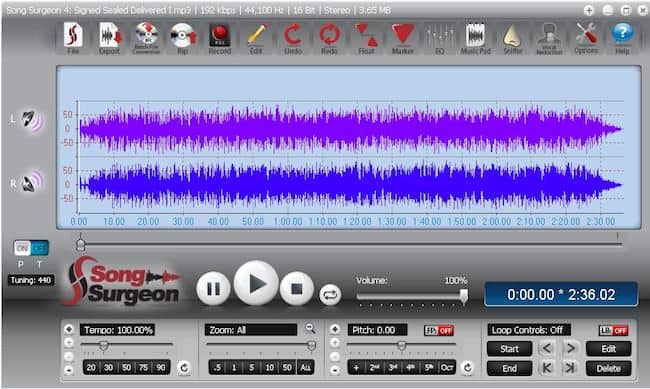
I find the main GUI to be well laid out with an intuitive design. A song can be loaded by opening an audio file already stored on the computer hard drive, by ripping a file from a CD or by using the “Sniffer” – which allows the user to extract the audio from an internet video site such as Youtube.
 I find the upgraded Sniffer to be one of the most innovative and useful tools included in the Song Surgeon package. While reviewing this product, I was offered a corporate function gig that required me to learn a couple dozen old-school tunes in a rather short time frame. Some of the tunes were obscure and the bandleader also specified renditions by specific artists. With the Sniffer, I was able to quickly locate the material I needed to get the job done. The Youtube Sniffer simply requires that the user copy and paste the URL for the relevant video and then the Sniffer extracts the audio and converts it to a .WAV file for use with Song Surgeon.
In Use
Once a song is loaded into Song Surgeon, it’s simply a matter of pushing the play button and then setting the start and end loop points in order to focus in on learning a desired passage. I like to set the loop points in real time and then, if needed, I will go back and refine the loop placement by zooming in on the wave image to make adjustments


 If you lean toward making numerical adjustments, simply select the edit button to fine tune your parameters.
The user can readily adjust the tempo and pitch of the entire song or the selected loop by using slider controls, selecting preset numerical values or by clicking on the available plus or minus buttons for these parameters.
I have also found the pitch function to be a real lifesaver when dealing with older tunes that were not recorded at concert pitch ( with the A note at 440 HZ).
Loop 1 – Pitch Shift Up a Third
Loop 1 – Slowed to 75%
Version 4 Upgrades
Version 4 has added some upgrades that I find to be quite convenient. When opening a file, the user can now quickly navigate to “Recently Opened Files” which greatly speeds up the process of accessing files that may be stored in different locations on your hard drive. There is also a Loop Bypass button which allows the user to toggle between playing a specific loop or the entire song without loosing the loop settings. The user now has access to a 31 band graphic equalizer to enhance or de-emphasize selected frequencies.

Loop 1 – Flat
Loop 1 – Bass Enhance
Additional Functions
At this point, I have covered the functions that I commonly use to learn songs with Song Surgeon. There are, however, several more tools and functions that are available to the user.
Some of the other additional functions include:
- saving a song as a project
- exporting: loops, the entire song or even a Song Surgeon Project
- audio file conversion of multiple songs via a batch file process
- the ability to record audio information/notes in sync with the song file
- comprehensive editing of the song file
- production and editing of song markers
- vocal reduction in a song file
- the ability to produce musical notation and notes using the Music Pad function
In Conclusion
I find Song Surgeon to be an extremely useful tool for any musician who needs to transcribe musical parts, particularly when on a short time frame. At the time of writing this article the MSRP of Standard and Pro versions of Song Surgeon were $69.00 and $99.00 respectively, but were being offered at a sale price of $55.20 and 79.20.
For more information, or to download a fully functional demo go to : Song Surgeon


Check out our top 10 favorite basses on Instagram this week…
Click to follow Bass Musician on Instagram @bassmusicianmag
FEATURED @hiltonguitars @olintobass @vortice.custom.guitars @cb_basses @belforti.instruments @acguitars.co.uk @basscentralofficial @michaeltobiasdesign @timsway1 @officialspector
Check out our top 10 favorite basses on Instagram this week…
Click to follow Bass Musician on Instagram @bassmusicianmag
FEATURED @didonatoguitars @brancoguitars @ja.guitars @lindoguitars @sawtooth_musical_instruments @pensacustomguitars @alpherinstruments @dtcbass @camazon_guitars @ebg_instruments
Check out our top 10 favorite basses on Instagram this week…
Click to follow Bass Musician on Instagram @bassmusicianmag
FEATURED @ja.guitars @mrrjackson @skjolddesign @karvanguitars @sireusaofficial @wonkorbasses @mihado_gs @odiengcustom @sirekorea @brute_bass_guitars
Check out our top 10 favorite basses on Instagram this week…
Click to follow Bass Musician on Instagram @bassmusicianmag
FEATURED @polarisbasses @daveswiftbass @ramabass.ok @officialibanezguitars @serek_basses @dacruzluthieria @alusonic @sadowskynyc @maruszczyk_instruments @pensacustomguitars
Check out our top 10 favorite basses on Instagram this week…
Click to follow Bass Musician on Instagram @bassmusicianmag
FEATURED @officialspector @alusonic @ariaguitars @stradiluthier @sandbergguitars @billysheehanonbass @offbeatguitar @colibriguitars @jens.ritter @overwaterbasses

Maestro Ron Carter, Sharing the Spirit – June/July 2026 Issue

New Music: Danielle Nicole, Tug Of War

Right Hand Technique Strategies with Dr. Randy Kertz

New Music: Golden Flower, Are You Even Awake?

Interview With Bassist Adam Russell
Right Hand Technique Strategies with Dr. Randy Kertz

April 6 Edition – This Week’s Top 10 Basses on Instagram
April 13 Edition – This Week’s Top 10 Basses on Instagram
20 April Edition – This Week’s Top 10 Basses on Instagram