
Gear Reviews
Review: Anaconda Basses Ultra J5 Essence Bass

A Review of Anaconda Basses Ultra J5 Essence Bass…
By Guest Contributor Kenery Kent Smith
As a professional bassist of 40+ years (geez Louise—I said that out loud…), I have owned, played and even built my fair share of a wide variety of bass guitars from many manufacturers. Some have been exotic, handmade and amazing instruments, built by equally amazing small shop luthiers. Some have been very nice, mass-produced instruments which did exactly what they were made to do—make beautiful music; and they did that rather well. And some—let’s just be honest here— some were junkyard dogs that I had to wrestle and fight with on stage EVERY night—just to prove my love (and to prove, despite those instruments shortcomings and challenges—that I could actually play)!
While I have never had a bass collector’s mindset—I have always striven to own enough of the right basses that provided the right tools and the flexibility to do any bass chair job I was called to do; whether it was fitting the sounds of a particular genre of music or needing a beautifully singing fretless to fluidly maneuver a bass line through an equally beautiful song.
But in all those years, and through all those basses—only a handful have truly stood out as being something REALLY special. Only a few have presented as having that THING that makes a bass perfect for YOU, and that allows you to effortlessly speak in YOUR voice—and not the voice of a brand name or a company sound. Craftsmanship, flexibility, tone, feel, reliability, aesthetics—and a GREAT feeling of communication and support from the manufacturer; these qualities are not always the norm. And even less common, is the ability to find those qualities in a high-end custom bass manufacturer whose entire line of instruments don’t break the bank; yet still has offerings of which you can truly and confidently know that the benefits of their higher-end basses’ build standards, quality, and “trickle down” technology, is reflected in every bass they build—from the top of their line to their more affordable (yet still high-quality) instruments.
Enter Andrew Taylor-Cummings, and his UK-based ANACONDA BASSES. More specifically, enter their latest offering; the amazing ULTRA J5 ESSENCE BASS.
And yes—I am getting to the actual review of THAT specific bass. Please—indulge me for a few more moments—it’ll be well worth it!
I first met Andrew in 2018 at NAMM through a mutual friend and amazing fellow bassist Vuyani Wakaba. This was only a year before Anaconda Basses made its stunning official US debut at the 2019 NAMM Show. And of all the places at NAMM for me to meet an aspiring luthier was on the OUTSIDE of the convention center (Andrew was not new to bass building; he had been doing his thing in the UK since 2013 and was simply in the process of bringing his wares to we low enders across The Pond). It felt very clandestine, geeky, and mysterious to me at the time; but I had great trust in the quality of product of anyone who Vuyani introduced me to; his track record is stellar! And like me, he is a very discerning person and musician, and he doesn’t give his stamp of approval lightly!
And so—outdoors—in the middle of the promenade between convention buildings, I was introduced to Andrew Taylor-Cummings. I was immediately struck by Andrew’s friendliness, character, and humility— not always the attributes of many instrument builders. Yet here, there was an unspoken pride and confidence in the quality of the product he had created. Next, after formal introductions, came Vuyani’s declaration of, “Kenery—you have GOT to try this bass!” Andrew had with him, a lone gig bag slung over his shoulder, in which Vuyani insisted the bass guitar equivalent of Mjolnir or the Infinity Stones was contained. Totally geeked at this point, I outstretched my hands as if awaiting the gifting of a bazillion dollars. What actually got placed in my hands turned out to be equally as valuable (yes, figuratively!) to a bassist like me.
What was placed into my hands, was a beautifully exotic and unique, high-quality, and ergonomically friendly bass guitar.
It was lightweight, yet solid; a well-balanced and resonant groove-making instrument. One that paid a well-deserved homage to the legacy of Leo (all hail Leo!) yet possessed a uniqueness and individuality that separated it greatly from anything Leo—or any other bass builder for that matter—had available for the offering. Without even being able to plug it in, I knew that this bass sounded phenomenal. Playing it unplugged elicited an immediate connection to it via both a comfortable familiarity and a sense of innovation. This bass SPOKE through its beautifully symbiotic choice of woods, its hardware, and its overall master craftsmanship. There was a true LOVE of the bass guitar and music— and a commitment to high standards of quality—that were defined within this instrument. And I didn’t need to plug it into an amp to recognize that.
As it turns out—and validating everything that I felt about that bass when I played it unplugged outside the doors of NAMM in 2018—it was the VERY SAME bass that would later that year, go on to win the prestigious Bass Guitar Magazine “Best Bass of 2018” Award (£1000-£2500 Category; then roughly $1300 – $3300 US). And that award-winning bass, my friends— was Anaconda’s Ultra J4E-Elite. The rest as they say, is bass-ic history (no one really says that, but you get the point). This FINALLY brings us to the present day, and the heirs of that “trickle down” build quality and technology that I spoke of earlier; the brand-new second generation of Anaconda’s amazingly successful import line of basses, aptly named the Essence Series. And more specific to this review, their Ultra J5 Essence bass.
THE BASICS
The Ultra J5 Essence review model is a 5-string, 34.5-inch scale bass, featuring the star of this story IMHO: an amazingly comfortable and amazingly fast 20” radiused, beautifully bound 21-fret Indian Laurel fingerboard, mated to an elegantly grained and “rock solid” Rock Maple bolt-on neck reinforced with dual carbon fiber rods, and a smooth turning dual action truss rod—which is conveniently accessible at the neck heel via a generous but handsomely finished truss rod access slot routed into the body. Other neck options available are a maple fingerboard with black or pearloid rectangular position markers with either black or white binding—and on the Jahmal Nichols Signature Model, pearloid block markers with white neck binding. This lovely satin finished neck also sports a new “C” profile with softer shoulders than the previous generation, making it thinner and easier to navigate up and down the entire neck, even considering that the 1.89” nut, and 19mm string spacing at the bridge may in one’s mind, present as a possible challenge for some who may be used to shorter scales and tighter string spacings. But let me tell you—you won’t even notice! As a player who recently went back to all 34” scale basses because 35” plus began to feel literally like a stretch, the 34.5” scale, “C” shape and 20” radius of the Ultra J5 is an absolute joy and effortless to play. Andrew Taylor-Cummings has found that magical, mystical “sweet spot” for bass guitar necks of strength, playability, feel, and tone.
The Indian Laurel fretboard isn’t a species of wood I have personally owned on a bass before, but it is a pleasant surprise to play. Without plying the murky waters of the infamous “tone woods do/don’t make a difference” argument; to my ears (the ears of both a 30+ year professional player, an experienced producer and sound engineer, and amateur luthier), Indian Laurel features the best of both worlds; the clarity and brightness of maple, and the warmth and tonal character of rosewood. The increased denseness and hardness of Indian Laurel over Indian Rosewood makes the fretboard woods feel slightly different from one another, with Indian laurel feeling smoother as compared to rosewood. Thus, you benefit from both its warmth and ease of playability. And the perfectly cut and seamlessly inlaid pearloid rectangular position markers, in combination with the flawless matte black binding with inlaid white dot side markers that frames the fretboard, are indeed of a look and quality the belies this bass’s humble price tag.
The body of the Ultra J5 Essence is a wonderfully resonant and back pleasingly light Alder wood. Alder has been the wood of choice for fine electric bass building, in addition to Swamp Ash, for as long as electric basses have been built. It not only looks great as a standalone wood (the grain is quite a bit less pronounced than in ash in most cases, but is still quite attractive), but it also pairs well with almost any figured wood top you may choose to have on a bass. That said, this Ultra J5 flaunts a lovely flame maple veneer, which adds just the right amount of high-end deliciousness beneath the flawlessly applied gloss Cherry Burst finish of my personal model. That flawless finish is protected around the plucking area, by a perfectly transparent, perfectly cut clear pickguard. This allows the full beauty of the flame maple top to be seen in all its glory, while still being well protected from the rigors of normal playing use. Other finish options include Island Blue for the 4 String, and Gen 2 adds Satin Black, and Arctic White (Jamal Nichols Signature bass) to the palette. The available body finish/fingerboard/hardware combinations are listed at the end of the review but include the aforementioned pearloid or black block position markers on either the Indian Laurel or Maple fingerboards, and either black, chrome, or gold hardware.
BUT OH, MY GOODNESS—THAT TONE THOUGH!
Let’s start with acoustic and unplugged; the Ultra J5 Essence has that very same type of wonderful resonance and voice that its fancier sibling had when I played that very first Anaconda Ultra J4E-Elite Bass. The Ultra J5 Essence speaks clearly and authoritatively as an acoustic instrument, which is a portent of all things to come electric. Once I finally stopped geeking out on its unplugged tone and put cord to jack, the Ultra J5 Essence did not disappoint! As a matter of undeniable fact, it delivered in SPADES! And here’s why…
New for 2023 are Anaconda’s very own proprietary AC-TN Jazz bass style pickups for 4-string and 5-string models. The AC4-TN pickups are hum-canceling split coils, while the AC5-TN feature a stacked coil hum-canceling design. Both configurations quite effectively eliminate the dreaded 60-cycle hum that is the typical tradeoff for owning that revered single-coil J bass pickup sound. But the AC-TN pickups deliver a gloriously noise-free playing experience, without sacrificing that trademark single-coil punch, warmth, and clarity. For 6-string Ultra J Essence basses, the AC6SB-TN dual coil soapbar (P2 shape) comes as standard ware (NOTE: the ACSB-TN soapbar configuration is available as a retrofit option for 5 stringers as well when ordering your Ultra J5 or J6). And the ACSB-TN soapbar pickups are of course, traditional humbuckers, having their own unique tone derived from the wider string sensing aperture of two parallel pickup coils. According to the man himself, Andrew Taylor-Cummings: “The 4 string pickups have different resistance values to the 5 strings, so they will sound a little different. To my ear, they are more aggressive, with more mids. The 5 & 6-string ACSB-TN pickups are dual coil soapbars. They don’t sound like the AC-TN pickups. [They have] sweeter mids, less output, a fuller bottom end.” But bringing the focus back around to the subject of this particular review, my Ultra J5 Essence bass came equipped with the stacked coil AC5-TN pickup configuration.
Regardless of which of the available pickup configurations you choose, they all punch well above their weight with a string-to-string evenness due to being designed around their large 9.5mm Alnico pole pieces, which are near perfection in their ability to capture attack and to convey note dynamics clearly and concisely. What you hear is the entirety of the ecosystem of the Ultra J Essence Bass from tone woods to string choices. Most importantly, you will hear YOU as a player—and all the nuances of what you put into every plucked, thumped, popped, and picked note. This bass is perfect for any and every style and technique of playing. And you hear it all with an uncanny clarity and tonal girth that makes you want to play the bass even more. The end result is that the Ultra J5 Essence gives you permission to express yourself as fully as you choose to. Play softly, and the AC5-TN pickups respond in kind with a mellow smoothness and a sweet tonality. Dig in, and they reward you with plenty of high-end clarity, mid-range growl, and low-end authority. There is no musical style these pickups cannot handle, from Rock to Gospel; Jazz to Country; Hip Hop to New Wave and Dance—the Anaconda AC5-TN pickups allow the Ultra J Essence Basses to do it all.
And the sound of every Ultra J5 Essence Bass is all neatly tied together and managed by one of the quietest, most versatile and non-intrusive onboard preamps I have heard in a long time; the Anaconda AC3-TZ Active 3-Band Preamp. On top of giving you the player, and access to your uniquely personal sound and not some brand’s pre-chosen “house sound”, the AC3-TZ’s clean and ergonomically friendly layout is easy peasy to use and allows you to dial in a tone that works in any room, the one that’s in your head, or the tone that gives you exactly what each and every song calls for. The AC3-TZ controls are as follows; Volume/Passive Tone concentric pots, a Pickup Blend, all mated to a push/pull Mid Boost/Cut pot set at 250Hz pushed down or 800Hz pulled up, giving you +/-11dB of range; and a Stacked Treble/Bass pot set at frequencies of 3KHz and 60Hz respectively, both having +/-15dB of boost and cut. Both an optional Bright switch (+6dB @ 8KHz) and a Battery life LED Indicator are also available as add-ons.
Even beyond the apparent benefits of having a bass with articulate and powerful pickups and a versatile onboard preamp system, the Anaconda Ultra J5 Essence is at its heart, a fantastic jazz bass. But it’s a jazz bass that is on steroids, offering a welcome fresh take on a much-loved traditional style. Its pickup spacing seems to split the difference between a 60’s and 70’s configuration: being that the scale length is 34.5”, I would have to do some fancy math to figure out which the Ultra J5 Essence leaned closer to. But either way, the end result is the best of both worlds; clarity and prodigious low end from the neck pickup, Jaco-eques growl and midrange openness from the bridge pickup, and classic, funky modern scoop and thump from both pickups set wide open. The tonal landscape in between is infinite, as it is with most great Jazz Bass pickup configurations. And all of this is available even while in passive mode, with no preamp engaged— because the AC-TN pickups just sound amazing! They possess a rock-solid low end that never sounds muddy or bloated, a sweet but not overly pronounced midrange center, and an openness to their highs that is never too bright or brittle. On their own merit, the AC-TN pickups give you everything you need tonally, that they give you with the preamp engaged—minus of course the flexibility to further shape the sound beyond the basic balance settings and tone control roll-off of a passive J Bass.
But here’s the kicker; depending on where you have the internal volume of the preamp set (adjustable via a trim pot on the preamp board), the Ultra J5 Essence sounds EXACTLY THE SAME in passive mode, as it does when you have the preamp engaged and all tone controls set to flat. THAT is a testament to the beauty of Anaconda’s preamp design, and to the lack of unwanted coloration, the AC3-TZ preamp introduces to the bass. There is none. It really and truly gives you exactly what you ask it for; nothing more, nothing less. And that is how a great onboard preamp is supposed to operate.
View Sounds Samples Below:
Borrowing from a popular cultural phrase—The Anaconda Ultra J5 Essence Bass “owes me nothing.”
It pays off in spades and checks every box most any professional player could ever desire—all in a GAWJUS, solid, well-built, high-quality bass guitar. Pricing for the Ultra J Essence line starts at around $1,110.70 retail USD for the Ultra J4. The retail price of the Anaconda Ultra J5 Essence Bass is $1,352.17 USD with my Cherry Burst Ultra J5 clocking in at around $1600 USD total, including taxes, shipping and import duty charges. With that in mind, the Ultra J5 Essence is THE five-string bass to own if you want or need one of the highest quality, consistent, versatile, and well-thought-out basses on the market, bar NONE. That sentiment extends to basses even well above its price point. And what you get for that price, besides ALL the goodies mentioned above—is the quality, integrity, support, and customer service and satisfaction of Andrew Taylor-Cummings and Anaconda Basses. And in today’s overly saturated cookie-cutter musical instrument market—being able to build a relationship by owning a quality bass guitar from a company that takes its products, its customers, and its reputation quite seriously; a company that even in its meteoric success, remains both personable and professional—is invaluable.
EVERYTHING important which makes Anaconda’s higher-end Elite Series handmade basses so special and highly coveted, is “in Essence”, fully distilled into their Ultra J Essence Series of basses. The feel and playability are really where it’s at. Andrew Taylor-Cummings made certain that the very same build specs he created for the Elite Series Basses were reflected in the Essence Series; feel, measurements, tolerances, and all. He left no stone unturned, no spec to chance. And he created the Essence Series with the same pride and level of performance he demands in every hand-carved bass that leaves his shop. As a testament to that fact, Andrew won’t ship ANY of his Essence basses without his hands having been on them for QC and final setup. THAT’S how much he cares about his basses and his customers. And THAT’S what makes the Anaconda Ultra J5 Essence THE best mid-priced professional five-string bass guitar on the market today. It is also why, after all those years ago, on that late evening outside of a NAMM convention hall—catching my first very glimpse of that award-winning Ultra J4E-Elite, Andrew Taylor-Cummings and Anaconda Basses had me at “here— you have GOT to try this bass ….”
SPECIFICATIONS:
- Body: Alder
- Neck – Maple Bolt-on
- Dual carbon fiber rods
- Frets: 4 & 5 string – 21 Frets, 6 String – 24 Frets.
- Scale length: 4 string – 34″, 5 & 6 String – 34.5″
- Fingerboard: Maple or Indian Laurel
- Fingerboard radius: 4 String – 16″, 5 String – 20″, 6 String – 20″.
- Block Markers: Pearloid or black
- Binding: White or black
- Pickups: 4 String (Anaconda AC4-TN), 5 String (Anaconda AC5-TN), 6 Strings (Anaconda AC6SB-TN) All Hum-cancelling.
- Preamp: New for 2023: Anaconda AC3-TZ Active 3-Band Preamp. Vol/Passive Tone, Pickup Blend, Mid 250Hz/800Hz push/pull, Stacked Treble/Bass, Bright switch (optional), Gain Trim Pot, Battery life LED Indicator (optional).
- Tuners: Lightweight Gotoh GB528 RES-O-LITE
- String Tree: Hipshot
- Bridge: Sung Il BB009 Bridge (4 string), Sung Il Monorail Saddles (5 & 6 String). All 19mm Spacing
- String Spacing: 19mm spacing at bridge (4, 5 & 6 String)
- Tusq Nut: 40mm (1.575”) Nut width (4 String), 48mm [1.89”] (5 String), 52mm [2.047”] (6 String)
- Strings: D’Addario EXL165 Nickel Bass Strings
- Finish: Range of Bursts, Solid color, Gloss or Satin
- Gig bag: Anaconda Gig Bag, 25mm padding
- Weight: Approximate weight 4.0-4.4 Kg. (8.818 – 9.7lbs)
For pricing and more information, visit online at anacondabasses.co.uk/essence-series-basses
About Kenery Kent Smith

As a music industry veteran, Chicago-based Kenery Kent Smith is an accomplished professional bassist of 40 + years. His musical résumé includes performances with artists ranging from Neo-Soul diva (and former Erykah Badu background vocalist) YahZarah, to Acid Jazz pioneers Liquid Soul; from world-famous comedian Bernie Mac to Grammy Award-winning Gospel recording artist Darius Brooks. He has toured extensively throughout both the US and Europe, helmed a successful New Jazz band Detour JazFunk for 15 years, and has left his groovalicious low-end mark on many an artist’s recordings and projects. Being a world-class musician was not enough self-expression for him, so Kenery has also become a self-appointed “Worderer” as well, sharing words of encouragement and enlightenment as a co-author in the Amazon Best Seller book, “Lessons for The Little Boy” by author Jaime Gill— and he will do so again in his forthcoming memoir and self-help-ish book entitled, “I Said What I Said.”
Visit online at k2sproductions.com


Disclaimer: This pedal was kindly provided by Donner Music for the purpose of this review. However, this does not influence our opinions or the content of our reviews. We strive to provide honest, unbiased, and accurate assessments to ensure that our readers receive truthful and helpful information.
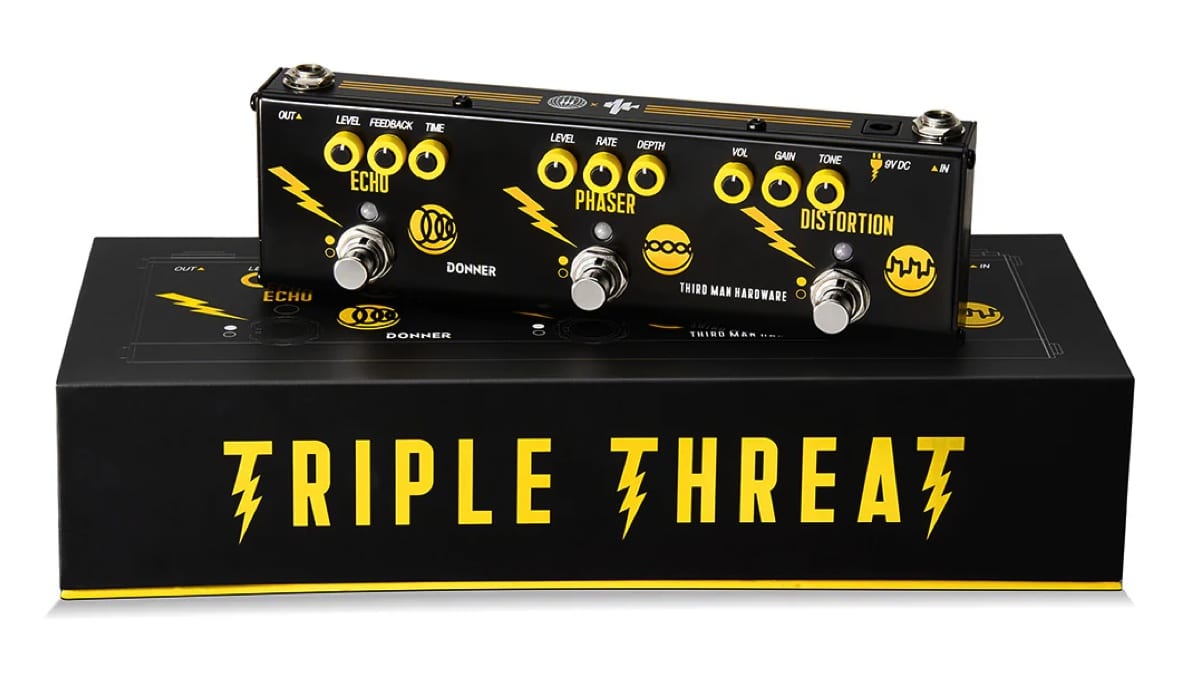
Triple Threat… A compact burst of analog attitude with unexpected appeal for bass players.
Multi-effects pedals are not usually the first stop for bassists. Most of us build our rigs piece by piece, choosing pedals that preserve low end and offer precise control. The Donner Triple Threat Pedal, created in collaboration with Jack White’s Third Man Hardware, takes a very different approach. It keeps things simple: distortion, phaser, and echo, all in one compact unit, with no menus or deep editing, just knobs and footswitches.
At first glance, it feels like a guitar pedal through and through. But spend a little time with it on bass, and it starts to reveal a different kind of usefulness, less about precision, more about character.
Built around simplicity
The Triple Threat is all about immediacy. Each effect has its own dedicated controls and footswitch, making it easy to dial in sounds quickly without overthinking the process. There’s something refreshing about plugging in and getting straight to experimenting, especially for bass players who are used to more complex signal chains.
The compact enclosure makes it easy to fit onto almost any pedalboard or even use as a standalone unit for rehearsals and smaller gigs. That said, the small size does mean the knobs are quite tight and not the easiest to adjust mid-performance. It’s a minor compromise, but one that becomes noticeable on a dark stage.
Analog character
Rather than aiming for clean, studio-like tones, the Triple Threat leans into a more raw and expressive sound. This becomes particularly apparent in the distortion section. It delivers a gritty, garage-inspired voice that can add real personality to a bass line, especially in indie or lo-fi contexts.
On bass, the key is restraint. Lower gain settings bring out a nice edge without sacrificing too much low end, while higher settings can start to thin things out. Without a blend control, there’s no easy way to bring back the fundamentals once it’s gone, so it rewards a lighter touch.
The phaser is more immediately cooperative. With slower rates and moderate depth, it adds movement without overwhelming the core tone. It’s the kind of effect that works best when you don’t notice it right away, but feel it sitting underneath the groove.
The echo section stands out as the most naturally suited for bass. It’s warm, slightly dark repeats sit comfortably behind the dry signal, adding space without clutter. Whether used subtly or pushed into more ambient territory, it complements the instrument rather than competing with it.
Real-world perspective
The Triple Threat has also found its way onto the pedalboard of Dominic John Davis, bass player for Jack White, which gives some insight into how it functions in a professional setting.
Looking at his broader setup, typically including tools like the Boss TU-3 Chromatic Tuner, MXR M108 Ten Band Graphic EQ, and boutique pedals such as the Mantic Effects Vitriol and Mantic Effects Isaiah Delay, it becomes clear that the Triple Threat isn’t a centerpiece. Instead, it serves as a flexible addition, a way to access a few extra textures without expanding the pedalboard further.
That context is important. For bass players, this isn’t about replacing carefully chosen pedals, but about adding something a little different to the mix.
Versatility in practice
In practical use, the strength of the Triple Threat lies in how quickly it lets you shift between sounds. Having three effects available at your feet without needing multiple pedals can be surprisingly useful, especially in stripped-down setups.
It’s easy to imagine it being used in rehearsals, smaller gigs, or situations where portability matters. It also lends itself well to experimentation, encouraging players to step outside their usual tonal comfort zones.
At the same time, its limitations remain part of the experience. The distortion’s guitar-oriented voicing and the absence of a blend control mean it won’t satisfy players looking for a fully optimized bass overdrive. Instead, it offers something a bit less predictable, and that’s part of its charm.
The Donner Triple Threat Pedal isn’t trying to be a precision tool, and it doesn’t need to be. What it offers is a straightforward, character-driven set of effects that invite exploration.
For bass players willing to approach it on those terms, it can be a surprisingly inspiring addition. It won’t replace a dedicated pedalboard, but it can add texture, movement, and a bit of unpredictability in a way that feels immediate and fun.
For more information, visit online at donnermusic.com
Disclaimer: This pedal was kindly provided by Valeton for the purpose of this review. However, this does not influence our opinions or the content of our reviews. We strive to provide honest, unbiased, and accurate assessments to ensure that our readers receive truthful and helpful information.
Two Paths to the Same Goal: Better Workflow, Real Control
Valeton’s GP series has followed a clear and consistent trajectory. The GP-5 introduced the core sound engine in an ultra-compact, app-driven format, proving that solid tones could exist in a minimal footprint, but at the cost of hands-on control. The GP-50 took a major step forward by adding onboard editing and a second footswitch, making the platform far more usable without relying on external devices.
With the GP-150 and GP-180, Valeton shifts the focus again, this time toward how players actually interact with their sound while playing.
These aren’t about reinventing the tone engine. They’re about making it more accessible, more flexible, and ultimately more musical in real-world use.
It’s also worth noting that while these pedals build on workflow ideas introduced in smaller GP units like the GP-5 and GP-50, the GP-150 and GP-180 are more closely related to the GP-100 platform, positioned as more complete, floorboard-style solutions rather than compact multi FX.
The Big Picture
Both the GP-150 and GP-180 share the same core foundation:
- 200+ effects
- NAM (Neural Amp Modeler) support
- IR loading (up to 20 files)
- 12-module fully flexible signal chain
- Looper (180 seconds) and drum machine
- USB audio interface and Bluetooth connectivity
- Built-in rechargeable battery
So in terms of sound and raw capability, they’re very similar.
The real difference comes down to workflow and control.
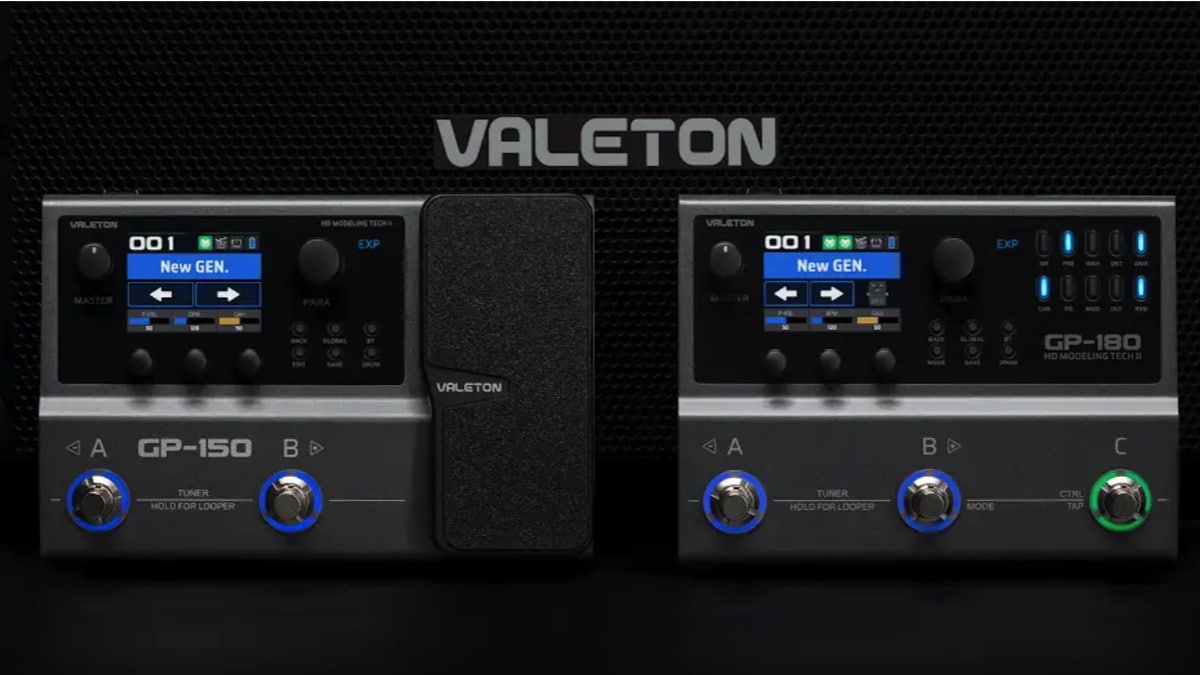
GP-150: Compact Rig with Real Expression

The GP-150 is where the platform starts to feel like a proper, self-contained rig.
The standout feature here is the built-in expression pedal. That alone changes how you use the unit. Instead of just switching presets or toggling effects, you can actively shape your sound in real time… volume swells, wah, parameter control… it’s all immediately available.
Combined with dual footswitches and onboard editing, the GP-150 strikes a strong balance
between portability and control. It carries forward the independence introduced in the GP-50,
but expands it into something more expressive and complete.
It’s especially appealing for players who want a minimal setup that still feels dynamic and
responsive.
GP-180: Hands-On Control, Pedalboard Feel

The GP-180 takes a different approach. Instead of adding expression, it doubles down on direct
control.
The addition of a third footswitch already makes navigation more natural, but the real shift
comes from the dedicated effect block buttons.
Each block has its own button, which lights up when active and can be toggled instantly. That
means you can turn distortion, delay, modulation, or reverb on and off with a single press—no
menu diving, no reassignment needed.
In practice, this makes the GP-180 feel much closer to a traditional pedalboard. You’re not just
switching presets, you’re interacting directly with your signal chain, something that wasn’t really possible with the more minimal GP-5 or even the GP-50.
For live use, that immediacy makes a big difference.
Tone & Real-World Use
Both units share the same sound engine lineage, and overall quality remains strong.
There are more effects available compared to earlier models, and the addition of NAM support
opens the door to more realistic amp tones and modern workflows.
One of the most noticeable improvements, particularly for bass players, is the octave tracking. Lower octave sounds are significantly tighter and more usable than in earlier GP units like the GP-5, making them far more practical in a mix. Higher octaves still feel a bit clunky, but the improvement where it matters most is clear.
In terms of real-world use, both pedals are flexible enough to cover practice, recording via USB, direct-to-PA live setups, and compact fly rigs.
That said, they cater to slightly different players.
Which One Should You Choose?
Go for the GP-150 if:
- You want a compact, all-in-one unit
- Expression control is important to your playing
- You prefer a streamlined setup with minimal footprint
Go for the GP-180 if:
- You play live and need faster, more direct control
- You prefer a pedalboard-style workflow
- You want to toggle effects individually rather than relying on presets
The GP-150 and GP-180 aren’t competing pedals; they’re two different interpretations of the same idea.
The GP-150 focuses on expression and portability, giving you a compact rig that still feels
dynamic and interactive, something that builds directly on the usability improvements
introduced after the GP-5.
The GP-180 focuses on control and immediacy, turning the GP platform into something that
feels much closer to a traditional pedalboard.
Both share the same solid tonal foundation, but they approach usability in different ways.
And that’s really what this generation of the GP series is about, not just sounding good, but
feeling right under your hands and feet.
Visit online at valeton.net/


Disclaimer: This bass strap was kindly provided by Italia Leather Straps for the purpose of this review. However, this does not influence our opinions or the content of our reviews. We strive to provide honest, unbiased, and accurate assessments to ensure that our readers receive truthful and helpful information.
I’ve spent years searching for the perfect wide bass strap, something that delivers both comfort and durability without compromising on style. That search ended nearly two decades ago when I discovered Italia Leather Straps.
Handcrafted in the USA from premium Italian leather, Italia Straps offers an impressive range of straps for both bass and guitar players. What immediately stood out to me was the exceptional craftsmanship; every detail, from stitching to material selection, reflects a commitment to quality. These aren’t just accessories… they’re long-term investments for serious musicians.
After more than 19 years of consistent use with my original strap, I can confidently speak to its longevity and comfort. Even under the demands of extended performances, the support provided by a 4” wide strap makes a noticeable difference.
In this review, I’m taking a closer look at the 4” Elite Series Leather Backed Bass Strap, now available in a sleek new Slate Black finish. It’s a refined addition to an already outstanding lineup, combining aesthetic appeal with the same trusted performance.
For more information, visit www.italiastraps.com.
Disclaimer: This pedal was kindly provided by Empress Effects for the purpose of this review. However, this does not influence our opinions or the content of our reviews. We strive to provide honest, unbiased, and accurate assessments to ensure that our readers receive truthful and helpful information.
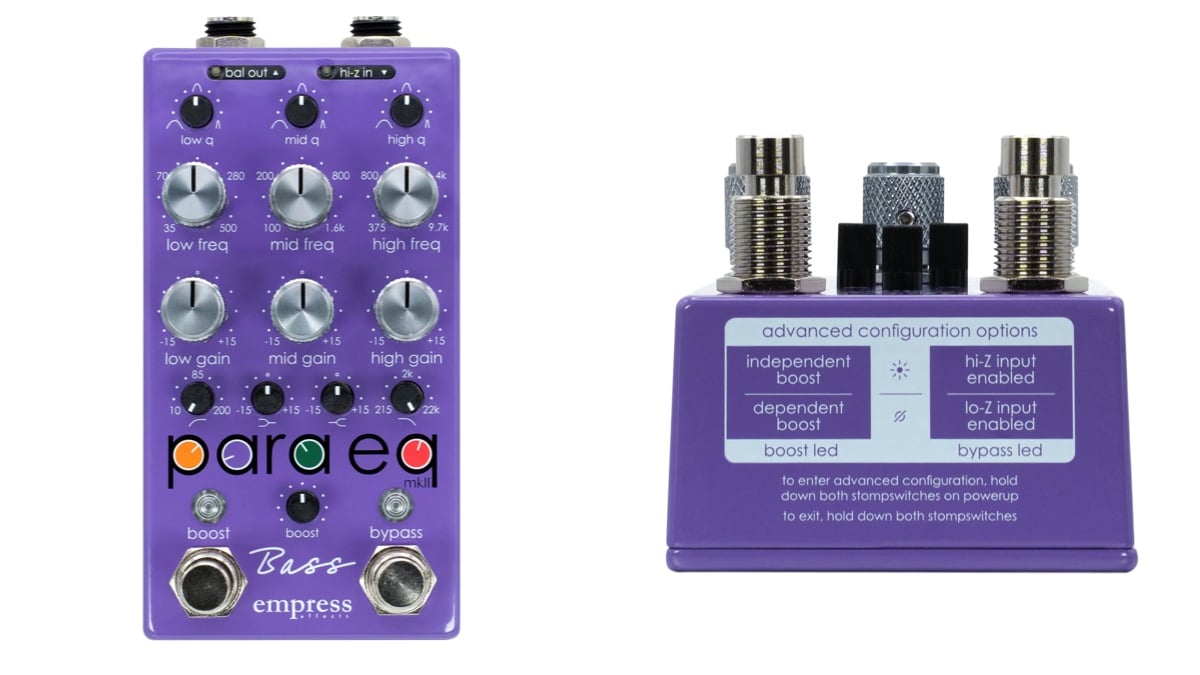
ParaEQ… Precision tone shaping in a pedalboard-friendly format.
EQ pedals are often the unsung heroes of a bass rig. While overdrives and compressors tend to get most of the attention, a good EQ can completely transform how a bass sits in a mix. The Empress Effects Bass ParaEQ takes that idea much further, offering studio-style tone shaping in a rugged pedal designed specifically for bass players.
Based on the company’s well-known ParaEQ MKII Deluxe, the Bass ParaEQ adapts the concept for low-frequency instruments, delivering a powerful and flexible tool for dialing in everything from subtle tonal tweaks to major corrective EQ.
Built for bass
At its core, the Bass ParaEQ is a three-band parametric equalizer, meaning each band allows you to select the frequency you want to adjust, how much you want to boost or cut it, and how wide the adjustment should be. For bass players, this level of control can make a huge difference when trying to solve real-world tone problems.
In addition to the three parametric bands, the pedal includes a low-shelf and high-shelf EQ, along with high-pass and low-pass filters. Together, these controls allow you to shape everything from deep sub-bass to the upper harmonics of the instrument.
The controls are laid out clearly on the pedal, and while there are quite a few knobs, the layout remains intuitive once you spend a little time with it. Each parametric band offers frequency selection, boost or cut of up to ±15 dB, and a Q control that adjusts the bandwidth of the EQ band.
Another thoughtful feature is the selectable input impedance. The standard 1M? input works perfectly with most electric basses, while a 10M? high-impedance mode is available for instruments with piezo pickups, making the pedal particularly useful for upright bass players.
Massive headroom and clean performance
One of the technical highlights of the Bass ParaEQ is its 27-volt internal operation. Although the pedal runs on a standard 9-volt power supply, the internal circuitry steps that voltage up to 27 volts, providing enormous headroom. In practical terms, this means the pedal remains exceptionally clean even when applying large EQ boosts.
This extra headroom is especially noticeable when boosting low frequencies, where many EQ pedals can start to sound strained or compressed. The Bass ParaEQ handles these boosts effortlessly, maintaining clarity and punch across the entire frequency range.
The pedal also includes a foot-switchable boost capable of delivering up to 30 dB of clean level increase. This feature turns the ParaEQ into more than just a tone-shaping tool. It can also function as a volume boost for solos, a way to match output levels between instruments, or even a clean gain stage to push an amplifier slightly harder.
Real-world performance
In real-world playing situations, the Bass ParaEQ quickly proves its value. One of its biggest strengths is how easily it can adapt to different instruments and environments.
For example, during a recent gig, I used the pedal while switching between an active Jazz bass and a passive bass with flatwound strings. The active bass had a fairly aggressive top end that tended to jump out in the mix. With the ParaEQ, it was easy to smooth that out by slightly trimming the upper mids and rolling off some of the extreme highs.
The passive bass, on the other hand, benefited from a small boost in the presence range, helping it cut through the band without losing its warm character. Instead of constantly adjusting the amp between songs, the ParaEQ handled those changes instantly.
The pedal is equally useful for addressing common live sound issues. A quick adjustment can tighten up muddy low mids, add clarity to a dull stage tone, or remove problematic resonances that appear in certain venues.
Versatility for stage and studio
While the Bass ParaEQ is incredibly useful in live settings, it also shines in the studio. Engineers frequently use parametric EQ to shape bass tones during mixing, and having this level of control directly on the pedalboard allows players to dial in a more refined sound before the signal even reaches the recording chain.
The combination of parametric bands, shelving filters, and high-pass and low-pass filters makes the pedal capable of handling a wide range of tonal adjustments. Whether the goal is tightening the low end, adding articulation, or smoothing out harsh frequencies, the ParaEQ delivers precise results without altering the natural character of the instrument.
Final thoughts
The Empress Effects Bass ParaEQ is not your typical EQ pedal. With its parametric controls, extensive filtering options, and massive internal headroom, it offers a level of precision more commonly found in studio equipment than on a pedalboard.
For bassists who want deeper control over their tone—or simply a reliable way to handle the tonal challenges of different rooms, instruments, and mixes—the Bass ParaEQ is an incredibly powerful tool. It may require a little more understanding than a simple three-band EQ, but the payoff in flexibility and sound quality makes it one of the most capable EQ pedals available today.
Visit online at empresseffects.com/

Valeton GP-50… Compact Power with Real-World Control
Disclaimer: This pedal was kindly provided by Valeton for the purpose of this review. However, this does not influence our opinions or the content of our reviews. We strive to provide honest, unbiased, and accurate assessments to ensure that our readers receive truthful and helpful information.
Valeton continues to refine its compact multi-effects platform, and the GP-50 represents a significant step forward from the GP-5. Rather than chasing extreme miniaturization, Valeton focused on improving control, connectivity, and independence, areas that matter most to working musicians. The result is a compact processor that feels genuinely usable in rehearsal, studio, and live environments.
At its core, the GP-50 builds on the same modeling engine that made the GP-5 appealing, but expands it in meaningful ways that greatly improve workflow and performance flexibility.
Design & Build
The GP-50 is housed in a rugged metal chassis and remains lightweight and travel-friendly despite its added functionality. One of its most practical features is the internal rechargeable battery, which allows for cable-free practice, fly gigs, and mobile setups without sacrificing reliability.
This is a pedal clearly designed with modern bassists in mind—portable, durable, and adaptable.
Control & Editing
One of the GP-50’s most important upgrades is onboard editing. Unlike the GP-5, which relied entirely on a companion app for sound creation, the GP-50 allows players to edit amp models, effects, and signal chains directly from the pedal. This makes it far more practical in live and rehearsal situations where quick adjustments are essential.
The Valeton app is still available and useful for deeper patch organization, but it is no longer required for day-to-day operation.
Dual Footswitch Advantage
The addition of a second footswitch dramatically improves usability. Preset changes, effect toggling, and tap tempo can all be handled directly from the unit, eliminating the need for an external MIDI controller in many scenarios.
For bassists who want a compact rig that can handle real performance demands, this change alone makes the GP-50 far more viable on stage.
Sound Quality
The GP-50 delivers solid amp modeling, responsive dynamics, and a wide selection of usable effects. Drives retain low-end integrity, modulation effects are clean and musical, and delays and reverbs are well-suited for both subtle enhancement and more ambient textures.
IR loading further expands tonal flexibility, making the GP-50 suitable for direct-to-PA setups, recording, and silent practice. With quality IRs, the unit produces polished, professional results well beyond what its size might suggest.
Connectivity & Features
Expanded input and output options make the GP-50 easy to integrate into a variety of bass rigs, whether running into an amp, FRFR system, or audio interface. USB audio functionality allows it to double as a recording interface, adding further value for home studios and content creation.
Additional tools such as the onboard tuner and rechargeable battery round out a feature set that feels thoughtfully designed rather than excessive.
Final Thoughts
The Valeton GP-50 is a clear evolution of the GP-5, addressing its limitations while preserving its strengths. With onboard editing, dual footswitch control, expanded I/O, and battery power, it moves beyond “compact practice pedal” territory and into legitimate all-in-one rig status.
For bassists seeking a portable, affordable, and capable multi-effects solution that doesn’t compromise on control or tone, the GP-50 stands out as one of the most practical options currently available in its class.
The Valeton GP-50 is available online at Amazon.com

Interview With Bassist Virginia Franks

Nathan East, Echoes of a Lineage – April/May 2026 Issue

Gear Review: Italia Leather Straps

New Album: Oteil Burbridge & Lamar Williams, The Offering

Interview With Bassist Tom Doyle

Feb 16 Edition – This Week’s Top 10 Basses on Instagram
Feb 23 Edition – This Week’s Top 10 Basses on Instagram
Mar 2 Edition – This Week’s Top 10 Basses on Instagram
Mar 9 Edition – This Week’s Top 10 Basses on Instagram