
Cover
Bassist Jah Wobble and the Power of the Universe, August 2024


By David C. Gross and Tom Semioli

JW: Jah Wobble
DCG: David C. Gross
TS: Tom Semioli
If it were only his application of dub style bass to a genre termed ‘punk rock’ with the John Lydon (aka former Sex Pistol crooner/poet ‘Johnny Rotten’) collective Public Image Limited (PiL)- the bloke christened John Wordle would be legend. We have the late Sid Vicious – born John Simon Ritchie aka the Sex Pistols bass player who couldn’t actually play bass – to thank for the moniker ‘Jah Wobble’ – bestowed in a drunken episode. Wordle kept the name figuring that people would never forget it. He was right!
Jah’s approach expanded the language of punk and rock. The punks embrace of reggae and dub in the UK showed the music world that there was more depth to the subgenre than it was given credit for.
Jah and early PiL’s influence can be heard through many a British bassist including Gary ‘Mani’ Mounfield (Stone Roses), Adam Clayton (U2) – two players in bands who took the Jah/PiL methodology to the top of the charts and then some.
Wobble didn’t stay with PiL for long. He split after two studio albums and continues to forge a remarkably prolific career. His body of work spans partnerships with Bill Laswell, Brian Eno, Bjork, Dolores O’Riordon, Sinead O’Connor, Primal Scream, Pharoah Sanders, and Bernie Worell to cite a very select few.
His ever-morphing collective Jah Wobble & The Invaders of the Heart embrace world music, ambient, dance and folk – and have enjoyed commercial popularity in Europe over the decades.
Jah’s humor is infectious. His working-class disposition was proudly on display throughout our conversation. Wobble took great pleasure in conversing with two simpatico bassists who learned the rules like professionals and continued to break them like artists! (Props to Pablo Picasso, who was not a bass player.)
INTRODUCTION
TS: He is a bass player, a recording and performing artist, he is an author – in fact, his 2010 autobiography Memoirs of a Geezer is being reissued under the title Dark Luminosity.
Jah is also a collaborator, he is a producer, a composer, a bandleader, he is an educator… Jah also rides public transportation and we know that from his album The Bus Routes of South London.
JW: I am also a scholar and an acrobat! Just like The Pink Panther! (laughter)
TS: …and in his spare time he was a founding member of one of the most influential ensembles of popular music… or unpopular music: Public Image Limited with John Lydon.
JW: I would say the latter – unpopular! It was a cult band!
DCG: Did we overlook any of your life accomplishments? Are you a brain surgeon? Have you tried to save the planet recently?
JW: I’m a typical narcissist, I try to hide the fact that it’s all about me – not the planet, I am sorry.
TS: In the 1970s, British youth became infatuated with reggae and dub – the music of Jamacia – which, the last time we checked, was nowhere near the United Kingdom. What happened?
JW: Reggae was the music I grew up with. That was the music on the radio – ska, bluebeat. That was the popular music in this country. Especially in London at the time.
My local record shop had the Top 40 on display, and next to it there was the Top 40 comparison to ska records. Most of it corresponded to the pop chart. You’d have reggae versions of whatever was in the charts.
I preferred the reggae versions. It wasn’t something I had to fall into. It did not seem exotic to me. It was the best music around at that time. I was only seven or eight years old, listening to such artists as Desmond Dekker, and the Trojan Records compilations which my sister was into.
I was incredibly lucky that my elder sibling listened to Caribbean music. Radio London used to have a Sunday reggae show which I never missed. And that’s where the very first dub started – ‘round ’71 and by ’74 The Wailers came along and it was starting to cook again.
I saw Bob Marley at the Lyceum in London in 1975. It was the best show I’ve ever seen.
[Note: The concert series Jah attended was released as Live! (1975) on Island Records.]
TS: In the scriptures according to Jah – the bass of The Wailers’ Aston “Family Man” Barrett held ‘the power of the universe!’
JW: It hit me the other day… the bass isn’t an instrument. The bass, at that level, when it is played by Aston through a PA system with his tone – becomes the ‘power of the universe.’
DCG: When you think about the power of the earth – that too is low-end!
JW: Yes! The E string is like ‘Om.’ The resonance of the cosmos.
TS: In 2021 you released an album entitled Metal Box: Rebuilt in Dub which is a re-interpretation of Public Image Limited’s 1979 Metal Box album. Let’s return to England in 1979: the Conservative party wins the general election, Margaret Thatcher becomes the first female Prime Minister; the country is suffering through an economic depression, Monty Python’s Life of Brian is among the top films in Britain. How was Metal Box a reflection of the times?
JW: It was a bleak, primal recording. The world around us was very austere. It was still post WW ll. We hadn’t had a boom like America or Germany. We were really backward. There was a horrible class system in this country. It’s as rigid as the Indian caste system, really.
Streets after street after street had boarded-up buildings. Metal fences that went on for miles. People drank a lot. There were rough night clubs – it was pretty violent. Football was always big – and hooliganism was a massive thing then too. Working class culture was still very vibrant.
Humor was great – you mentioned Monty Python. The British have always got great humor. As do the Irish. Great irony as well. And there is some of that you can hear in Public Image as well.
For me, it was definitely a case of where being in a band was great. We’d make our own fun. It was a bonus for me – I was never a trained musician. I was very drawn to bass.
Soon as I picked up a bass, I knew what to do with it. If you’d have given me a guitar…ugh! Those little chords… that’s not for me. I have big hands. They’re very sensitive hands… surprisingly so for a rough working-class man like me. (laughter)
TS: It was a very experimental record as well since ‘punk’ was morphing into commercial new wave music.
JW: Yes, the first thing we did was the eponymously titled Public Image: First Issue in 1978.
And as I recall the first reaction was ‘Wow, this is going to be fantastic!’ We had a poppy single ‘Public Image.’
Then we quickly grew bored of doing song structure. Usually, for a second album, you repeat what you did on the first. Then for the third album, you do something crazy. We thought it would be best to go-for-broke on our second album, and that’s what we did.
It’s a primal, modal record. There’s not much modulation in it. Not much melody or musicality. I think that was very much pushed by myself and (guitarist) Keith Levine. John went along with it.
To be fair, the lyrics that he wrote – in my opinion – were like great prose. Like Samuel Beckett or Harold Pinter. John was like a playwriter. I don’t think he’s done anything like it since. It was a one-off.
The other factors I think were as we didn’t have a manager – everything was free form. The business was not looked after properly at all.
The record company was run by Richard Branson – who was kind of a hippy guy. He was very personable. There was no parental guidance – we just did what we wanted. You can imagine if we’d had a hard-bitten manager! They’d insist on us writing proper songs with a proper producer.
I think the record company tried getting a producer in. One producer came in, but there was a story that I’d mugged him. (laughter)
His name was John Leckie. The sessions started, and I walked in and mugged him. Then I went off to the pub. It just wasn’t going to work with producers, we just did what we wanted. And that was that!
I don’t have a clue about notation or anything. I just look at the dots on the fretboard and play my ‘diagonals’ – it’s all very simple…as you both know as bass players.
The ‘Poptones’ style is all diagonals and open strings. The sound has a lot to do with the fact that I was using a Fender Precision. I wouldn’t have done those bass lines if I wasn’t using that bass.
There is something about a Fender Precision that lends itself to those chromatic runs. Of course, the Fender has an incredibly good E string. When you get down (up) to the G string it’s a bit tinny.
I also use a Magnum Ovation and that’s got a lovely fruity G string – it has a stand-up harmonic to it. That bass is a thick wooden instrument.
DCG: Metal Box is not only a rhythm album, but it seems as if all the songs are built on one key. And it struck me about how much of today’s pop music – though not as experimental as PiL – is being built on a single chord with a beat.
JW: The simpler, the better for me. I’m a very simple guy that talks a lot. I may appear as a complex personality, but I’m a simple soul.
I like thinking of music as a novel, where you turn the pages. You can’t take all the information in one go. With a painting, you can stand in front of a Rothko – it’s almost visceral – you’re looking up at it and the whole thing is there – spread out. I like to think of music like that as well. It’s vertical, and it’s all happening at once in some way.
And I like it with a very simple basis. Like architecture, with Gothic sort of arches, and the classic Greek pillars – very straight lines, that you can build a lot on.
There’s something about the key of E – I’ve talked with Bill Laswell a lot about this. I like going down really low. What I find is sometimes the keyboard bass is even better. There is a real juiciness when you get into the tonalites of a low A or B.
TS: In 1979 I purchased Metal Box. It was actually packaged in a metal box akin to a film container. And the four discs within were at 45 RPM, not the standard LP 33 1/3 RPM. Why was that?
JW: I remember when we first discussed it – me, John (Lydon) and Dennis Morris (British photographer, designer). The idea was to get away from bloody square cardboard covers. We were bored, fed up with it.
Let’s package these records in something else…. So, we started thinking elemental: wood, metal, glass…some sort of material, maybe a pouch of some sort.
As we were talking, we kept going back to metal and we saw a cinema film cannister in the room. Dennis lived around the corner from a metal box company – actually a famous British company called Metal Box – which manufactured all kinds of metal containers. That’s where it came from – it was as simple as that.
The reason we had 45 RPM – or disco 45s as we used to call them – the bass response is maximum and much better than the bass response you’d get on 33 1/3. The grooves are wider.
[Note: Later editions of Metal Box were released as Second Edition in a traditional cardboard double album jacket. As Jah notes, the bass resonance is considerably lower on the 33 1/3 format.]
TS: What inspired you to rebuild Metal Box in dub?
JW: I have a slightly long-winded answer. As bass players, you’ll get it!
In 2018 I came to America and did a couple of shows – Toronto, Brooklyn, and a couple of other places I can’t remember.
Then we went to Bill Laswell’s studio with my band to record an album. My intention was to hang out, record, and eat fantastic pizza that you have in America – which we did.
The promoter in Canada asked me if I wanted an Ovation bass. I said ‘Nah, you might get one that is so old that it might not be working properly. Just get me a Fender Precision.
It was like falling in love with a sweetheart again. ‘Why did I ever leave you?’
Then I started to play those old PiL lines that I had done on Metal Box on the Fender Precision and I started thinking that this really sounds fantastic! During Covid lockdown I got a call from Cleopatra Records asking me if I would like to do a new version of Metal Box.
He was slightly nervous. I think he thought I might say ‘How dare you! That is a perfect record! You impertinent American!’ (laughter)
Actually, I would have said ‘impertinent American’ in the 1990s! ‘I’ve moved on, I make world music now, how dare you!’ (laughter)
But I was already interested in messing with those Metal Box songs live. In fact, I had been doing ‘Poptones’ with string arrangements on stage.
So, I immediately responded ‘yes!’ which I don’t think he expected. Another thing that I don’t think he realized that was such a big factor was that at the time he asked me – it was lockdown and I was working remotely with Jon Klein the ex-Siouxie and the Banshees guitarist. Talk about a post-punk man, he is a powerful player and producer.
He is the only person in the world that I know who is capable of handling Keith Levene’s guitar parts and more. Remember, songs such as ‘The Suit’ never had guitar. Towards the end of Metal Box Keith had stopped playing guitar – he was doing things on a Prophet synthesizer. Jon put a great guitar part on ‘The Suit’ (Metal Box: Rebuild in Dub) that should have been there years ago! Stuff such as ‘Careering’ now has blinding guitar parts.
That’s how this all came together. When I sent the first two songs to Jon Klein ‘Albatross’ and ‘Poptones’ – he emailed me with the message ‘Are you sure?’ Then he phoned me asking ‘Are you really serious? We could get really hung for doing this! It’s so radical’ (laughter)
I responded ‘Jon, trust me. This stuff has been going around in my head. I have a good feeling about it. I put strings across the A minor chord – it gives it a lot more of a minor kind of vibe. On ‘Poptones’ I even put a Japanese segment in there. There is something about that mode that kind of leads towards that sound. ‘Albatross’ now has heavy metal guitar – but it’s still ‘Albatross!’
‘Albatross’ has a blues vibe as you bass players both realize! When those power chords come in on the new version of ‘Albatross’ the hairs on the back of my neck stand up!
We’ve taken it out live already, and you always get psyched when you take a ship out into sea trials. You find out what floats. What I’ve found out about ‘Careering’ – though I liked the studio recording, I never liked it live. It was kind of a rave thing. So, we stripped it back down to what it originally was and made it a lot more improvisational. And you’ve got an over-the-top vocal with lots of delay.
There’s a real spontaneity in the performance now. For me, it was there in the beginning with PiL. There was a sense of braveness when we toured America in 1980. And that’s very much there now with this version of Metal Box.
When we first started doing these shows, I was nervous. There is something quite intense about this music. I was nervous back when I was with PiL doing these songs on stage. You can’t play this music casually…
TS: For our readers who are unaware of the Public Image Ltd. history, Jah, you often bring up the name Keith Levene a founding member of PiL. Talk about his contribution to the band.
JW: Well, Keith was a very innovative guitarist. He had been the roadie for Steve Howe of Yes – which I think he picked up a few good things there.
He was a privately educated guy – he had piano lessons and music theory going on. He was considered the best of the musicians by a mile on the London punk scene at the time.
Keith was in The Clash, but he had an issue early on with heroin, unfortunately. And that is well documented, but that was always a problem. So, he didn’t last with The Clash.
He came over to PiL, and when he was good, he was really good. For me, the best three groundbreaking compositions are ‘Poptones’ from Metal Box, ‘Theme’, and the eponymously titled ‘Public Image’ from the first album.
Keith’s sounds on those songs were so widely imitated. The Edge from U2 certainly picked up something from Keith. Many post-punk guitarists were influenced by Keith as well.
I teamed up with him again briefly in 2012. We performed a half-dozen shows, which I knew was all we could do. He knew how to wind me up – how I never punched him I don’t know. I remember we had a little try-out rehearsal with some of the musicians I was playing with at the time – and they were amazed.
Then I realized they were looking around at his feet, and his amplifier, and they could hear ‘flanging’ but there weren’t any flange pedals around – it was just him playing guitar with his fingers and doing something with harmonics that just sounded like an effect.
And these were experienced guys in my band! When you put us in a room together it was like nuclear fusion happening.
I was angry when he died. I spoke at his funeral – I know his sister and his partner – he threw it all away. Addiction is a terrible thing.
I’m glad we got to play together again. We played a festival at Mt. Fuji and we did a show in London.
And this is the interesting thing, when he died the news was all over the telly (television), with pictures of him. I’m talking prime-time BBC TV! The press was phoning me for quotes… and as I said to a few of the journalists ‘no offense, but none of you came to review the shows we did’ – and many of the shows were sold out. Not one rock magazine in the world wanted to do a story on Keith and our band. No one wanted to interview Keith. But when he died, everyone wanted to know about him. It’s like the old saying, the best thing you can do for your career is die!
For all things Jah Wobble, including tour dates – visit jahwobble.com/


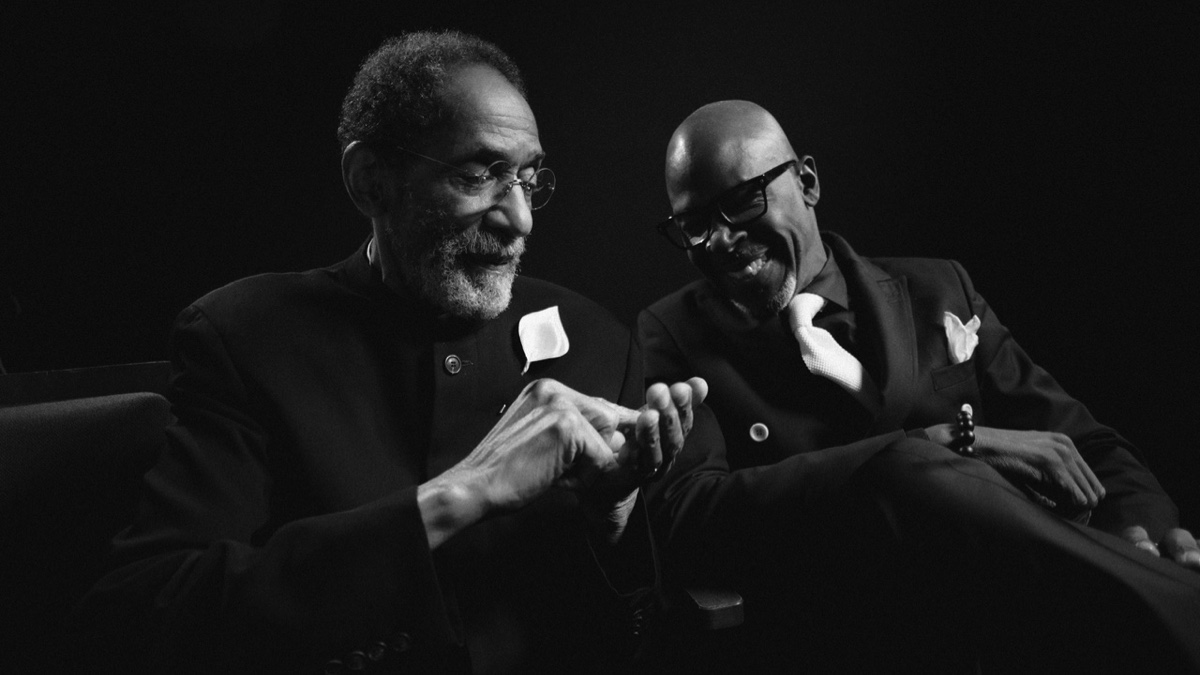
For more than six decades, the sound of the upright bass in modern jazz has carried the unmistakable authority, elegance, and intelligence of Ron Carter.

Recognized as the most recorded jazz bassist in history, Maestro Carter’s tone has become part of the very architecture of the genre.
From shaping the harmonic foundation behind countless landmark sessions to collaborating with many of the greatest jazz artists of our time, his artistry has both defined and expanded what the bass can be.
But beyond the staggering discography lies something even more enduring: dedication.
Maestro Carter has never stopped learning, never stopped refining, and never stopped listening. His commitment to excellence extends well beyond the stage and studio. As an educator and mentor, he has invested deeply in the next generation of bassists, setting a living example of discipline, curiosity, and musical integrity.
Now, in yet another inspired chapter of his extraordinary career, Maestro Carter joins forces with renowned choirmaster Ricky Dillard for a powerful gospel–jazz collaboration, Sweet Sweet Spirit, released February 6, 2026.

This project beautifully bridges sanctified soul and sophisticated swing, blending Carter’s masterful touch with Dillard’s uplifting choral brilliance.
The result is music that feels both reverent and rhythmically alive, deeply rooted, yet refreshingly expansive.
It is truly an honor to share this conversation with a living legend whose work continues to inspire musicians across genres and generations.
Here is Maestro Ron Carter.
Photo, Paul Rivera
Featured Videos:
Follow Online:
www.RonCarterJazz.com
www.facebook.com/RonCarterMusic
www.instagram.com/roncarterbassist/
x.com/RonCarterBass
www.youtube.com/@RonCarterBassist
www.threads.com/@roncarterbassist
www.tiktok.com/@roncarterjazz
imgur.com/user/RonCarterJazz/posts
www.tumblr.com/roncarterjazz
bsky.app/profile/roncarterjazz.com
open.spotify.com/artist/4wnzivx3OQ3vjrySAdTdJP?si=RUS946O4SpyHDD2ZI8-Y8Q
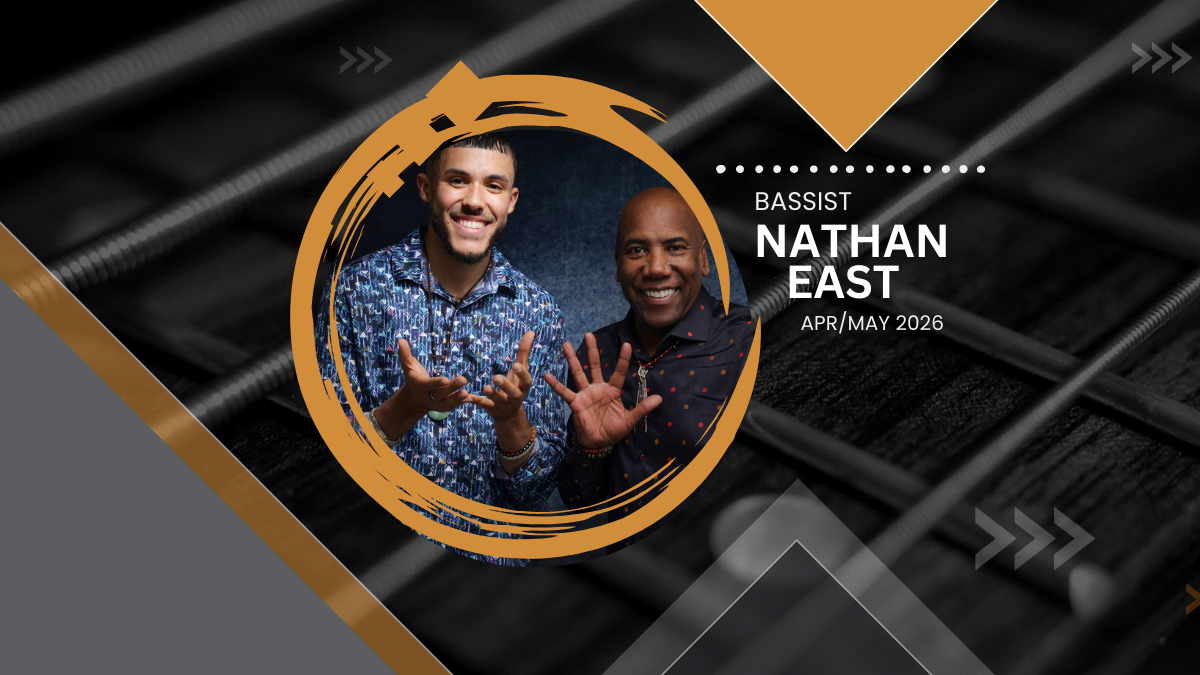
For decades, we’ve had the privilege of following the remarkable career of Nathan East, listening closely to his albums, tracking his milestones with Yamaha Instruments, and watching his evolving partnership with Laney Amplification with great interest. Along the way, we’ve talked gear, tone, and technique, while hearing his unmistakable musical “voice” woven into the work of more iconic artists than we could possibly list.

Today, we’re thrilled to reconnect with this true giant of the bass world following the release of a very special new album, Father Son, produced by Nathan alongside his son, Noah East. It’s a deeply personal project that showcases not only extraordinary musicianship but also a powerful family bond.
Join us as we dive into the making of this outstanding record, explore the new Laney Nathan East Signature Bass Preamp, and look ahead to what the future holds for one of music’s most respected and influential bassists.
Here is the one and only… Mr. Nathan East.
Photos, John Abbott @johnabbottphoto
Featured Videos:
Visit Online:
www.NathanEast.com
FB, IG, X, & YouTube @NathanEast
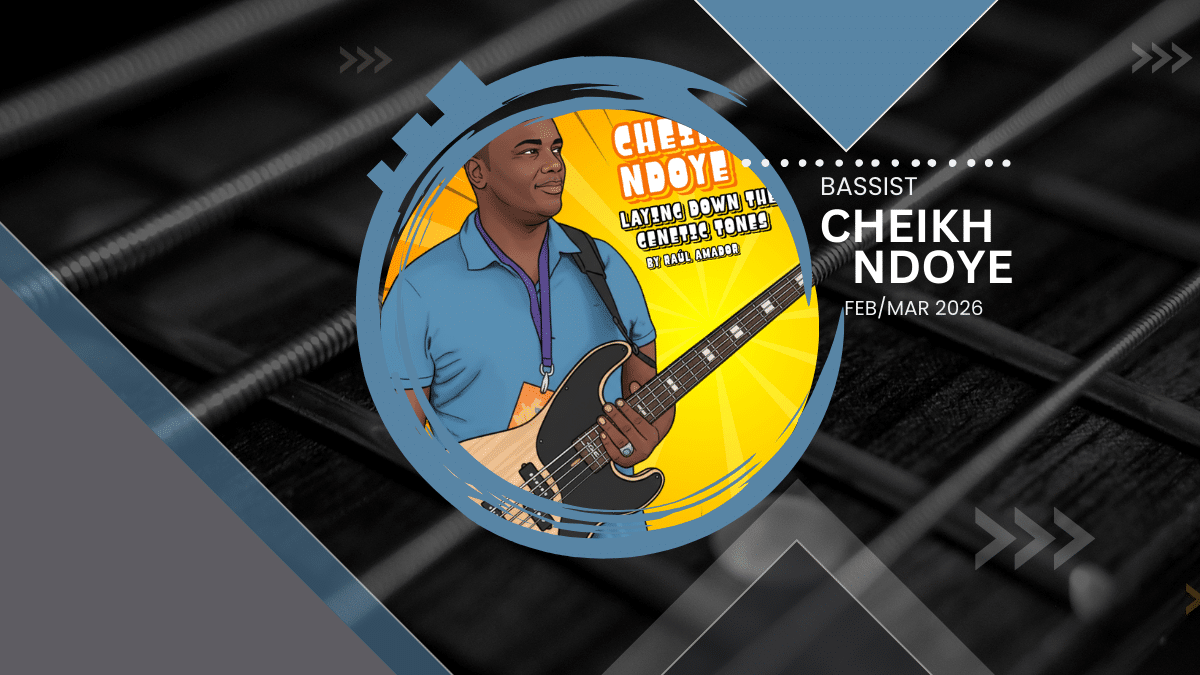
For nearly seventeen years, we’ve followed the ever-evolving journey of bassist Cheikh Ndoye, watching with admiration as his musical vision continues to deepen and expand. Each project has revealed a restless curiosity and a commitment to sound that resists easy categorization.

When we last spoke in 2018, Ndoye was already hinting at new directions, and he hasn’t slowed down since.
In the years that followed, he’s been quietly and intensely at work, culminating in a new album, Genetic Tones, a project that captures both his roots and his forward-looking approach to music.
I recently had the great pleasure of listening to several rough tracks from the album, and, as always, I was both impressed and genuinely excited by what I heard. Genetic Tones feels like a bold and thoughtful statement, rich in texture and intention. Join me as Cheikh shares insights into the making of this upcoming release and reflects on the ways his musical language has continued to transform over the years.
Photo Credits: Courtesy of Cheikh Ndoye and Courtesy of Aguilar Amplification
Featured Videos:
Visit Online:
IG @thegenetictones
tiktok.com/@cheikh.ndoye.the

This month, we have a real treat for all you metal fans out there! Joining us is none other than Pär Sundström, the powerhouse bassist and co-founding member of Sabaton, a band many consider to be the #1 global power metal act in the world.

Pär isn’t just the man behind those thunderous bass lines; he’s also one of the main lyricists and the band’s manager, helping to shape Sabaton’s unmistakable sound and unstoppable rise.
Hailing from Sweden, Sabaton has been conquering stages and hearts around the world for over twenty-five years, delivering their signature blend of history, heroism, and heavy metal might. And now, with the release of their brand-new album ‘Legends,’ the band is gearing up for a tour that promises to be absolutely spectacular.
We’re diving into all the details, from the making of Legends, to the evolution of Sabaton’s epic sound, to what lies ahead for this legendary band.
So, without further ado, let’s welcome the man himself… Pär Sundström!”
Photos: Jens De Vos (cover & interview photos), Ben Alexis (interview photos)
Featured Videos:
Templars”
“Hordes of Khan”
“The Duelist”
“Lightning at the Gates”
“Crossing The Rubicon”
(Featuring singer Jonny Hawkins and guitarist Mark Vollelunga of NOTHING MORE)
Visit Online:

I’m sure many of you will remember that I had the pleasure of chatting with Lettuce bassist Erick “Maverick” Coomes just last year, where we covered a ton of great material. (If you missed it, you can check out that interview here>>>bassmusicianmagazine.com.)

Now, with Lettuce on the verge of releasing their brand-new album Cook, I thought it was the perfect time to catch up with Erick and see what’s been cooking… pun definitely intended!
In this conversation, we dive into the new album and the videos that accompany it, explore Lettuce’s exciting collaboration with Aquila Cellars on their signature wines, and get a glimpse into what’s next for the band.
So sit back and enjoy… here’s Erick “Maverick” Coomes!
Cover Photo, Alex Varsa | Other Photos: HIllary Clinton, and Sam Silkworth
Featured Videos:
Visit Online:

Maestro Ron Carter, Sharing the Spirit – June/July 2026 Issue

New Music: Danielle Nicole, Tug Of War

Right Hand Technique Strategies with Dr. Randy Kertz

New Music: Golden Flower, Are You Even Awake?

Interview With Bassist Adam Russell
Right Hand Technique Strategies with Dr. Randy Kertz

April 6 Edition – This Week’s Top 10 Basses on Instagram
April 13 Edition – This Week’s Top 10 Basses on Instagram
20 April Edition – This Week’s Top 10 Basses on Instagram