
Latest
Adam Nitti Technique Series: Practicing With Chord Tones, Part 2: Navigating Changes

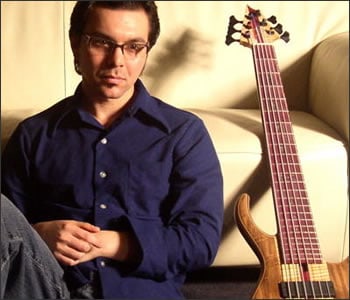
 Meet Adam Nitti –
In this installment, we are going to continue where we left off in part 1 by practicing over some more complex chord changes. For the exercises in this lesson, we are once again going to limit ourselves to the use of chord tones only. If you have so far been practicing your arpeggio forms and inversions over the entire range of the fingerboard, you should by now seeing some significant improvement in your ability to navigate the fingerboard while outlining harmony. I will present you with 3 new exercises in this lesson to practice improvising over using chord tones. Each of them is modeled after a popular jazz standard and represents common harmonic movement that you might encounter on a regular basis on jazz gigs.
Exercise 1 is a standard 12 bar jazz blues progression in F. An example of a tune that would contain changes like this would be “Straight, No Chaser.” The changes in exercise 2 are similar to the changes in the tune, “Tune Up.” Exercise 3 contains the identical chord changes to the tune, “Autumn Leaves.”
For each of these exercises, you will once again start by playing continuous swing 8th notes using chord tones only. As you will be faced with having to play through many more individual chords and modulations, it is absolutely critical that you look ahead as much as possible. In other words, keep your eyes moving ahead of the measure you are currently playing so that you are able to pre-meditate your position shifts and arrive at each chord change with accuracy and confidence. As we have done in the past with prior challenging exercises, start with very slow tempos and work into a comfort zone before kicking up the speed. For examples of how to play through each exercise, check out the accompanying videos.
exer 1: (Click to enlarge)

exer 2: (Click to enlarge)

exer 3: (Click to enlarge)

Obviously, once you get these progressions down you’ll want to move onto new challenges. One thing you can do to challenge yourself is to try playing tunes you know transposed to new keys. This is vitally important, because if you play the same changes over and over without any variation, your eyes will have a tendency to rely on the same visual cues on the fingerboard and you will find that you are not able to play as well in other keys. Ideally, you should practice playing through these exercises in all 12 keys. If that seems intimidating to you right now, start simpler by trying to improvise over a ii-V-I progression in all 12 keys.
Once you become proficient with controlling placement of chord tones, then you can go back to practicing in a less restrictive manner, for example using only chord tones 3, 5, or 7 on the downbeats of each chord change, and then completing your phrases using combinations of other scale tones or chromaticisms. This ‘chord-tone-boot camp’-like approach that I have shared with you in this lesson is primarily designed to make you much more aware of where the chord tones are found on the fingerboard. Ultimately this helps you to navigate harmonic motion better and will also help you to become a better foundational bassist, as well.
Until next time, keep on chord-toning!


Check out our top 10 favorite basses on Instagram this week…
Click to follow Bass Musician on Instagram @bassmusicianmag
FEATURED @pensacustomguitars @niklas_lukassen @malinoskiguitar @custom_painter @belforti.instruments @mubcustom @sebastiengavetguitars @carl_thompson_guitars @marleaux_bassguitars @wilcockbasses
Check out our top 10 favorite basses on Instagram this week…
Click to follow Bass Musician on Instagram @bassmusicianmag
FEATURED @hiltonguitars @olintobass @vortice.custom.guitars @cb_basses @belforti.instruments @acguitars.co.uk @basscentralofficial @michaeltobiasdesign @timsway1 @officialspector
Check out our top 10 favorite basses on Instagram this week…
Click to follow Bass Musician on Instagram @bassmusicianmag
FEATURED @didonatoguitars @brancoguitars @ja.guitars @lindoguitars @sawtooth_musical_instruments @pensacustomguitars @alpherinstruments @dtcbass @camazon_guitars @ebg_instruments
Check out our top 10 favorite basses on Instagram this week…
Click to follow Bass Musician on Instagram @bassmusicianmag
FEATURED @ja.guitars @mrrjackson @skjolddesign @karvanguitars @sireusaofficial @wonkorbasses @mihado_gs @odiengcustom @sirekorea @brute_bass_guitars
Check out our top 10 favorite basses on Instagram this week…
Click to follow Bass Musician on Instagram @bassmusicianmag
FEATURED @polarisbasses @daveswiftbass @ramabass.ok @officialibanezguitars @serek_basses @dacruzluthieria @alusonic @sadowskynyc @maruszczyk_instruments @pensacustomguitars

Artist Updated With The Revivalists’ Bassist George Gekas

Maestro Ron Carter, Sharing the Spirit – June/July 2026 Issue

New Music: Danielle Nicole, Tug Of War

Right Hand Technique Strategies with Dr. Randy Kertz

New Music: Golden Flower, Are You Even Awake?
Right Hand Technique Strategies with Dr. Randy Kertz

April 13 Edition – This Week’s Top 10 Basses on Instagram
April 27 Edition – This Week’s Top 10 Basses on Instagram
20 April Edition – This Week’s Top 10 Basses on Instagram