
Latest
Reel Ear Personal Ear Trainer – Review by Eric Parsons

 Reel Ear Personal Ear Trainer… What is music? There is obviously no one right answer to such a question. Some might spew out a rigid Webster’s definition while others may simply say “It’s my life” or “It’s what gets me through my day”. Music is amazing – it can be universally powerful; captivating and unify ing entire populations of people and yet it can also be painfully personal – who doesn’t have that one special song that evokes the ghosts of a lost love or some other treasured memory.
There are probalby as many opinions as to what music is as there are people. One point that we would all agree on is that music is something that we hear. The key point of this little discussion is that our ears are fundamental to our understanding and enjoyment of music – this fact can tend to get lost in the day-to-day life of the aspiring musician who is striving to learn music theory, harmony, phrasing, technique… the list is almost never ending. A trained musical ear provides a tremendous advantage, allowing a musician to easily tune their instrument, readily interact (jam) with other musicians, pick out melodies, chords and song structures by ear and become a fundamentally sound musician.
Overview
Reel Ear is a software progarm for musical ear training which was originally created for the Reel Space Music school in Valencia, Spain and is now being made available to the public.
Reel Ear was developed in an academic setting, and this lineage likely explains the spartan, yet practical, layout of the graphical interface. All of the parameters and settings can be accessed from the main page which makes Reel Ear a fairly easy program to navigate and learn. I used the qualifier “fairly” because there are some design features that were not readily apparent to me, thereby forcing me to read the provided manual before being comfortable with the operation of the program.
What sets Reel Ear apart from other ear training programs, of which there are many, is that Reel Ear uses a random melody and chord progression generator to train your ear. The thought behind this approach is that other programs often use prerecorded exercises which can be memorized by the user and thereby minimize the actual effectiveness of those training exercises. Reel Ear also has a large selection of user defined variables: pitch, key, scale, note duration, loop length, octave range, and chord structure to name a few.
Installation and Setup
Reel Ear was easily downloaded and installed on my system. It is designed to run on Windows XP, Vista and Windows 7 only. Reel Ear then requires the product to be licensed through the website for permanent installation. A manual is included as a separate document, and again, I strongly recommend that you take the time to read the manual first – it will clear up a lot of little questions. One example: there is no universally recognizable start or stop button in the software (like there is on a CD player) there is a button labelled “Paused” – this is actually the start button.
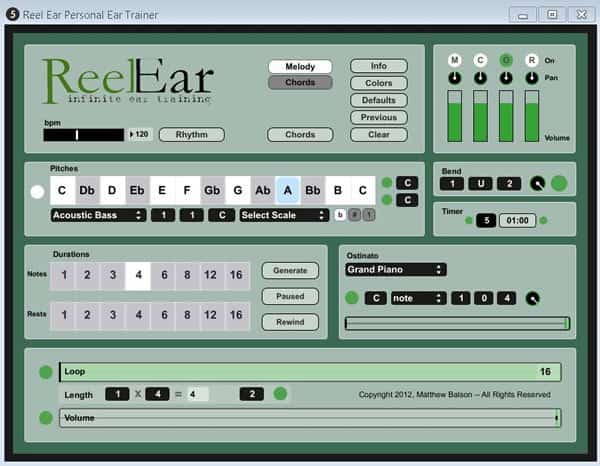
The main window in Reel Ear is divided into eight panels that contain the controls of all its functions.

Panel 1 : Basic settings
Panel 2: Pitches
Panel 3: Durations
Panel 4: Loops
Panel 5: Volume
Panel 6: Bends
Panel 7: Timer
Panel 8: Ostinato
In Use
For my initial trial, I selected an acoustic bass sound and hit play (I mean the paused button ) and… heard a pattern that sounded more like chimes than a bass. I glanced around and realized that the ” melody octave reset” default was set to ” 3″, I reset this to “1” which then gave me a nice sounding accoustic bass. After this, I was off and running. The program lets the user set tons of variables, such as key, scale, the start and stop note, duration of notes and rests, and loop length and number of repetitions.
In addition to interval and melody ear training, Reel Ear also has a section devoted to recognition and identification of various of chords. The user is again able to configure a number of variables: instrument sound, chord type, starting chord, ending chord, octave offset, etc.
In use, I find that Reel Ear is a very useful and effective tool for improving one’s musical ear. The variety of user definable variables really helps to keep the process both interesting and relevant to a users particular needs. The timer is a nice added touch, in that I would get so engrossed in the exercises that I didn’t realize how much time had passed!
Cost: $12.95
Website: reelear.com



Check out our top 10 favorite basses on Instagram this week…
Click to follow Bass Musician on Instagram @bassmusicianmag
FEATURED @hiltonguitars @olintobass @vortice.custom.guitars @cb_basses @belforti.instruments @acguitars.co.uk @basscentralofficial @michaeltobiasdesign @timsway1 @officialspector
Check out our top 10 favorite basses on Instagram this week…
Click to follow Bass Musician on Instagram @bassmusicianmag
FEATURED @didonatoguitars @brancoguitars @ja.guitars @lindoguitars @sawtooth_musical_instruments @pensacustomguitars @alpherinstruments @dtcbass @camazon_guitars @ebg_instruments
Check out our top 10 favorite basses on Instagram this week…
Click to follow Bass Musician on Instagram @bassmusicianmag
FEATURED @ja.guitars @mrrjackson @skjolddesign @karvanguitars @sireusaofficial @wonkorbasses @mihado_gs @odiengcustom @sirekorea @brute_bass_guitars
Check out our top 10 favorite basses on Instagram this week…
Click to follow Bass Musician on Instagram @bassmusicianmag
FEATURED @polarisbasses @daveswiftbass @ramabass.ok @officialibanezguitars @serek_basses @dacruzluthieria @alusonic @sadowskynyc @maruszczyk_instruments @pensacustomguitars
Check out our top 10 favorite basses on Instagram this week…
Click to follow Bass Musician on Instagram @bassmusicianmag
FEATURED @officialspector @alusonic @ariaguitars @stradiluthier @sandbergguitars @billysheehanonbass @offbeatguitar @colibriguitars @jens.ritter @overwaterbasses

Maestro Ron Carter, Sharing the Spirit – June/July 2026 Issue

New Music: Danielle Nicole, Tug Of War

Right Hand Technique Strategies with Dr. Randy Kertz

New Music: Golden Flower, Are You Even Awake?

Interview With Bassist Adam Russell
Right Hand Technique Strategies with Dr. Randy Kertz

April 6 Edition – This Week’s Top 10 Basses on Instagram
April 13 Edition – This Week’s Top 10 Basses on Instagram
20 April Edition – This Week’s Top 10 Basses on Instagram