
Gear Reviews
Nordstrand np4a and NJ4SV Pickups Review

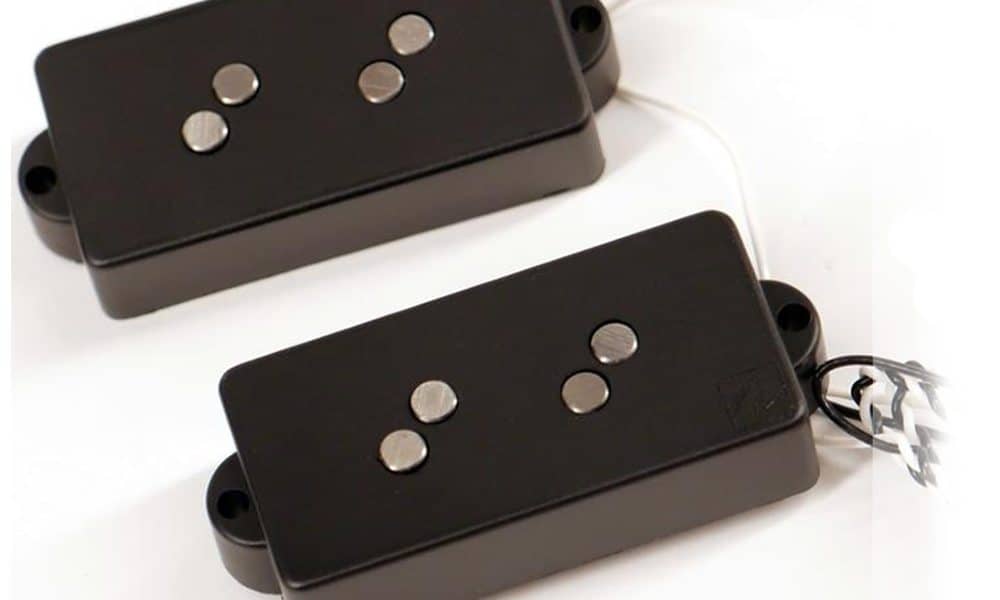
On the newer side from Nordstrand Pickups are the np4a and NJ4SV pickups.
The np4a is quite unique in that it takes the angled pole pieces that Nordstrand is so well known for and puts it in a classic style pickup. The np4a is a 4-string hum-canceling split coil pickup with two pole pieces for each string and is available with either alnico III V magnets.
THE NJ4SV pickups are 4-string vintage style single coil pickups and they are available only in Alnico V, based on the 60’s wind. As with the np4a, there are two pole pieces per string.
Installation for both the np4a and NJ4SV pickups was pretty straightforward, even if you have never replaced pickups in your bass.
That was the case with me, and while I was a little nervous about replacing my own pickups, it was actually quite easy. All you need is a little time, patience and some very basic tools such as a screwdriver and soldering iron. The soldering iron I used is a 40-watt one, which I picked up from my local hardware store and it did the job perfectly. Nordstrand provides accurate and easy to follow instructions and new screws for the pickups. The Nordstrand website also has pickup/preamp wiring and schematics as well as advice on how to choose the right pickup for your bass.
Both the np4a precision pickups and the NJ4SV jazz pickups sound absolutely stunning and were a definite upgrade from my stock pickups.
Both of the basses I used to test the pickups are passive and I noticed from the start that they produced more volume and clarity, sounding tighter, yet punchy and defined.
Nordstrand also produces a fine line of other pickups for precision, jazz, and has sets for PJ basses. They also have 3 and 2 band preamps as well as a 2 band music man style preamps, and for those bassists that also play guitar, Nordstrand offers guitar pickups too.
Find them at nordstrandaudio.com or a music retailer near you!


Disclaimer: This pedal was kindly provided by Valeton for the purpose of this review. However, this does not influence our opinions or the content of our reviews. We strive to provide honest, unbiased, and accurate assessments to ensure that our readers receive truthful and helpful information.
Two Paths to the Same Goal: Better Workflow, Real Control
Valeton’s GP series has followed a clear and consistent trajectory. The GP-5 introduced the core sound engine in an ultra-compact, app-driven format, proving that solid tones could exist in a minimal footprint, but at the cost of hands-on control. The GP-50 took a major step forward by adding onboard editing and a second footswitch, making the platform far more usable without relying on external devices.
With the GP-150 and GP-180, Valeton shifts the focus again, this time toward how players actually interact with their sound while playing.
These aren’t about reinventing the tone engine. They’re about making it more accessible, more flexible, and ultimately more musical in real-world use.
It’s also worth noting that while these pedals build on workflow ideas introduced in smaller GP units like the GP-5 and GP-50, the GP-150 and GP-180 are more closely related to the GP-100 platform, positioned as more complete, floorboard-style solutions rather than compact multi FX.
The Big Picture
Both the GP-150 and GP-180 share the same core foundation:
- 200+ effects
- NAM (Neural Amp Modeler) support
- IR loading (up to 20 files)
- 12-module fully flexible signal chain
- Looper (180 seconds) and drum machine
- USB audio interface and Bluetooth connectivity
- Built-in rechargeable battery
So in terms of sound and raw capability, they’re very similar.
The real difference comes down to workflow and control.
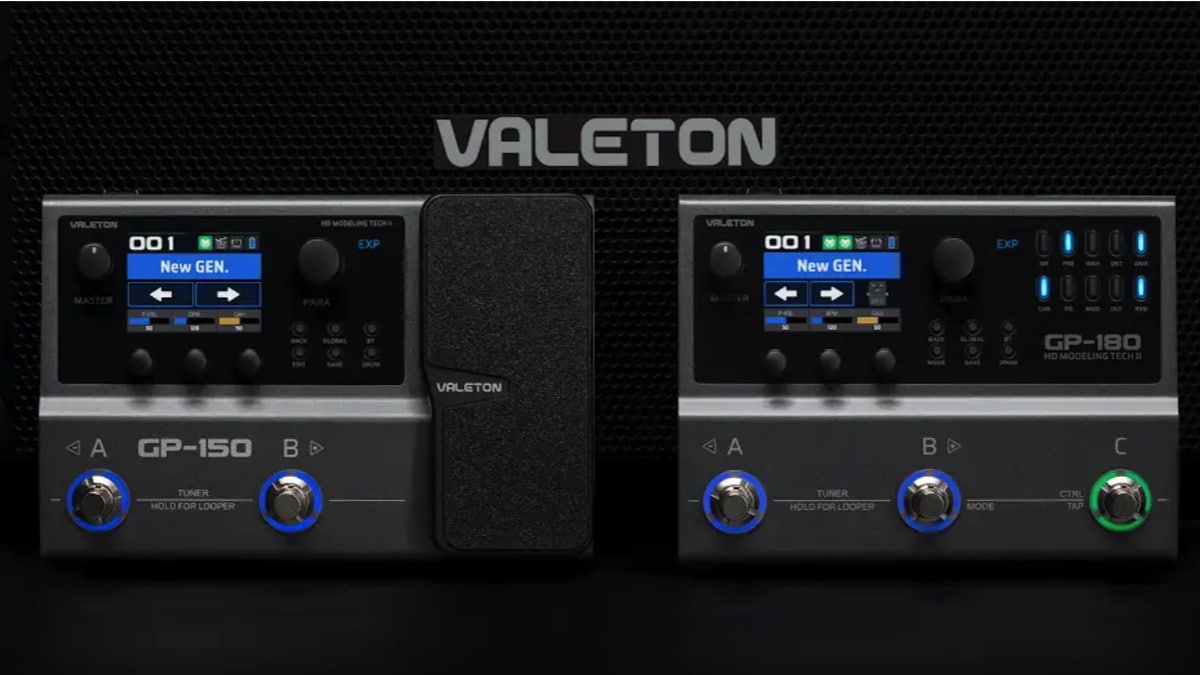
GP-150: Compact Rig with Real Expression

The GP-150 is where the platform starts to feel like a proper, self-contained rig.
The standout feature here is the built-in expression pedal. That alone changes how you use the unit. Instead of just switching presets or toggling effects, you can actively shape your sound in real time… volume swells, wah, parameter control… it’s all immediately available.
Combined with dual footswitches and onboard editing, the GP-150 strikes a strong balance
between portability and control. It carries forward the independence introduced in the GP-50,
but expands it into something more expressive and complete.
It’s especially appealing for players who want a minimal setup that still feels dynamic and
responsive.
GP-180: Hands-On Control, Pedalboard Feel

The GP-180 takes a different approach. Instead of adding expression, it doubles down on direct
control.
The addition of a third footswitch already makes navigation more natural, but the real shift
comes from the dedicated effect block buttons.
Each block has its own button, which lights up when active and can be toggled instantly. That
means you can turn distortion, delay, modulation, or reverb on and off with a single press—no
menu diving, no reassignment needed.
In practice, this makes the GP-180 feel much closer to a traditional pedalboard. You’re not just
switching presets, you’re interacting directly with your signal chain, something that wasn’t really possible with the more minimal GP-5 or even the GP-50.
For live use, that immediacy makes a big difference.
Tone & Real-World Use
Both units share the same sound engine lineage, and overall quality remains strong.
There are more effects available compared to earlier models, and the addition of NAM support
opens the door to more realistic amp tones and modern workflows.
One of the most noticeable improvements, particularly for bass players, is the octave tracking. Lower octave sounds are significantly tighter and more usable than in earlier GP units like the GP-5, making them far more practical in a mix. Higher octaves still feel a bit clunky, but the improvement where it matters most is clear.
In terms of real-world use, both pedals are flexible enough to cover practice, recording via USB, direct-to-PA live setups, and compact fly rigs.
That said, they cater to slightly different players.
Which One Should You Choose?
Go for the GP-150 if:
- You want a compact, all-in-one unit
- Expression control is important to your playing
- You prefer a streamlined setup with minimal footprint
Go for the GP-180 if:
- You play live and need faster, more direct control
- You prefer a pedalboard-style workflow
- You want to toggle effects individually rather than relying on presets
The GP-150 and GP-180 aren’t competing pedals; they’re two different interpretations of the same idea.
The GP-150 focuses on expression and portability, giving you a compact rig that still feels
dynamic and interactive, something that builds directly on the usability improvements
introduced after the GP-5.
The GP-180 focuses on control and immediacy, turning the GP platform into something that
feels much closer to a traditional pedalboard.
Both share the same solid tonal foundation, but they approach usability in different ways.
And that’s really what this generation of the GP series is about, not just sounding good, but
feeling right under your hands and feet.
Visit online at valeton.net/


Disclaimer: This bass strap was kindly provided by Italia Leather Straps for the purpose of this review. However, this does not influence our opinions or the content of our reviews. We strive to provide honest, unbiased, and accurate assessments to ensure that our readers receive truthful and helpful information.
I’ve spent years searching for the perfect wide bass strap, something that delivers both comfort and durability without compromising on style. That search ended nearly two decades ago when I discovered Italia Leather Straps.
Handcrafted in the USA from premium Italian leather, Italia Straps offers an impressive range of straps for both bass and guitar players. What immediately stood out to me was the exceptional craftsmanship; every detail, from stitching to material selection, reflects a commitment to quality. These aren’t just accessories… they’re long-term investments for serious musicians.
After more than 19 years of consistent use with my original strap, I can confidently speak to its longevity and comfort. Even under the demands of extended performances, the support provided by a 4” wide strap makes a noticeable difference.
In this review, I’m taking a closer look at the 4” Elite Series Leather Backed Bass Strap, now available in a sleek new Slate Black finish. It’s a refined addition to an already outstanding lineup, combining aesthetic appeal with the same trusted performance.
For more information, visit www.italiastraps.com.
Disclaimer: This pedal was kindly provided by Empress Effects for the purpose of this review. However, this does not influence our opinions or the content of our reviews. We strive to provide honest, unbiased, and accurate assessments to ensure that our readers receive truthful and helpful information.
ParaEQ… Precision tone shaping in a pedalboard-friendly format.
EQ pedals are often the unsung heroes of a bass rig. While overdrives and compressors tend to get most of the attention, a good EQ can completely transform how a bass sits in a mix. The Empress Effects Bass ParaEQ takes that idea much further, offering studio-style tone shaping in a rugged pedal designed specifically for bass players.
Based on the company’s well-known ParaEQ MKII Deluxe, the Bass ParaEQ adapts the concept for low-frequency instruments, delivering a powerful and flexible tool for dialing in everything from subtle tonal tweaks to major corrective EQ.
Built for bass
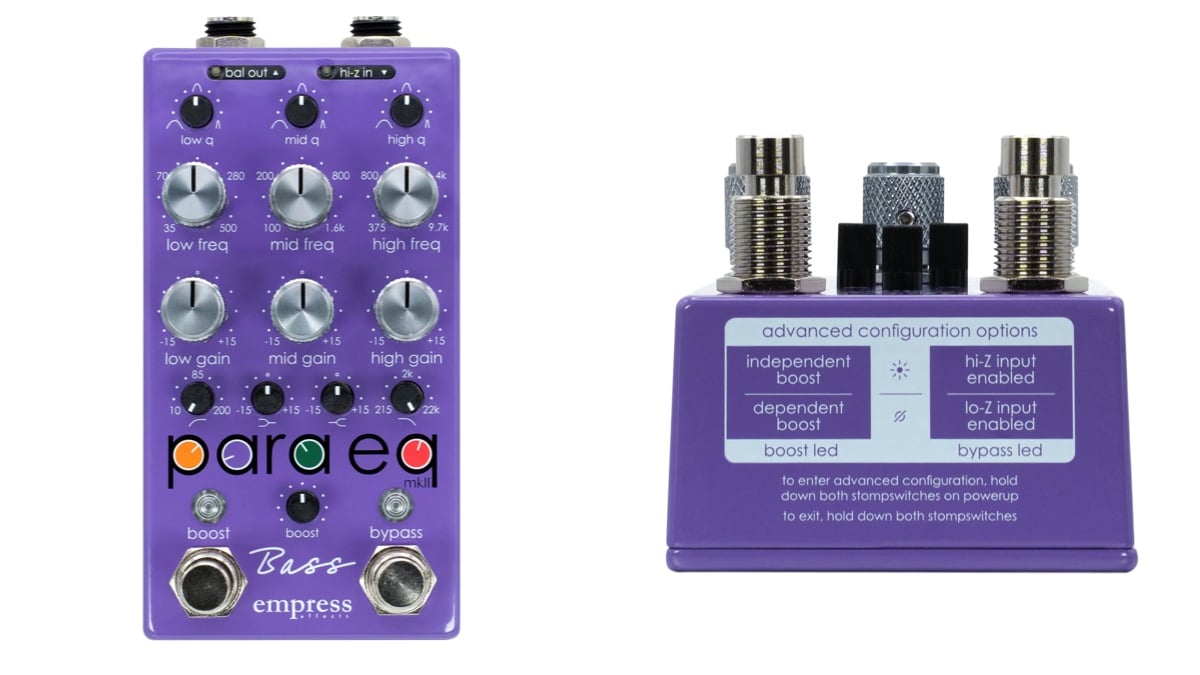
At its core, the Bass ParaEQ is a three-band parametric equalizer, meaning each band allows you to select the frequency you want to adjust, how much you want to boost or cut it, and how wide the adjustment should be. For bass players, this level of control can make a huge difference when trying to solve real-world tone problems.
In addition to the three parametric bands, the pedal includes a low-shelf and high-shelf EQ, along with high-pass and low-pass filters. Together, these controls allow you to shape everything from deep sub-bass to the upper harmonics of the instrument.
The controls are laid out clearly on the pedal, and while there are quite a few knobs, the layout remains intuitive once you spend a little time with it. Each parametric band offers frequency selection, boost or cut of up to ±15 dB, and a Q control that adjusts the bandwidth of the EQ band.
Another thoughtful feature is the selectable input impedance. The standard 1M? input works perfectly with most electric basses, while a 10M? high-impedance mode is available for instruments with piezo pickups, making the pedal particularly useful for upright bass players.
Massive headroom and clean performance
One of the technical highlights of the Bass ParaEQ is its 27-volt internal operation. Although the pedal runs on a standard 9-volt power supply, the internal circuitry steps that voltage up to 27 volts, providing enormous headroom. In practical terms, this means the pedal remains exceptionally clean even when applying large EQ boosts.
This extra headroom is especially noticeable when boosting low frequencies, where many EQ pedals can start to sound strained or compressed. The Bass ParaEQ handles these boosts effortlessly, maintaining clarity and punch across the entire frequency range.
The pedal also includes a foot-switchable boost capable of delivering up to 30 dB of clean level increase. This feature turns the ParaEQ into more than just a tone-shaping tool. It can also function as a volume boost for solos, a way to match output levels between instruments, or even a clean gain stage to push an amplifier slightly harder.
Real-world performance
In real-world playing situations, the Bass ParaEQ quickly proves its value. One of its biggest strengths is how easily it can adapt to different instruments and environments.
For example, during a recent gig, I used the pedal while switching between an active Jazz bass and a passive bass with flatwound strings. The active bass had a fairly aggressive top end that tended to jump out in the mix. With the ParaEQ, it was easy to smooth that out by slightly trimming the upper mids and rolling off some of the extreme highs.
The passive bass, on the other hand, benefited from a small boost in the presence range, helping it cut through the band without losing its warm character. Instead of constantly adjusting the amp between songs, the ParaEQ handled those changes instantly.
The pedal is equally useful for addressing common live sound issues. A quick adjustment can tighten up muddy low mids, add clarity to a dull stage tone, or remove problematic resonances that appear in certain venues.
Versatility for stage and studio
While the Bass ParaEQ is incredibly useful in live settings, it also shines in the studio. Engineers frequently use parametric EQ to shape bass tones during mixing, and having this level of control directly on the pedalboard allows players to dial in a more refined sound before the signal even reaches the recording chain.
The combination of parametric bands, shelving filters, and high-pass and low-pass filters makes the pedal capable of handling a wide range of tonal adjustments. Whether the goal is tightening the low end, adding articulation, or smoothing out harsh frequencies, the ParaEQ delivers precise results without altering the natural character of the instrument.
Final thoughts
The Empress Effects Bass ParaEQ is not your typical EQ pedal. With its parametric controls, extensive filtering options, and massive internal headroom, it offers a level of precision more commonly found in studio equipment than on a pedalboard.
For bassists who want deeper control over their tone—or simply a reliable way to handle the tonal challenges of different rooms, instruments, and mixes—the Bass ParaEQ is an incredibly powerful tool. It may require a little more understanding than a simple three-band EQ, but the payoff in flexibility and sound quality makes it one of the most capable EQ pedals available today.
Visit online at empresseffects.com/

Valeton GP-50… Compact Power with Real-World Control
Disclaimer: This pedal was kindly provided by Valeton for the purpose of this review. However, this does not influence our opinions or the content of our reviews. We strive to provide honest, unbiased, and accurate assessments to ensure that our readers receive truthful and helpful information.
Valeton continues to refine its compact multi-effects platform, and the GP-50 represents a significant step forward from the GP-5. Rather than chasing extreme miniaturization, Valeton focused on improving control, connectivity, and independence, areas that matter most to working musicians. The result is a compact processor that feels genuinely usable in rehearsal, studio, and live environments.
At its core, the GP-50 builds on the same modeling engine that made the GP-5 appealing, but expands it in meaningful ways that greatly improve workflow and performance flexibility.
Design & Build
The GP-50 is housed in a rugged metal chassis and remains lightweight and travel-friendly despite its added functionality. One of its most practical features is the internal rechargeable battery, which allows for cable-free practice, fly gigs, and mobile setups without sacrificing reliability.
This is a pedal clearly designed with modern bassists in mind—portable, durable, and adaptable.
Control & Editing
One of the GP-50’s most important upgrades is onboard editing. Unlike the GP-5, which relied entirely on a companion app for sound creation, the GP-50 allows players to edit amp models, effects, and signal chains directly from the pedal. This makes it far more practical in live and rehearsal situations where quick adjustments are essential.
The Valeton app is still available and useful for deeper patch organization, but it is no longer required for day-to-day operation.
Dual Footswitch Advantage
The addition of a second footswitch dramatically improves usability. Preset changes, effect toggling, and tap tempo can all be handled directly from the unit, eliminating the need for an external MIDI controller in many scenarios.
For bassists who want a compact rig that can handle real performance demands, this change alone makes the GP-50 far more viable on stage.
Sound Quality
The GP-50 delivers solid amp modeling, responsive dynamics, and a wide selection of usable effects. Drives retain low-end integrity, modulation effects are clean and musical, and delays and reverbs are well-suited for both subtle enhancement and more ambient textures.
IR loading further expands tonal flexibility, making the GP-50 suitable for direct-to-PA setups, recording, and silent practice. With quality IRs, the unit produces polished, professional results well beyond what its size might suggest.
Connectivity & Features
Expanded input and output options make the GP-50 easy to integrate into a variety of bass rigs, whether running into an amp, FRFR system, or audio interface. USB audio functionality allows it to double as a recording interface, adding further value for home studios and content creation.
Additional tools such as the onboard tuner and rechargeable battery round out a feature set that feels thoughtfully designed rather than excessive.
Final Thoughts
The Valeton GP-50 is a clear evolution of the GP-5, addressing its limitations while preserving its strengths. With onboard editing, dual footswitch control, expanded I/O, and battery power, it moves beyond “compact practice pedal” territory and into legitimate all-in-one rig status.
For bassists seeking a portable, affordable, and capable multi-effects solution that doesn’t compromise on control or tone, the GP-50 stands out as one of the most practical options currently available in its class.
The Valeton GP-50 is available online at Amazon.com

Disclaimer: This equipment was kindly provided by IK Multimedia for the purpose of this review. However, this does not influence our opinions or the content of our reviews. We strive to provide honest, unbiased, and accurate assessments to ensure that our readers receive truthful and helpful information.
Context and Intent
Portable practice and recording solutions have become increasingly sophisticated, but bass players are often left navigating tools primarily designed with guitar in mind. The TONEX Plug positions itself as a compact, headphone-based tone device powered by IK Multimedia’s AI Machine Modeling technology, offering access to a massive library of amp, cabinet, and pedal captures. While its size and design clearly point toward convenience and mobility, the real question for bassists is whether it can deliver convincing low-end response and dynamic feel in a format this small.
After spending time with the TONEX Plug in practice, writing, and recording situations, it became clear that this is not a novelty device, but rather a focused tool designed for specific use cases where portability and tone quality need to coexist.
Design and Connectivity
Physically, the TONEX Plug is about as minimal as a tone device can get. It plugs directly into the instrument, routes audio to headphones, and connects via Bluetooth to a companion app for deeper control. USB-C connectivity allows it to function as an audio interface for direct recording, which immediately expands its usefulness beyond simple practice.
The trade-off for this level of portability is a reliance on software for most editing. Hardware controls are intentionally sparse, but given the form factor, this feels like a practical compromise rather than a limitation. Once presets are loaded, the device can be used entirely on its own, making it easy to grab and play without additional setup.
Tone and Low-End Performance
For bass players, low-frequency integrity is the ultimate benchmark. In use, the TONEX Plug performs better than its size might suggest. Clean tones retain weight and depth, with a solid fundamental that doesn’t feel artificially hyped or rolled off. Dynamic response is particularly noteworthy; variations in touch and attack translate naturally, which goes a long way toward making the experience feel musical rather than clinical.
Driven tones also hold together well, provided the selected models are appropriate for bass. As with any modelling platform, the quality of the tone depends heavily on the source capture. Bass-oriented models deliver convincing results, while guitar-focused captures may require EQ adjustment or filtering to sit properly in the low register.
AI Modeling and Tone Library
The defining feature of the TONEX ecosystem is its AI Machine Modeling engine, which allows real-world rigs to be captured and reproduced digitally. Through the companion app, users can access an enormous library of tone models created by both the manufacturer and the broader user community. For bassists, this means exposure to a wide range of classic and modern bass amp tones without owning the physical gear.
Navigating such a large library takes time, and curation is essential. Once a set of reliable bass presets is identified and stored on the device, the experience becomes far more immediate. The ability to switch between markedly different tones with minimal effort is one of the TONEX Plug’s strongest creative advantages.
Onboard Processing and Practice Tools
In addition to amp and rig modeling, the TONEX Plug includes onboard EQ, compression, noise gating, modulation, delay, and reverb, all adjustable via the app. For bass practice, the compressor and EQ are especially useful, allowing players to shape articulation and control dynamics without external pedals or plugins.
A built-in tuner and metronome reinforce the device’s role as a complete practice solution. Bluetooth audio streaming further enhances this, making it easy to play along with backing tracks, lessons, or recordings directly from a mobile device.
Recording and Creative Use
As a recording tool, the TONEX Plug functions well within its intended scope. Acting as a USB-C audio interface, it allows bass parts to be tracked quickly into a DAW, making it ideal for songwriting, demos, and mobile recording setups. While it is not a replacement for a full studio interface, it offers more than enough quality for capturing ideas and producing usable tracks.
The immediacy of the device encourages experimentation. Being able to audition different amp characters and effects chains without reconfiguring hardware makes it easier to explore new tonal directions, which is particularly valuable during the writing process.
Final Assessment
The TONEX Plug is not designed to replace a traditional bass rig, nor does it attempt to. Instead, it excels as a focused tool for silent practice, mobile playing, and quick recording, delivering tone quality that far exceeds expectations for its size. From a bass player’s perspective, its ability to preserve low-end depth and dynamic feel is what ultimately sets it apart from simpler headphone amps.
For bassists who practice frequently with headphones, travel often, or work in compact recording environments, the TONEX Plug offers a compelling blend of portability and sonic credibility. It fits neatly into the modern bassist’s toolkit as a practical, inspiring solution that respects the demands of low-frequency instruments.
For more information, visit online at ikmultimedia.com/

Nathan East, Echoes of a Lineage – April/May 2026 Issue

Gear Review: Italia Leather Straps

New Album: Oteil Burbridge & Lamar Williams, The Offering

Interview With Bassist Tom Doyle

Interview With Bassist Alex Blake

Feb 16 Edition – This Week’s Top 10 Basses on Instagram
Feb 23 Edition – This Week’s Top 10 Basses on Instagram
Mar 2 Edition – This Week’s Top 10 Basses on Instagram
Mar 9 Edition – This Week’s Top 10 Basses on Instagram