
Bass Gear Guide
Best Guitar Cables for Bass: Try These Instrument Cables Now

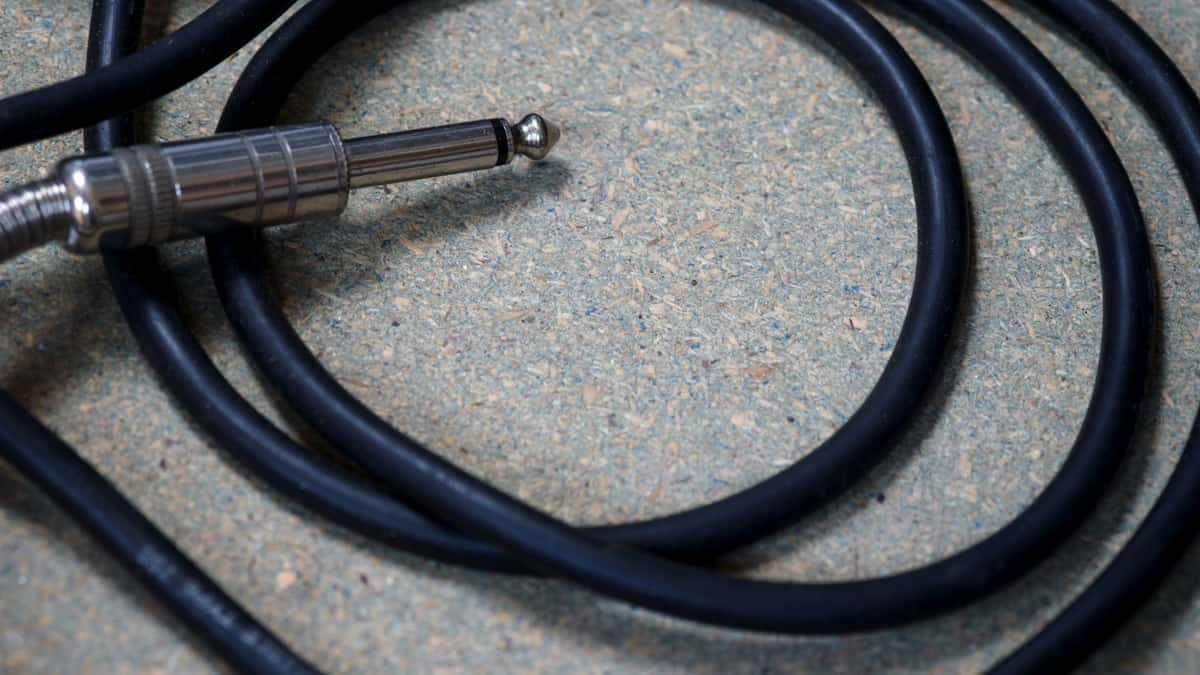
The Best Guitar Cables / Instrument Cables for Bass Players…
Guitar cables and instrument cables may not be the flashiest part of your rig, but they undoubtedly do the behind-the-scenes work and are a critical and often overlooked link in your sound chain.
While players are always looking for the perfect bass and amp, often going to great lengths to find the best design, woods, weight, and wattage, they often overlook instrument cables.
Over the years we have had the opportunity to test out cables, as well as talk with many bass players about their gear, including the types of instrument cables they use to get their sound. Our ‘best of’ list comes from those conversations and in-house tests.
[su_content_slide class=””]Here is our current ‘best of’ guitar cables / instrument cables for bass:
Asterope

We had the pleasure of interviewing Asterope’s Dariush Rad, the President and CEO of Asterope Premium Audio Cables. This guy KNOWS his stuff! In the video, Dariush shared information on signal optimization and the scientific details that go into the Asterope line.
Check out bassist Derek Jones review of the Asterope Cables!
Asterope MI and Pro Audio cables feature unique technology that delivers unsurpassed performance, with an aesthetic and rugged design. All audio cables are built with a unique architectural structure, are made with extremely pure conductive materials, and undergo a series of proprietary processes to reduce the overall noise bed created by “arcing“. These unique designs, materials, and processes help maximize signal inductance and the fluidity of electron flow, preserving the integrity of the data (sonic) packets being delivered by the wire.
VISIT >>>> asterope.com
Tsunami

If you don’t know Keith Stickney, owner of Tsunami Cables, you need to! We have covered Tsunami extensively over the years and know that Keith is a great guy who builds a VERY solid product, including custom options.
Tsunami Cables are designed to eliminate the need for having two sets of audio cables (an industry standard). Using a cable for studio recording and another for the road. Our cables are designed to handle both the road and the studio.
VISIT >>>> tsunami-cables.square.site
Rattlesnake Cable Company

We had the opportunity to cover Rattlesnake at the 2020 Winter NAMM show. They take pride that their cables are milled in the United States and are hand assembled in Missoula, Montana.
Founder Hank Donovan, “I hate cables that tend to be noisy due to poor shielding or worse, cease to work due to the shielding being weak or easily broken. The cables we use have a strong heavily braided copper shielding with 95% coverage. This makes the cable super heavy duty… and quiet!”
VISIT >>>> rattlesnakecables.com
Cordial Cables

We recently had the pleasure of doing a video interview with “Ace of Cups” Bassist Denise Kaufman, who sang the praises of Cordial Cables. Andrew Gouche is also an endorsee, “When I use Cordial cables, I hear my sound. Trust me, you’ll hear yours like never before!”
All CORDIAL cables are custom designed. The technical design of the individual cable types and the choice of materials react, for example, to the rigors of everyday stage work to the same degree as the high-end demands of recording studios.
VISIT >>>> cordial-cables.com
Analysis Plus
Analysis Plus endorsee and ERB artist Igor Saavedra, who uses the Pro Oval Studio, Power Oval 2 and Silver Oval.
Founded in 1992, Analysis Plus is a scientific research and design company now focused primarily on two markets: Music and Pro Audio industries and high-end Home Audio.
VISIT >>>> analysis.plus
More Guitar Cables for Bass on Our Radar
Phil Jones Bass
The PJB BI-12 Shielded Bass Cable has not only one shielded cable but three. By the combination of carefully chosen materials such as 99.999% oxygen-free pure copper and PTFE die-electric insulation, the BI-12 unleashes the true tone from your bass and gives you a whole new experience. The PJB 4′ Speaker Cable (SS-4) has the lowest possible internal resistance for efficient power transfer.
VISIT >>>> pjbworld.com
Lava Cable
GREAT back-story… Lava Cable creator and founder Mark Stoddard deployed to Afghanistan with a U.S. Army Special Forces Battalion as a Detachment Commander within weeks of forming his new company in June 2004. Excited about getting his business up and running, he took a roll of Canare GS-6 cable, and some Neutrik plugs into combat with him, making cables for his fellow soldiers and the local Morale, Welfare and Recreation center in his off-time.
VISIT >>>> lavacable.com
SpectraFlex
Spectraflex Cables are the “Original Braided Cables” used by musicians the world over. The rugged, high-quality nylon braiding is there for a reason: It protects and enhances the performance of the cable’s internal components while preventing tangles and adding flexibility.
VISIT >>>> spectraflex.com
Canary Cables
Canary Cables took the #9 spot in The Guitar World Magazine 2020 Best Cables List
VISIT >>>> canarycables.com
RapcoHorizon Guitar Cables
RapcoHorizon products provide optimal flexibility and premium performance as well as a state-of-the-art Custom Shop to modify existing products or build new devices to meet any need.
VISIT >>>> rapcohorizon.com
Pig Hog
Established in 2011, Pig Hog is crafted by musicians, for musicians. To date, they offer over 200+ cables, adapters, and accessories.
VISIT >>>> pighogcables.com
Solcor Guitar Cables
We were introduced to Solcor at Winter NAMM 2020. Solcor was founded in 1986 and is located in Mexico City. In 1995 they entered the music business, being one of the pioneers in the manufacture of cables for musical instruments, microphones, patches, etc.
VISIT >>>> solcoraudio.com
Shnoor Cables and Connectors
Developed and assembled in Russia, Shnoor promotes its outstanding sound transmission, using high-quality copper conductors with a 99,97% purity and low capacitance.
VISIT >>>> myshnoor.com
Mogami Cables
Mogami Overdrive, Platinum, Gold, CorePlus and Silver Cables are trusted by music professionals worldwide.
VISIT >>>> mogamicable.com
George L’s
George L’s cables have been honored by every major publication in the music industry and continue to win numerous awards.
VISIT >>>> georgelsstore.com
Evidence Audio
Evidence Audio™ was founded in 1997 by Tony Farinella to offer the finest Musical Instrument and studio cables available.
VISIT >>>> evidenceaudio.com
GLS Audio
GLS Audio, and its parent company, Orange County Speaker, are proudly family owned and operated by the Sunda Family.
VISIT >>>> glsaudio.com
We hope this guitar cables / instrument cables guide helped in your quest for finding your unique sound.
View More Bass Musician Gear Guides


Simple routines that keep your bass sounding great, plus gear that works as hard as you do
How to Keep Your Bass Rig Tight and Tone Ready
I’ve been around stringed instruments since I was a kid (yes, there were a few early accordion years, but let’s skip that chapter for now). One thing I’ve learned is that taking care of your gear is non-negotiable if you want it to feel and sound its best. For example, living in Las Vegas, the dry heat and long summer days are brutal on my basses and guitars, so I rely on humidifiers to keep them happy and hydrated. It’s a small step and investment that keeps my tone consistent, action smooth, and my instruments looking sharp.
Why Regular Bass Maintenance Matters
Basses may feel tough on stage, but sweat, grime, and environmental stress are always working against you. Left unchecked, corrosion hits your hardware, gunk builds up on the fretboard, and wood can dry out or warp. A consistent maintenance routine protects your investment and keeps your bass ready every time you play.
Proven Bass Care Routine That Works
Here’s a simple routine I use and recommend to anyone serious about their bass:
Clean the fretboard and body
Wipe away sweat, oils, and dust after every session. I keep a couple of microfiber and flannel cloths on hand for quick touch-ups.
Condition the fretboard
Natural woods like rosewood and ebony dry out over time, especially in a climate like mine. A light coat of fretboard oil keeps them from cracking.
Protect your strings
Keeping strings clean and lightly lubricated extends life and keeps them smooth under your fingers.
Support your bass during maintenance
A work mat or cradle makes setups and string changes easier and safer for your instrument.
Keep humidity in check
In Las Vegas, a dry day can wreak havoc on your bass. I rely on a case humidifier for every instrument. It keeps wood stable, necks straight, and finishes looking great.
Optional tools for deeper care
For those who like to get hands-on with frets or nuts, there are specialized kits for refinements:
Why These Changes Matter
Consistency is everything. A few minutes of care after each session prevents grime, corrosion, and damage from sneaking up on you. Using the right tools makes the process quick and worry-free. You spend a lot of time getting your sound right; maintenance ensures your bass never misses a note.
Real Player Perspective
Touring bassists and techs will tell you small habits add up fast. One tech told me that players who spend a few minutes each day caring for their bass rarely come back for major repairs. These routines and tools make it simple to keep your bass ready for gigs, sessions, or just jamming at home.
Music Nomad happens to be one of our supporting brands, but I only write about gear I actually use and trust. This article is my honest take.
Bass Gear Guide
The Best Fender Bass for Every Budget… From First Bass to Pro-Level Workhorse (With Chart!)
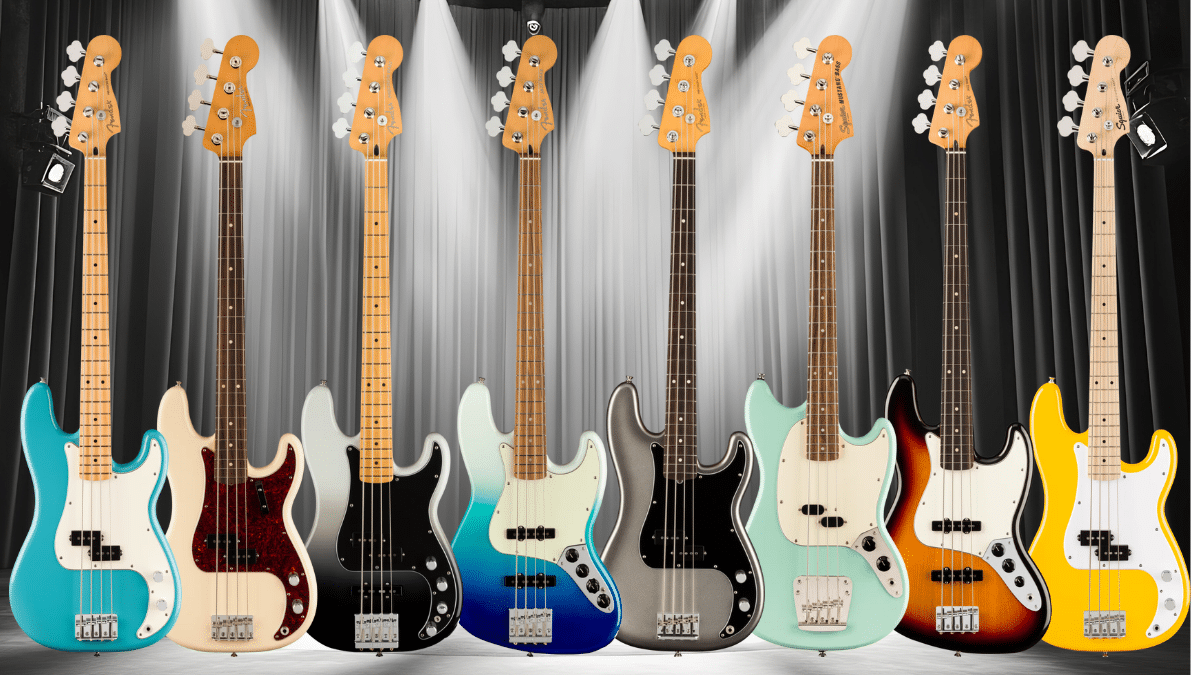
Check out the Fender Bass chart at the end of this article!
Table of contents
- If there’s one name that shows up again and again in bass history, studio sessions, and live stages around the world, it’s Fender.
- Which Fender bass actually makes sense for you and your budget?
- Best Fender Bass for Beginners: Player Series Precision or Jazz Bass
- Best Fender Bass for Intermediate Players: Player Plus Series
- Best Fender Bass for Vintage Tone on a Budget: Vintera Series
- Best Fender Bass for Working Pros: American Professional II Series
- Best Fender Bass on a Tight Budget: Squier by Fender
- Fender Bass Comparison Table
- So… Which Fender Bass Should You Choose?
If there’s one name that shows up again and again in bass history, studio sessions, and live stages around the world, it’s Fender.
From beginners buying their very first instrument to touring pros who rely on the same bass night after night, Fender basses have a reputation for being reliable, familiar, and easy to love. They show up everywhere…on classic recordings, in modern studios, and on stages of every size. But with so many models (and price points), the real question becomes…
Which Fender bass actually makes sense for you and your budget?
Let’s break it down… no hype, no sales pitch… just real-world guidance for bass players.
Best Fender Bass for Beginners: Player Series Precision or Jazz Bass
If you’re new to bass, here’s the good news… you don’t need anything fancy to get great tone.
The Fender Player Series is often the best place to start. These basses are made in Mexico and deliver classic Fender feel without the sticker shock of American-made models.
The big decision comes down to this:
Precision Bass: One pickup. Simple controls. Thick, punchy tone. If you’re into rock, punk, worship, or blues, the P Bass just works.
VIEW >>> Fender Player II Precision Bass
Jazz Bass: Slimmer neck. Two pickups. More tonal flexibility. Great for funk, jazz, pop, or slap-heavy playing.
VIEW >>> Fender Player II Jazz Bass
Why beginners love them:
- Comfortable necks
- Familiar Fender tone
- Easy to resell or upgrade later
Best Fender Bass for Intermediate Players: Player Plus Series
Once you’ve been playing for a while, you start noticing things like:
- How your bass sits in the mix.
- How flexible the tone controls are.
- Whether your instrument can handle different gigs without fighting you.
That’s where the Fender Player Plus Series comes in.
These basses take everything players like about the Player Series and push it a step further with:
- Active electronics
- Noiseless pickups
- Sleeker, more modern neck profiles
If you’re juggling rehearsals, gigs, recording sessions, or worship services, Player Plus basses give you extra tonal control without losing that familiar Fender vibe.
VIEW >>> Fender Player Plus Active Precision Bass
VIEW >>> Fender Player Plus Active Jazz Bass
Why intermediate players upgrade to Player Plus:
- More tone-shaping options
- Cleaner sound in noisy environments
- Great balance of price and performance
Best Fender Bass for Vintage Tone on a Budget: Vintera Series
Love old-school Fender tone but don’t love vintage price tags? You’re not alone.
The Fender Vintera Series is designed to capture specific eras of Fender history… right down to pickup voicing, neck shapes, and visual details.
These basses are ideal if you’re chasing:
- Classic rock warmth
- Motown-style thump
- Early funk or soul tones
VIEW >>> Fender Vintera II ’60s Precision Bass
(For Jazz Bass fans, additional Vintera Jazz models can be found via Fender’s Jazz Bass collection.)
They feel a little different under the fingers than modern Fender basses… and for many players, that’s the whole point.
Why players love Vintera models:
- Authentic vintage vibe
- Passive electronics
- Big tone without collector pricing
Best Fender Bass for Working Pros: American Professional II Series
If your bass is part of your livelihood, consistency matters.
The Fender American Professional II series is built for players who gig regularly, record often, or tour hard. These basses are made in the USA and feel refined without being flashy.
You’ll notice:
- Comfortable “Deep C” neck profiles
- V-Mod II pickups with clarity and punch
- Excellent fit and finish across the board
VIEW >>> American Professional II Precision Bass
VIEW >>> American Professional II Jazz Bass Collection
These are basses you can pull out of the case and trust… night after night.
Why pros rely on them:
- Studio-ready tone
- Road-tested durability
- Long-term value
Best Fender Bass on a Tight Budget: Squier by Fender
Not every bassist wants to spend thousands on an instrument, and you don’t have to.
Squier by Fender, especially the Classic Vibe Series, has come a long way. These basses are affordable, playable, and sound far better than their price suggests.
They’re great for:
- Beginners on a tight budget
- Backup basses
- Modding projects
VIEW >>> Squier Electric Basses (Classic Vibe Precision & Jazz)
Why Squier still gets love:
- Incredible bang for the buck
- Classic Fender designs
- Perfect “first Fender” experience
Fender Bass Comparison Table
| Model | Best For | Key Features | Why Players Choose It | Link |
|---|---|---|---|---|
| Player II Precision Bass | Beginners, rock & blues players | Passive pickup, simple controls, classic P-Bass tone | Easy to play, sits perfectly in a mix | View on Fender |
| Player II Jazz Bass | Funk, jazz, pop, slap styles | Dual pickups, slimmer neck, tonal flexibility | More tone options, fast neck feel | View on Fender |
| Player Plus Active Precision Bass | Gigging & intermediate players | Active electronics, noiseless pickups | More control across different venues | View on Fender |
| Player Plus Active Jazz Bass | Versatile, modern bassists | Active EQ, noiseless Jazz pickups | Clean tone with extra shaping options | View on Fender |
| Vintera II ’60s Precision Bass | Vintage tone lovers | Era-correct pickups, vintage neck feel | Classic sound without vintage prices | View on Fender |
| American Professional II Precision Bass | Working professionals | USA-made, V-Mod II pickups, premium hardware | Reliable, studio-ready, tour-worthy | View on Fender |
| Squier Classic Vibe Series | Budget-conscious players | Classic Fender designs, affordable pricing | Great tone at a beginner-friendly price | View on Fender |
So… Which Fender Bass Should You Choose?
Here’s the short version:
- Just starting out? Player Series
- Gigging regularly? Player Plus or American Pro II
- Chasing vintage tone? Vintera Series
- On a budget? Squier Classic Vibe
The best Fender bass isn’t about spending the most money… It’s about finding the instrument that fits your hands, your ears, and your goals as a bass player.

Revered bassist Dylan Desmond, known for his work with the critically acclaimed doom metal band BELL WITCH, has reunited with fellow doom act AERIAL RUIN for their second collaborative release, Stygian Bough Vol. II, which arrived on November 14th via Profound Lore.
About the Album…
In our human minds, according to the Law of Contagious Magic as described in The Golden Bough by anthropologist James Frazer, contact between two objects creates an inseparable thread between them. A gift from a dead friend forever holds this magic like a scar reflecting a wound. Similarly, a piece of food that touches the floor is suddenly abject and rotten. Pairing this notion with the Law of Similarity Magic, as described by Frazer, where an object resembling another can share its power, a musical notion can be understood to serve as an unbodied conduit of such magics; an emotional contact between the music and audience wherein such sorcery threads an inseparable seam that, for a time, resembles each other.
Aptly named in reference to the aforementioned book, on Stygian Bough Volume II, the collaboration between Bell Witch (Dylan Desmond, Jesse Shreibman) and Aerial Ruin (Erik Moggridge) enlivens its unbodied presence, resembling both collaborating projects as a conduit in its own separate entity. In the course of an hour, four musical pieces set themselves apart from the catalogs of both individual bands and branch into new territory, all the while threaded to the original encounter.
DYLAN’S BASS SETUP:
Ibanez BTB747 bass guitar
into
Lehle Volume pedal
into
Pettyjohn Compressor
into
Soursound ABCD splitter/effect loop
into
Channel 1
Benedict V1 distortion
Strymon DECO Tape
Strymon El Capistan delay
Strymon Bluesky reverb
Verellen Loucks
Sunn 4×12
Channel 2
Skreddy Pig Mine distortion
Chase Bliss Warped Vinyl chorus
Strymon El Capistan delay
Strymon Bluesky reverb
Ampeg V4 (70’s)
Lahar 4×12
Channel 3
Skreddy Perestroika
Ampeg SVT II
Ampeg 8×10
In Bell Witch I’ve always approached the bass guitar with the idea of recreating a bass/dual guitar trio on one instrument. To do this, I play the bass lines with my left hand and tap melodies on the right similar to a piano or Chapman Stick. I split my signal into three amplifiers –
1. SVT II representing bass and low frequencies. This one has minimal effects
2. Ampeg V4 representing the spectrum of mids with modulation and reverb
3. Verellen Loucks representing upper mids and highs with modulation and reverb.
The two guitar amps combined with different modulation patterns create a “doubling” or “dual mono” effect in the mid and high frequencies. Magic can happen in a live performance in instances such as one guitar amp falling into feedback while the other sustains a fretted note.
I’ve generally played on a six-string bass but the past few years I’ve gotten comfortable with a seven string. The extra high allows for notes to scream through like an electric guitar might in its upper registers.
I’m playing melody and bass lines simultaneously through three effect chains routed through a not-so-simple device I had custom-made by Soursounds in Portland, Oregon. It is a Phase Linear Distribution Amplifier, which is made to isolate and distribute signal between four outputs and a DI from one input. A few of the purposes it serves:
1. Splits signal from 1 to 4 sources
2. amplifies each source to compensate for loss of signal in split
3. has an effect loop for each channel, allowing all 4 channels to activate distortion at once instead of needing to each individual pedal.
4. can mute, change phase, change ground etc.
5. Has a DI
This device allows me to split my signal amongst three signal chains, while also sending a DI to FOH. Each chain is tailored to interact and complement the others with the speed/depth of chorus/flanger modulation, delays, reverb etc.
Visit Online:
Bell Witch – Website | Facebook | Instagram | Bandcamp | Spotify | Apple Music
Aerial Ruin – Website | Facebook | Instagram | Bandcamp | Spotify | Apple Music
Stygian Bough: Vol 1 Stream: Bandcamp | Youtube | Spotify | Apple Music
Beginner Bass Guitars and Essential Gear for Kids & Teens… Wishlist Suggestions
Have a child interested in taking up the bass? Check out these beginner bass guitars + essential gear to help them get started.
I was chatting with my brother on the phone the other day and he mentioned that he was getting one of my teenage nephews a bass for Christmas. The young man is currently showing great interest and my brother and I both believe in cultivating musical abilities.
This conversation made me remember how clueless I was when getting our son started on saxophone, as it is not my own instrument of choice. It would have been great if we could have had a list of everything we would need to get him started on the right track.
This article contains a list of suggestions to help you in navigating gear if your child is asking for a bass guitar.
Once you start looking, you will most likely be overwhelmed by the sheer volume of possibilities to choose from! I have tried to narrow this list down to more budget-friendly options, but still with decent quality and reliability to make the process easier.
One of the main considerations is that most children who start playing a musical instrument either change their minds as to what they want to play or quit altogether.
The delicate balance is finding a combination of a cost-effective rig but also one that sounds good and encourages them to go to the next level.
Even if your youngster doesn’t pursue a career in music, it has been shown that children benefit greatly from a musical education.
Another consideration you will want to keep in mind is what kind of music they want to play and their personality. Face it, they already are seeing themselves performing and want to look cool for their friends, so it is important to take that into account as well.
Now, I am aware that there are “Bass Starter kits” out there but I find them to be wanting in one way or another. They do make it easier, but the goal here is to facilitate the musical growth environment and I think they could be better.
Here is my list of bass gear if I were going to put together a bass starter package for my child:
(Prices are valid at the time of writing and are subject to change)
4-STRING BASSES (Under $200)
TIP: 4-string basses are the most common. And as the neck is narrower, it can be easier to learn/manage for those just getting started.
- Ibanez Gio GSR100EX Bass Guitar – [VIEW] $199.99
This is a very simple but effective member of the Soudgear Series basses. The Oil finish won’t show dings and dents as much as a glossy one, The slim neck will work great for smaller hands but this still has a full-length scale. - Jackson Spectra JS2 Bass Guitar – [VIEW] $199.99
Here we have a metallic blue finish, full-scale jazz bass with a slim neck profile, and jumbo frets. This one sports a gloss finish. - Squier Mini Precision Electric Bass – [VIEW] $149.99
This is a good choice for the smaller players as it is about 3/4 the size of the full-scale models. You can’t go wrong with a P-bass with a split single coil pickup.
STRAPS
TIP: A strap that is 3 inches wide or more helps to better distribute bass weight.
- D’Addario 3″ Padded Woven Bass Guitar Strap – [VIEW] $16.99
- Levy’s M26PD-BLK Top Grain Leather Guitar Strap – [VIEW] $29.99
- Gruv Gear SoloStrap Neo – 4″-wide Neoprene Guitar Strap – [VIEW] $64.99
GIG BAGS
TIP: These make carrying a bass easy as they can be worn in backpack style.
- Gator Economy Gig Bag – [VIEW] $29.99
- Fender FBSS-610 Short-scale Bass Gig Bag – [VIEW] $59.99
- Ibanez PowerPad Designer IBB541 Electric Bass Gig Bag – [VIEW] $99.99
CABLES
TIP: Should be at least 10 feet long and keep in mind where the output is located in case you need to choose a right-angled version.
- D’Addario PW-CGTPRO-10 Classic Pro Straight to Straight Instrument Cable – [VIEW] $14.99
- Pro Co EGL-10 Excellines Straight to Right Angle Instrument Cable – [VIEW] $13.99
- Fender 0990820092 Deluxe Series Straight to Straight Instrument Cable – [VIEW] $27.99
Want to know more about bass cables? Check out this article on Bass Musician: Opening a Can of Worms… 5 Bass Players Take on 15 Instrument Cables For An Unscientific Analysis
STRINGS
TIP: The bass will have a set on when you purchase, but having a fresh set can enhance the experience enormously.
- Fender 7250M Nickel Plated Steel Long Scale Bass Guitar Strings – .045-.105 Medium – [VIEW] $13.25
- DR Strings MR-45 Hi-Beam Stainless Steel Bass Guitar Strings – .045-.105 Medium – [VIEW] $19.99
- D’Addario EXL170 Nickel Wound Bass Guitar Strings – .045-.100 Regular Light Long Scale – [VIEW] $21.99
There is a LOT more to strings than meets the eye! Have a look at the following Bass Musician articles for more information on bass strings: All About Roundwound Strings | All About Flatwound Strings | Cool ‘How to’ – Changing Strings On a Sadowsky Bass | Bass Health – Things to Think About When Adding Strings
TUNER
TIP: Playing in tune makes it so much better for everyone!
- Snark SN-1X Guitar and Bass Tuner – [VIEW] $13.89
- D’Addario PW-CT-17CBK Eclipse Cello/Bass Tuner – [VIEW] $14.99
- Korg AW-LT100B Clip-on Bass Tuner – [VIEW] $29.99
AMP
TIP: Start with at least a 10-watt practice amp. If they decide to play in public you will have to figure out how much air you want to push.
- Positive Grid Spark Mini Portable Combo Amp – [VIEW] $229.00
This little guy doesn’t take up much space and has a ton of features to offer >>> check out our review here - Fender Rumble 25 1×8″ 25-watt Bass Combo Amp – [VIEW] $77.99
- Hartke HD15 1×6.5″ 15-watt Bass Combo Amp – [VIEW] $129.99
HEADPHONES
TIP: A decent pair of headphones will let them hear themselves clearly and spare the rest of the family.
- Samson SR550 Closed-back Studio Headphones – [VIEW] $39.99
- JBL Lifestyle Tune 500 Wired On-ear Headphone with 1-Button Remote/Mic – [VIEW] $24.95
- Sennheiser HD400S Folding Closed-back Headphones with Smart Remote – [VIEW] $49.95
INSTRUMENT STAND
TIP: Makes it easy to remember to practice if your student can see their bass all the time.
- Gator Frameworks GFW-GTR-1000 Single Guitar Stand – [VIEW] $16.98
- Hercules Stands GS200B EZ Pack Guitar Stand – [VIEW] $23.49
- Fender Universal A-frame Electric Stand – [VIEW] $59.99
INSTRUCTION
TIP: I HIGHLY suggest looking for a teacher in your local area to help your child get started with the best habits from the beginning… it can be hard to ‘un-learn’ bad habits!
- If looking for an easy book to get them started, check out Hal Leonard’s Essential Elements for Band – Electric Bass Book 1 with EEi – [VIEW] $12.99
All items in this article are currently available at Sweetwater.com
Bass Gear Guide
Opening a Can of Worms… 5 Bass Players Take on 15 Instrument Cables For An Unscientific Analysis

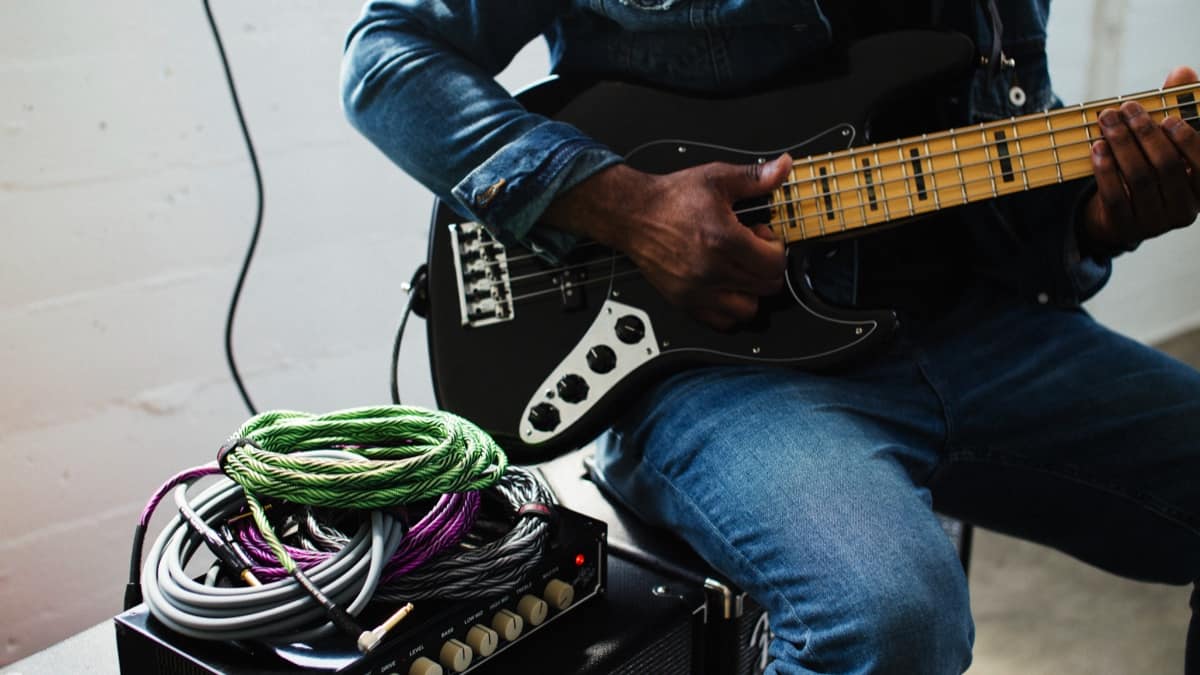
Opening Photo courtesy of: kirlincableshop.com
Instrument Cables…
I seem to enjoy finding myself in the middle of contentious topics among bassists, because here I am comparing instrument cables, which has long been a touchy subject for those with differing beliefs about the importance of instrument cables for electric bass. Do they really sound different from one another? Are expensive cables worth it? Is someone a chump for spending $X on a cable? (and other longstanding tropes). These are murky waters, and I wade carefully.
Let’s first separate out the tangibles from the subtle:
Some cables come with lifetime warranties, some don’t. Some utilize unquestionably higher quality connectors and materials than others. Some just feel more rugged and durable, some have heat shrink strain-relief covers on the connectors, abrasion-resistant “tech flex” outer layers etc…
From there, things get a little more esoteric. “Low strand count”, “cross braided tin copper shielding”, “increased grain linearity”, “Precision foamed polyethylene dielectric”. Do you know what any of this functionally means? If so, congratulations, most of us don’t have a functional knowledge of conductivity and the physics of electrical engineering.
Now, I’m not saying all of these assertions are purely marketing hyperbole, to the contrary, they literally are explaining what may make their product different from the crowd. But, as always, I’m not a lab tech, I’m a player. I don’t have the tools (or the desire) to put cables through rigorous bench testing apparatus. it’s just not where my interests or my strengths are.
When I thought of how I could be of value to this conversation…
…the best thing I could think to do was to get a small group of local bassists who I trust, some astoundingly good and highly seasoned players with lots of live and studio experience, but also those who have excellent ears and impeccable tone, for some good old-fashioned double-blind testing. I thought it would be mighty interesting to hear their reactions to a handful of high-end and budget instrument cables and see what, if any, themes, and trends rise to the surface.
I invited a handful of cable manufacturers to submit their products for this process and we had a blast listening and critiquing each cable against one another.
We tested everything from a $12.50 Rapco all the way up to a $220 Analysis Plus cable and a whole lot in between. Testing was done with an active 5-string Fodera Emperor Standard (EQ flat and tone wide open), Eich T-900 amplifier (set flat) and a Bergantino 2×10 cab with the tweeter at noon.
We first decided we should choose a “control” cable, one that we could refer back to when we couldn’t tell if our ears were deceiving us, or if the last thing we listened to was distorting our objectivity, so we came back to the control a number of times during the process. The group selected a Mogami Gold, as it was a familiar reference point for most of us.
Here is the list of cables we tested:

As we cycled through these at random, I played each for a bit (the same line or two over and over) as consistently as possible, and the fellas commented on what they heard.
Everyone’s perceptions are their own, and I/we are by no means the arbiters of any objective truth, I’m just doing my best to explore what I feel is a subtle but important component in a bassist’s playing experience:
- Some of the less expensive cables like the Rapco, ProCo and Hosa’s had a more “EQ’d sounding” and forward-accentuated high end, which some of the primarily live players thought might actually be more ideal for cutting through a busy mix on a loud stage.
- Some of the higher-end cables traded a bit of this articulate “spanky” high-end for more integration in the midrange, cleaner, less “congested” lows and general transparency overall. The mainly studio players among us tended to favor some of these, while the primarily live gigging players’ ears were drawn toward the cables with more audible bite. This, to me, is not surprising, given the goals of each type of player.
- One factor that wasn’t captured in this double-blind listening test was the concept of how a cable “feels” as a player experience, vs. how it sounds as a third-party listener. As the guy who played through all of these cables many times, I can attest that some cables felt faster, with a wider dynamic range, whereas others felt slower or more compressed to the touch. I do agree that this was more palpable as a player’s experience, as opposed to a listener’s. This is actually a big can of worms, as we often ask ourselves as testers or players “Yeah it kinda sounds xyz but is anyone gonna hear that on a gig?”. Well, if you FEEL that on a gig, that’s not nothing, regardless of whether the drunk frat party at table 6 is knocked out by your stellar bass tone. Your experience with your instrument and your sound as a player is super important, and will affect the way you perform, and likely how much you enjoy the experience. That’s true for me anyways.
Well, let’s get down to it, In the category of bass instrument cables, the Oscars go to:
Standout favorites – most universally well-loved cables for their overall tonal qualities: Lava Ultramafic, Asterope, Tsunami, Hosa Edge
Most articulate sounding – those with the most enunciated or present high end: Evidence Audio Lyric HG, Lava Ultramafic, Hosa edge, Rapco Player series
“Biggest” sounding – those with the fullest and largest sonic image: Colossal Sweet Fats, Asterope, Rattlesnake
If I had to pick the Top 3 as collectively indicated by the group for sound quality? Probably these:
- Asterope: “It had a certain clean, crisp yet warm character” that pretty much everyone loved right off the bat and kept referring to as a benchmark. This was my favorite-sounding cable of the bunch, all things considered.
- Lava Ultramafic: “Super quick sounding, very clear in the lower and upper octaves”, “Nice build quality, perfect blend of beefy but not bulky feeling”.
- Evidence Audio Lyric HG: “Really nice high end, lots of presence but not “poky” like some are up there”, “Very cohesive from top to bottom with excellent clarity”.
Best value MVP’s:
- Hosa Edge: Great sound with clear highs and balanced mids and lows, Neutrik connectors, lifetime warranty. A lot of bang for $44.
- Rattlesnake Snakehead: Very “big” sounding with “bone-rattling” low-end definition and good integration, at a competitive price point and with a lifetime warranty.
Some interesting and notable comments shared by the group:
- Control (Mogami): Dark, dry, a bit sterile, but well integrated.
- Lava Retro Silent Coil: “has a “spongy” sound to it.” “Almost like you put tubes in the head”.
- Zaolla Silverline: “Quick and clear, uncolored, highs and mids are well connected”
- Proco Evolution: “Ballsy in the low mid and low frequencies. Slower transients than some”
So, where is all this going?
Well, basically, that it’s apparent to me and the testers I enlisted that cables do indeed sound and feel different.
The trick is that what is “best” is highly subjective, and we all have different definitions of what that means. For some, it’s a ratio of cost to performance, for others, it’s reliability, for some it’s what simply sounds the best to their ears. But what even is THAT? More high-end articulation? Stronger lows? Smoother midrange? It’s clear that we’re all working with a different set of preferences, and that these preferences are based on our experience, our likes and dislikes, and the applications we find ourselves in.
I hope this long-winded and admittedly anecdotal analysis proves to be of some educational value to you. I sure enjoyed the process and look forward to the next muddy puddle of provocative topics that I find myself in.
Got some thoughts on this?
Drop me a line on social media, you can find me on FB @Jake Wolf and Instagram @jakebwolf, I’d love to hear from you.
And huge thanks to all of the companies who participated, and sent us cables for testing:
Analysis Plus Yellow Oval: analysis.plus/product/yellow-oval/
Asterope Bass Cable: asterope.com/custom-shop/pro-bass-series
Colossal Sweet Fats: colossalcable.com/cables/sweet-fats/
Evidence Audio Lyric HG: evidenceaudio.com/products/the-lyric-hg-guitar-cable
Hosa Edge: hosatech.com/products/analog-audio/instrument-cables/hosa-edge-guitar/cgk-000/
Lava Ultramafic: lavacable.com/product/533/lava-ultramafic
Lava Retro Silent Coil: lavacable.com/product/530/lava-retro-coil
Proco Evolution: rapcohorizon.com/category/117/evolution-instrument
Rattlesnake Snakehead: rattlesnakecables.com/products/snake-head-rattlesnake-cable/
Rapco Instrument cables: rapcohorizon.com/category/49/instrument-cables
Tsunami Instrument Cable: tsunami-cables.square.site/
Zaolla Silverline: zaolla.com/products/zgt-000
Check out more of my articles here